
Climate Change and Energy Efficiency
The impact of disasters caused by climate change on cities and buildings is considered an important issue in design services for clients. We are committed to global efforts to reduce greenhouse gas emissions, leveraging our experience and knowledge in urban and architectural design and engineering, which we have accumulated over the years. Additionally, in aiming for a halving of carbon emissions by 2025 (compared to 2013), we conduct regular monitoring of climate change data within our company.
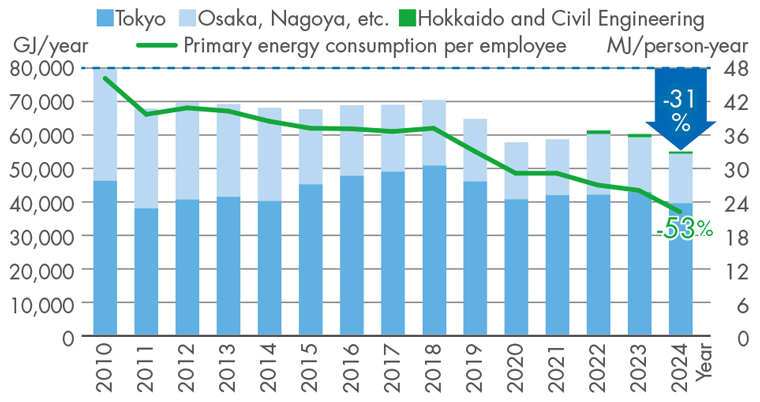
Achieved a 31% reduction in total primary energy consumption across all regions and a 27% reduction in primary energy consumption at Tokyo Building, compared to 2010 respectively.
Across our domestic offices, Nikken Sekkei has achieved a 31% reduction in primary energy consumption* compared to 2010. This has been accomplished through energy-saving renovations, in conjunction with the relocation of the Osaka office and the integration of group companies, as well as optimizing leased office space. As a result, energy consumption is now lower than during the COVID-19 period in 2020.
Additionally, primary energy consumption* per employee has decreased by 53% compared to 2010, showing a steady decline year by year.
*Primary energy conversion factors: Electricity (daytime) 9.97 MJ/kWh, City gas 45 MJ/m³
Additionally, primary energy consumption* per employee has decreased by 53% compared to 2010, showing a steady decline year by year.
*Primary energy conversion factors: Electricity (daytime) 9.97 MJ/kWh, City gas 45 MJ/m³
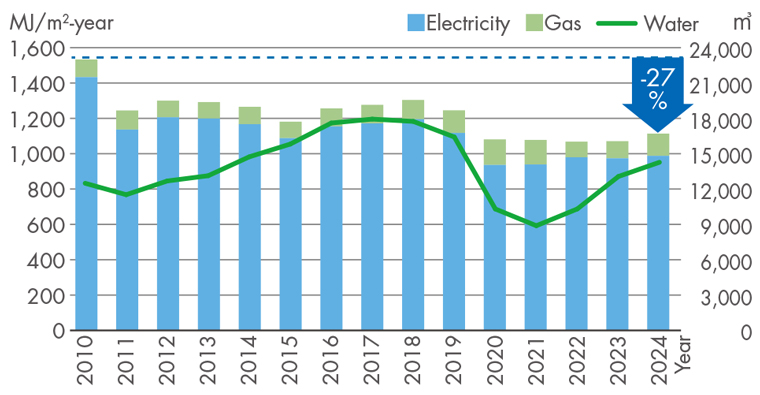
Through measures such as changes in lighting settings and LED renovations, the Nikken Sekkei Tokyo Building (hereafter referred to as Tokyo Building) achieved a 27% reduction, reaching 1,122 MJ/m² compared to 2010 levels. The Tokyo Building was completed in 2003 and has been in use for over 20 years. Although the heat source equipment has not been changed, daily maintenance and operational improvements have extended its lifespan and maintained its high efficiency. Additionally, water usage has been increasing along with the number of people using the Tokyo Building after the COVID-19 pandemic. Aiming to achieve “net-zero” by 2050, we will promote further energy savings and water conservation while considering timely equipment updates.
Stating the Climate Emergency Declaration as architecture & urban design professionals
On March 19, 2021, Nikken Sekkei issued its “Climate Emergency Declaration” which states the company’s commitment to seek a balance between economic activities and a carbon-neutral society from its position as a private corporation, along with an appeal to society for cooperation. Going forward, we will propose a model for achieving carbon neutrality by 2050 through workplace culture and urban and architectural design. This model will be shared with company clients and society, which will encourage their own action.
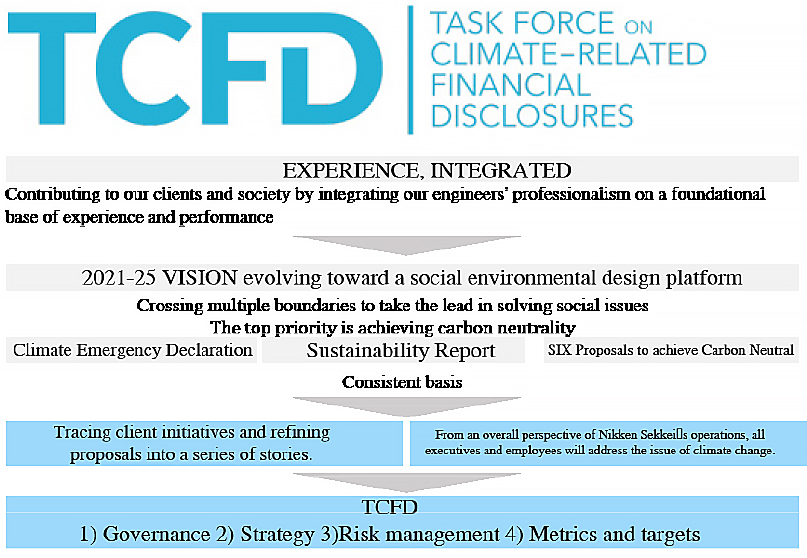
Endorsement of TCFD recommendations. First architectural design practice office in Japan to disclose information
In October 2022, we expressed our support for the recommendations of the TCFD (Task Force on Climate-Related Financial Disclosure) and subsequently disclosed climate change-related data on the Nikken Sekkei homepage. We believe that climate change is a challenge that should be addressed fully, in line with the Nikken Group tagline: “EXPERIENCE, INTEGRATED”. We have faith that this policy will enable us to further strengthen our relationships with clients and other stakeholders.
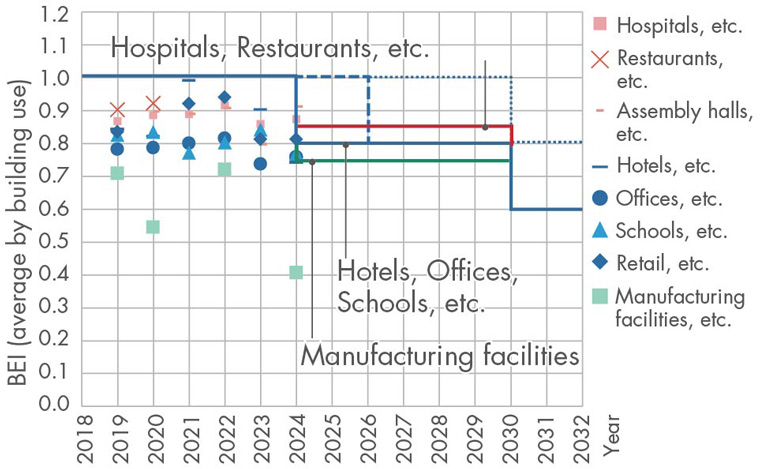
Improving environmental performance by monitoring BEI for each building use.
We manage the energy performance of projects
We manage the energy performance of projects using the BEI (Building Energy Index) value, which is an evaluation indicator under the Building Energy Efficiency Act. The average BEI for projects completed in 2024 are as follows:
Offices: 0.75
Schools: 0.77
Hotels: 0.74
Assembly halls: 0.91
Hospitals: 0.87
Retail: 0.81
Factories: 0.40
The mandatory values enforced from April 2024 for medium to large-scale buildings (greater than or equal to 300 m²) were met or all uses except hospitals and assembly halls. The average values include projects completed between January and March 2024, as well as projects that passed building permit before April 2024. As a result, the average values for hospitals and assembly halls exceeded the mandatory values.
We aim to improve environmental performance by continuously observing BEI, identifying current issues, and actively introducing energy-saving methods in each project.
Note: The smaller the BEI value, the higher the energy efficiency of the building.
Offices: 0.75
Schools: 0.77
Hotels: 0.74
Assembly halls: 0.91
Hospitals: 0.87
Retail: 0.81
Factories: 0.40
The mandatory values enforced from April 2024 for medium to large-scale buildings (greater than or equal to 300 m²) were met or all uses except hospitals and assembly halls. The average values include projects completed between January and March 2024, as well as projects that passed building permit before April 2024. As a result, the average values for hospitals and assembly halls exceeded the mandatory values.
We aim to improve environmental performance by continuously observing BEI, identifying current issues, and actively introducing energy-saving methods in each project.
Note: The smaller the BEI value, the higher the energy efficiency of the building.
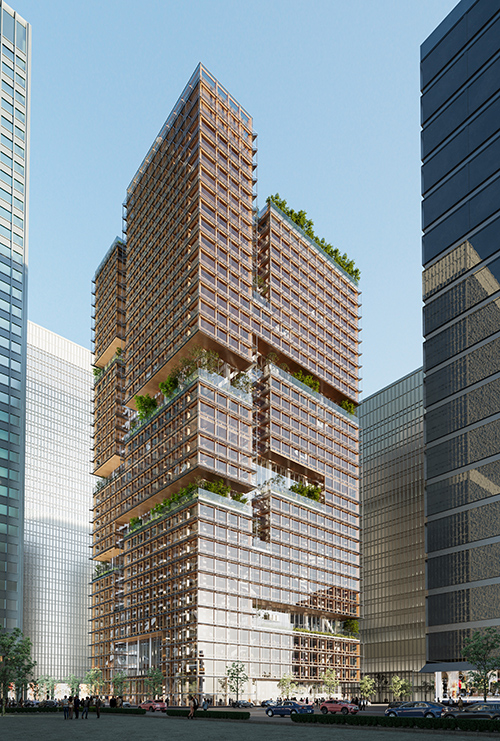
The prototype for the next-generation skyscraper, “Regenerative Tree,” has been unveiled.
“Regenerative Tree” is a prototype proposal for a next-generation skyscraper that incorporates various ideas to reduce greenhouse gases emitted over the building’s lifetime (whole life carbon). Optimizing architectural plans to accommodate diverse work styles and future conversions, utilizing wood, and implementing environmentally friendly building services designs promotes decarbonization not only during operation but also during construction, renovation, and demolition, reducing whole life carbon by up to 40%.
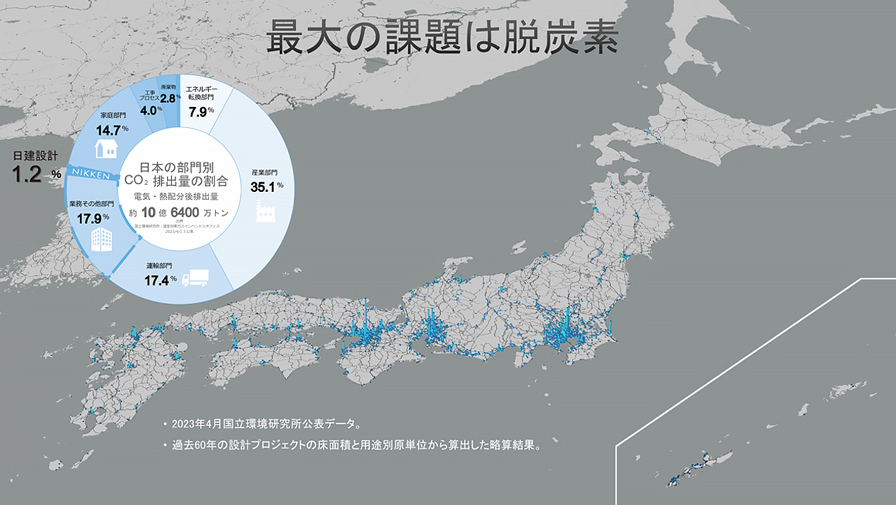
Digital technology for the transition to zero carbon
In order to achieve zero carbon while maintaining lifestyle comfort, a new scheme is needed to facilitate thinking beyond merely im¬proving building performance. We are currently developing a smart phone application, that displays the amount of carbon emissions by individuals to foster environmental awareness/action, and have launched an in-house trial. We aim to promote carbon neutrality through the application of digital technologies.