
Environmental Pollution and Circular Society
Nikken Sekkei proposes solutions to environmental issues that are increasingly important to clients, including the realization of a circular society, biodiversity conservation, and waste management. We adopt designs that consider the reuse of construction materials and ease of deconstruction, promoting the use of recycled materials. Additionally, we promote environmental education and are working towards paperless operations to improve resource efficiency.
Significant promotion of paperless operations through digital workplaces
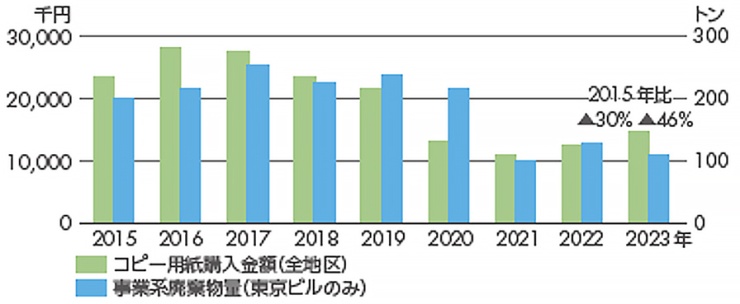
The establishment of digital workplaces around 2020 significantly accelerated the promotion of paperless operations and waste reduction. Subsequently, it was confirmed that waste levels had been maintained without significant increases. Copy paper usage per employee (across all offices) was reduced by 41% compared to 2015, and waste at the Tokyo Building was reduced by 44% compared to 2015.
Paperless operation at construction sites using digital tools
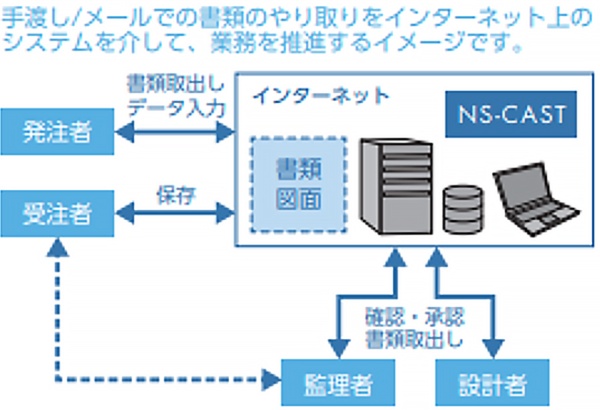
With NS-CAST, a complete storage system for construction-related documents developed by Nikken Sekkei, data information sharing, storage and management of books and documents is carried out between Nikken Sekkei, the client and contractor to enhance the system of paperless operation at each construction site. This system is expected to contribute to (1) taking risk management measures, (2) reducing administrative costs, (3) building a database, and (4) ensuring the execution of Construction supervision work.
Nikken Sekkei will leverage this system to expand customer services using the collected data and promoting LCD (Life Cycle Design) projects.
Nikken Sekkei will leverage this system to expand customer services using the collected data and promoting LCD (Life Cycle Design) projects.
Promotion of environmental protection activities with the introduction of “NIKKEN Eco-Bag”
As part of Nikken Sekkei’s environmental protection activities (reducing the number of paper bags used when delivering design drawings, reports, and other deliverables) and branding efforts, the company has created the “NIKKEN Eco-Bag”.
Earlier trials conducted in the Tokyo area from September to November, 2020 saw the NIKKEN Eco-Bag to be well received by users and included requests for larger-sized bags. Following this, this project moved into the full introductory stage in the summer of 2021.
Earlier trials conducted in the Tokyo area from September to November, 2020 saw the NIKKEN Eco-Bag to be well received by users and included requests for larger-sized bags. Following this, this project moved into the full introductory stage in the summer of 2021.

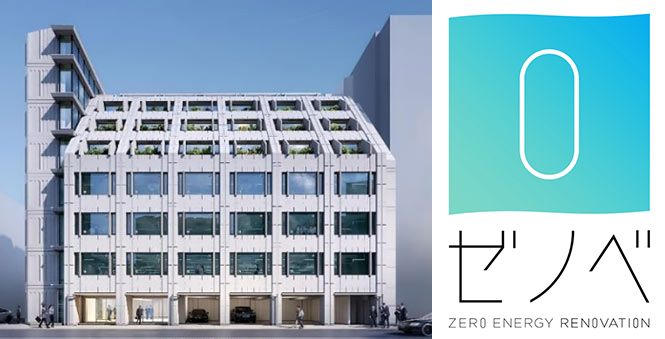
The first showcase of “Zero Energy Renovation” aimed at achieving “Net Zero” by 2050
Through energy-saving renovations such as improving insulation performance, adopting high-efficiency air conditioning equipment and optimizing its capacity, Nikken Building #1 has obtained ZEB-Ready certification. The Development Bank of Japan and Nikken Sekkei aim to drive nationwide environmental renovations of existing buildings by demonstrating specific successful examples that balance economic and environmental value, as does this project. We encourage other building owners and developers to practice sustainable energy-saving renovations, and contribute to the achievement of “net-zero” by 2050.
Idea catalog compiles insights on circular economy in the construction industry
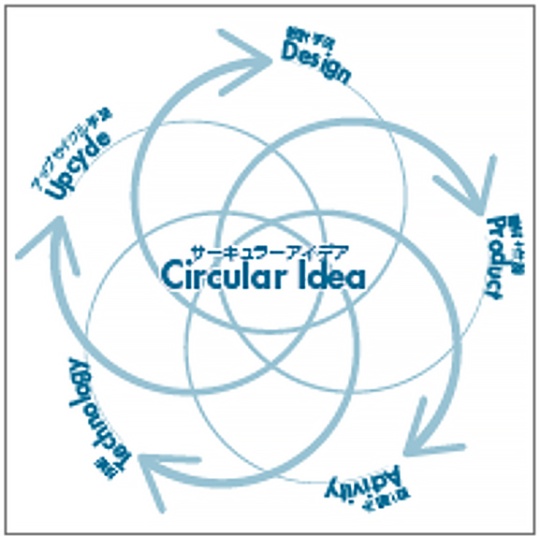
We have launched the “Circular Design Collective” initiative to promote the circular economy in the construction industry. As the first phase of our activities, we aim to create an environment where everyone involved in architecture and civil engineering can work towards realizing “circular construction.” To achieve this, we have started developing the “Circular Idea Catalog,” which compiles ideas, design methods, and other know-how. In the future, we plan to make the catalog open-source and establish it as a standard tool for the industry.
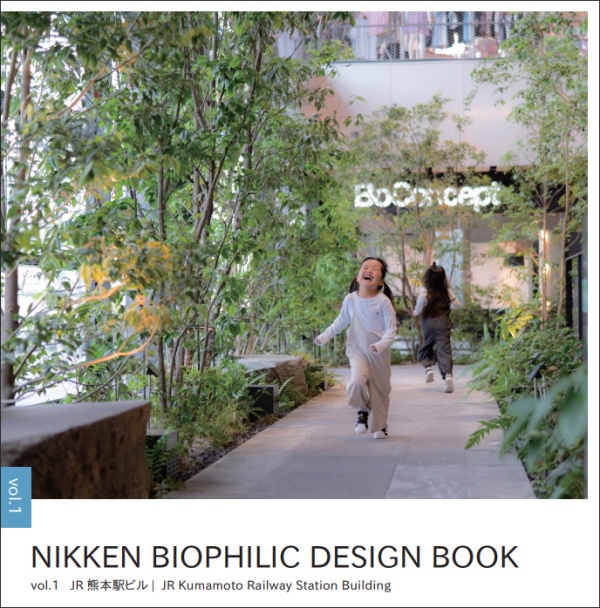
Release of a design book on biophilic design: Integrating nature into architecture and urban environments
Biophilic design incorporates nature in architecture and cities to produce a positive impact on people. Released to the public, NIKKEN BIOPHILIC DESIGN BOOK Vol.1: JR Kumamoto Station Building summarizes the results of a survey on the effects of introducing this concept to buildings from a quantitative perspective.
Development of “NIKKEN GREEN INITIATIVE” guidelines for landscaping in the green age
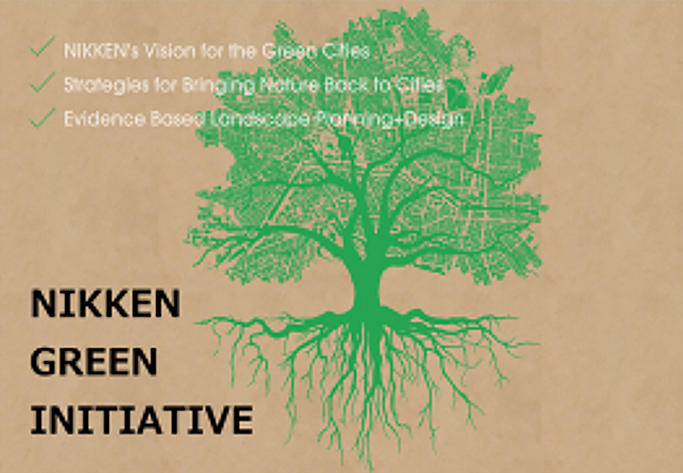
As environmental challenges grow increasingly visible in recent years, Nikken Sekkei has put together a booklet outlining the approaches we will take as landscape designers in the future. Nikken Sekkei’s green initiatives are based on three pillars:
(1) Vision for green cities
(2) Strategies for bringing nature back to cities
(3) Evidence-based landscape planning and design.
In the first pillar, we declare the importance of the vision of an ideal city, emphasizing the importance of restoring greenery while preserving and renewing social, economic, cultural, and urban functions. The second pillar categorizes approaches to how nature has been brought back to cities into four types and highlights leading projects. We have developed our own unique set of metrics to quantitatively evaluate and visualize the multifaceted effects of greenery from five environmental perspectives in eight select projects. Nikken Landscape aims to incorporate these metrics in the future and link them to evidence-based proposals highlighting environmental values.
(1) Vision for green cities
(2) Strategies for bringing nature back to cities
(3) Evidence-based landscape planning and design.
In the first pillar, we declare the importance of the vision of an ideal city, emphasizing the importance of restoring greenery while preserving and renewing social, economic, cultural, and urban functions. The second pillar categorizes approaches to how nature has been brought back to cities into four types and highlights leading projects. We have developed our own unique set of metrics to quantitatively evaluate and visualize the multifaceted effects of greenery from five environmental perspectives in eight select projects. Nikken Landscape aims to incorporate these metrics in the future and link them to evidence-based proposals highlighting environmental values.