

Designer Roundtable Discussion 1
Will “interior designers” disappear from society?
Scroll Down
With the merger of Nikken Space Design Ltd (NSD) and Nikken Sekkei Ltd on April 1, 2024, the Space Design Group (SpDG) was established in the design and supervision division. A roundtable discussion with Kenichi Shiota, editor-in-chief of Shoten Kenchiku (Monthly Magazine of Store Design) was held on three themes for sharing with prospective SpDG clients and partners. Mr. Shiota keeps a close eye on numerous facets of the interior design industry.
The first session was moderated by Akihiro Nishizawa, Branding Designer and President of Eight Branding Design Inc. With the development of digital technology such as generative AI, the city is now filled with uniformly fashionable spaces that afford a sense of deja’vu. In this age when anyone can design, the “designer-less” theory has been spreading. We talk about the true feelings and spirit from the field of design.
Part 1: Will “interior designers” disappear from society?
Moderator: Akihiro Nishizawa, Representative, Eight Branding Design Inc.
Part 2: Where is the value of design? (tentative)
Moderator: Kenichi Shiota, Editor-in-Chief, Shoten Kenchiku
Part 3: Expanding the designer field? (tentative)
Moderator: Yasuhiro Yamada, Editor
Participants
Nikken Sekkei, Space Design Group
Hiroshi Mizuhara, Mitsuhiko Imai, Yuko Kitano, Yuko Suzuki
Moderator
Representative, Eight Branding Design Inc.
Branding Designer
Akihiro Nishizawa
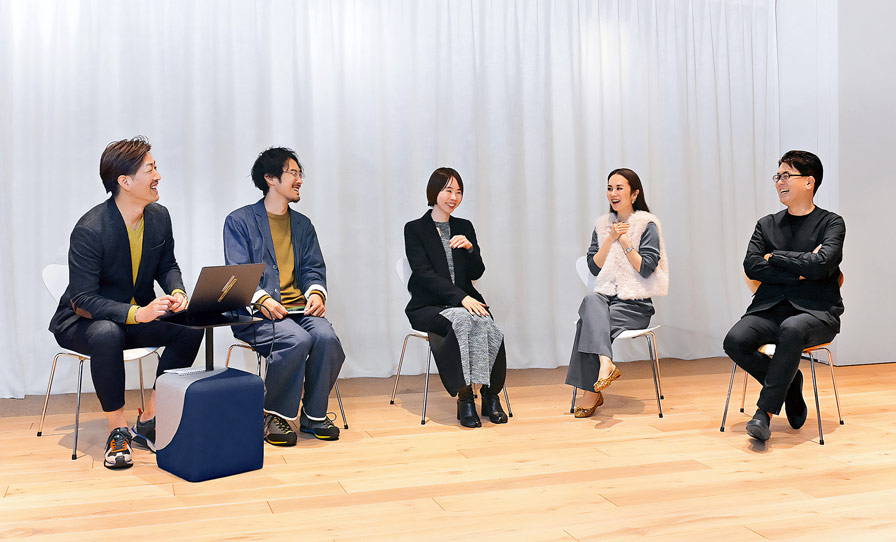
Mizuhara: The term “interior design” has many aspects. In terms of our role, I was pleased with our effort in the Panasonic XC KADOMA project (completed in January 2023). It was an ambitious project to create a new company building exclusively for the Panasonic Group, with multiple group companies located together in a seven-story building with a total floor space of approximately 24,000 square meters, communicating with each other and taking on the challenge finding new ways of working.
Designing Invisible “Activities”
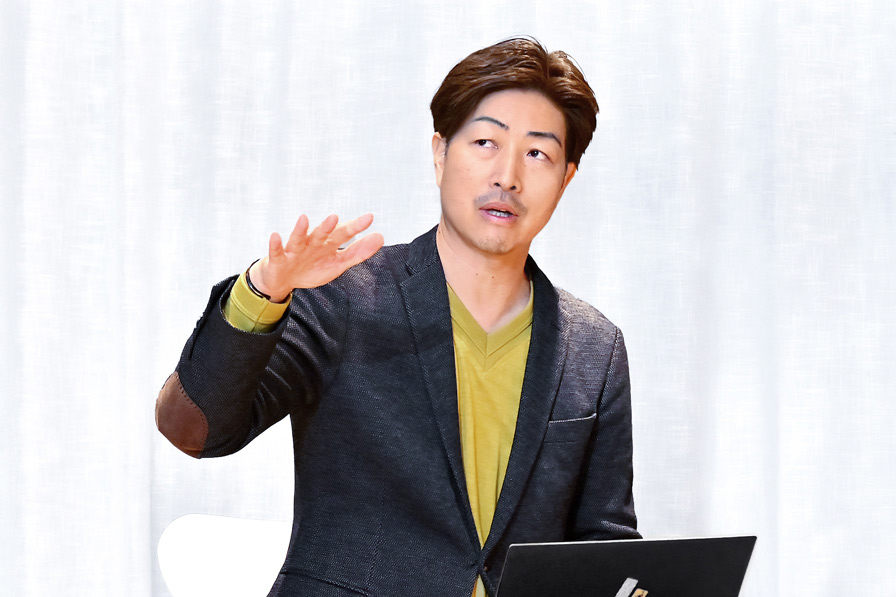 Hiroshi Mizuhara
Mizuhara: On the concept of “stirring activity,” we were conscious of designing human movement and communication in the space. The tool we developed to achieve this was the “activity card.” We visualized the movement of people by writing specific suggestions on the cards and placing them on the drawings, writing “You can do this here” in each common area. It helped us share our image with the client, the Nikken Sekkei design team, and with Takenaka’s team.
Nishizawa: I see. By putting something invisible, such as people's movements and activities, onto cards, you made it easier to grasp the intent of the design.
Mizuhara: Another key point is the simulation of the environment. Nikken Sekkei has a facilities team that specializes in environmental measurements and can verify the effects of wind and sun on buildings. For the common areas in this project, we were also able to confirm various patterns, such as rain in certain areas at specific times of year, direct summer sunlight in other areas, a nice breeze blowing into this seating area, and such. By representing the results with empirical values, such as hours of sunlight, we were able to incorporate them into furniture selection and zoning planning, and could count on solid support in doing so.
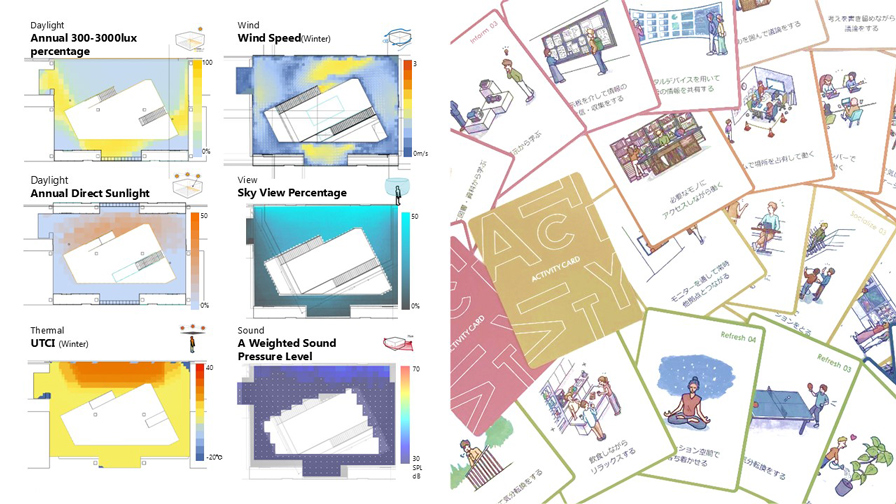 Environmental measurement distribution map and activity card ©NIKKEN SEKKEI LTD
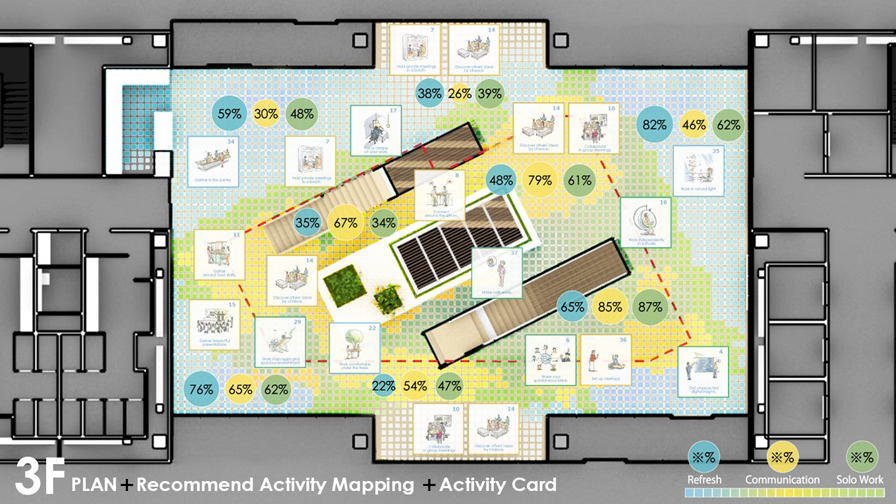 Designing the space by verifying the activity card and environmental measurement distribution ©NIKKEN SEKKEI LTD
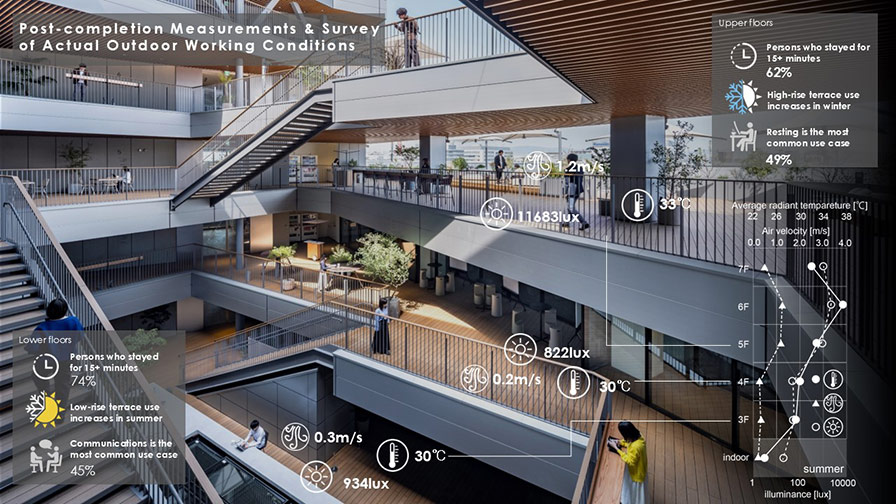 Verifying activities after the project handover ©NIKKEN SEKKEI LTD Photography: Akira Ito (aiphoto)
Mizuhara: After handing over the project, we conducted a survey to see how the rooms were actually used. While some activities were carried out as expected, others did not, so we were able to get involved in the planning of the next steps for those areas.
Nishizawa: Generally, common areas do not generate rental income, so it is hard to put that much effort into them...
Mizuhara: The client repeatedly checked with us if the area would really work. By carefully explaining the project using activity cards and simulations of the environment to allay their doubts, we were able to share our image of the project. For us as well, it was a great feeling to be able to go beyond our traditional realm as interior designers and engage in a new way.
HACKing Osaka culture and incorporating it into interior design
Imai: I think people with that image will be surprised when they see “Canopy by Hilton Osaka Umeda” (opening in September 2024), where I was in charge (laughs).
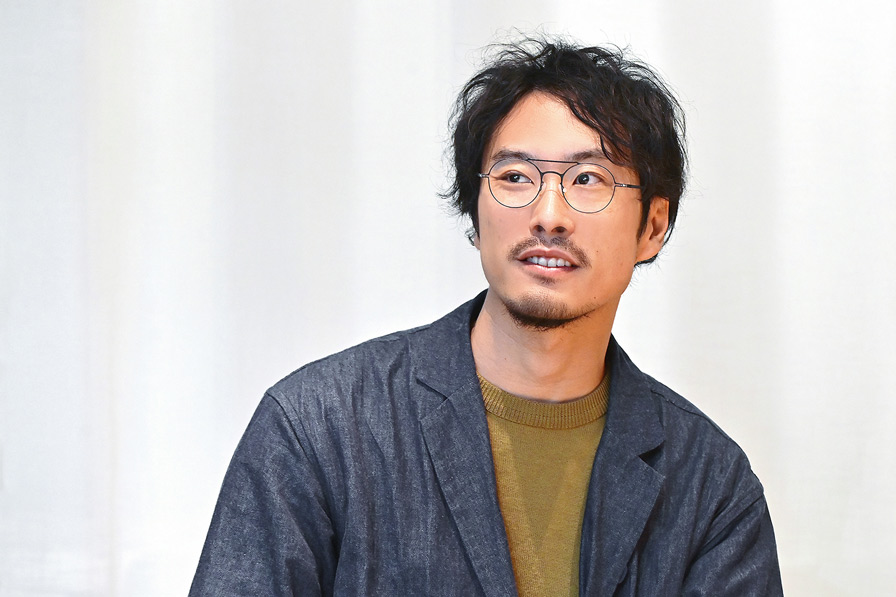 Mitsuhiko Imai
The hotel is in the “lifestyle hotel” category within the Hilton Group, and was designed to function as a “third place” while engaging the surrounding environment. The concept we developed for the interior design was “HACK Osaka” to express the “Osaka-ness” of the hotel and the welcoming atmosphere that creates a community. We thought it would be interesting to design a building with a motif of culture, history, and local specialties with a sense of humor that is uniquely Osaka -- using the keyword, “Osaka.”
Nishizawa: Even just looking at the photo, it is impactful (laughs).
Imai: For example, in the elevator hall at the hotel entrance, the ceiling is decorated with the shape of a takoyaki grill, and the walls are studded with motifs such as seaweed, octopus’ legs, and toothpicks. In addition, we “HACKed” and expressed Osaka in various ways in the guest rooms, corridors, and throughout the facilities with this kind of flair (laughs).
There are plenty of stories in which hotel staff members explain to guests, “This is takoyaki, this is kushikatsu, and so on…” --- surely fun conversations. A QR code to access a book explaining the design concept is also posted inside the building. “HACK Osaka.” You might say we've done it (laughs).
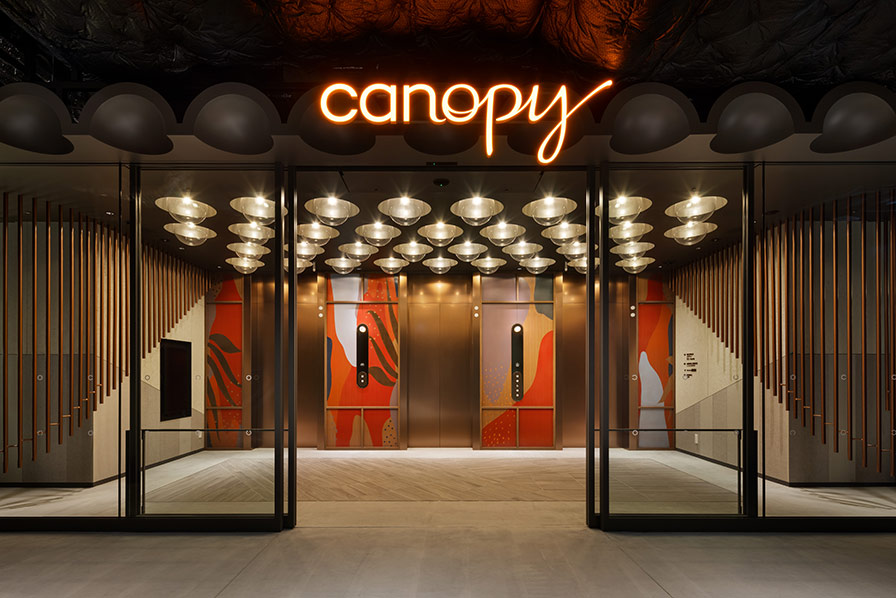 Canopy by Hilton Osaka Umeda/1st floor elevator hall
Photo: Nacása & Partners
Imai: There were members of the team, including myself, who liked graphics, so we put a lot of effort into every part of the project.
Nishizawa: You have expressed culture and history beautifully in the space design. This was only possible because of Mr. Imai's character. It would have been difficult for AI to do it (laughs).
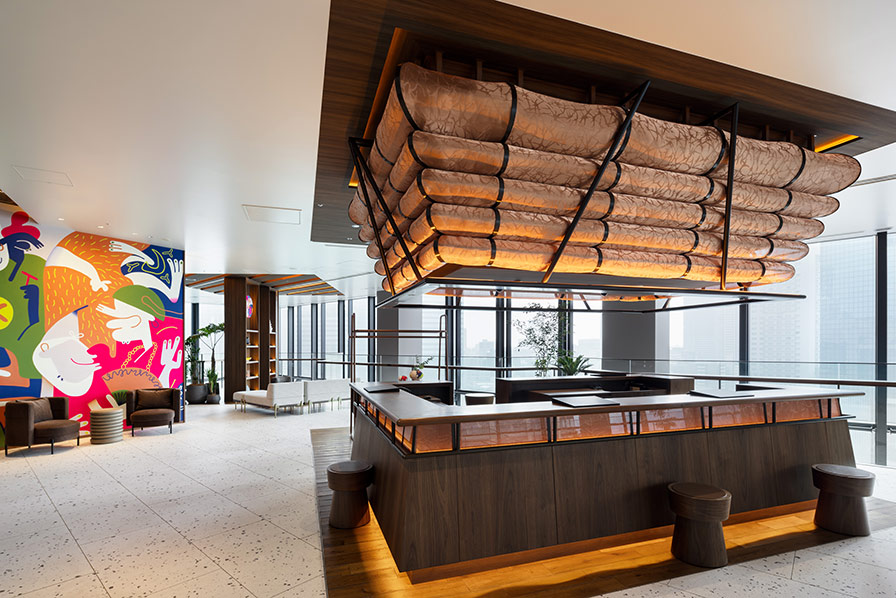 Canopy by Hilton Osaka Umeda / 11th floor reception
Photo: Nacása & Partners
Proposing renewal projects with a “handmade feel”
Kitano: We also handle exhibition booth designs. We are consulted on everything from small items to large spaces. I was in charge of the renovation of the ANA Crowne Plaza Hotel Hiroshima, which included the renovation of the area used as a restaurant into a club lounge and the renovation of guest rooms on three floors.
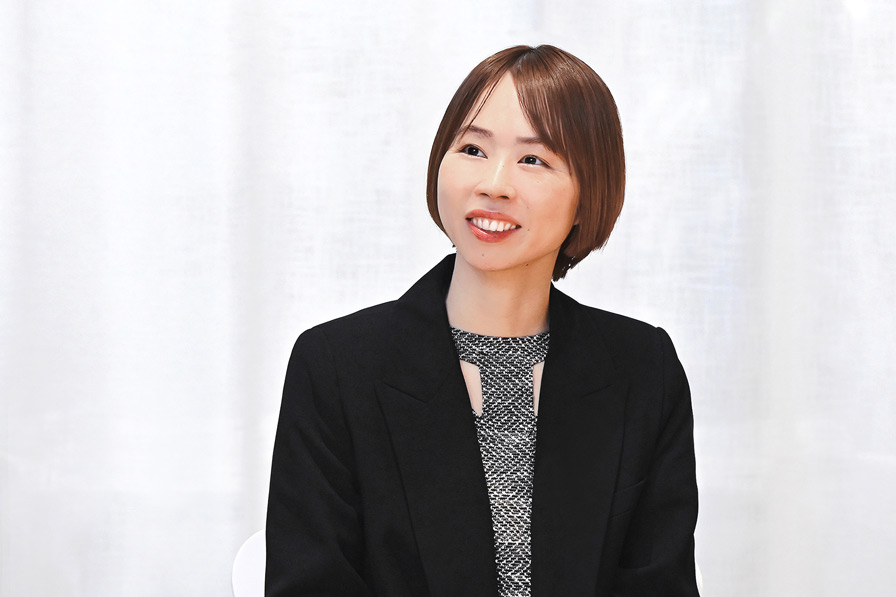 Yuiko Kitano
Kitano: One of our strengths is that we have a wide range of expertise, from offices to hotels and villas. For this renewal job, we were able to create a club lounge of approximately 200 sqm. with a panoramic view of the city of Hiroshima and the islands of the Seto Inland Sea from the windows on the entire south side of the 22nd floor.
Instead of coordinating the lounge in a single luxurious color, we proposed a design plan that envisages different uses for different areas, such as a relaxing space here and a space for coworking there, and created a reception area, a workspace, a dining space, a relaxing space, a meeting room, and so on. Each of the areas is designed to meet the various needs of guests.
For the guest rooms, we proposed combining two rooms into one suite to increase the guest expenditure. We also incorporated local traditional crafts and specialties into the design motifs to express the diverse changing landscape of Hiroshima under the concept, “HIROSHIMA GRADATION.”
We did not outsource the displays, but instead sought out and commissioned local artists and committed ourselves to a handmade, handcrafted feel.
Nishizawa: I thought Nikken Sekkei did not undertake work of that scale.
Kitano: Actually, we do (laughs). I love this kind of work.
Working face to face, kind of like a family doctor
Suzuki: Yes, I participated in the team as an FF&E designer for Panasonic XC KADOMA and Canopy by Hilton Osaka Umeda (only during the competition).
 Yuiko Suzuki
Suzuki: The way we communicate differs depending on the designer we are working with. For example, in the Canopy by Hilton Osaka Umeda project with Imai, the concept was “HACK Osaka,” which is a difficult concept for me since I grew up in Tokyo (laughs). So, we focused on how to materialize the image Imai had in his mind.
I was given some handwritten notes, so I used them as hints to select chairs that I thought would be a hit, printed them on A4 sized paper in about four panels each, and cut them into pieces. We laid them out on a drawing board and decided on the placement of this one here, that one there, and so on.
Imai: Since this hotel was meant to attract not only overnight guests but also various people from inside and outside the region, we adopted various styles of chairs to accommodate the diverse scenes and various ways of sitting.
Suzuki: I feel like we took the story he created and just kept working away at it.
Nishizawa: That must have been tough.
Suzuki: It was hard work, but fun. I think that in order to get customers excited, we also have to be excited while working on the project to convey our enthusiasm. We are like a family doctor who is close to our clients. We place importance on the attitude of looking at the client's face and providing a prescription that suits the client's needs. For example, we read their true feelings from their facial expressions and posture when they sit in our chairs.
Interior designers create new architecture and spaces
Mizuhara: We take on some projects on our own. I would say the ratio is about 50-50. Originally, we had been active for about 30 years as Nikken Space Design, as one of group companies, which was independent from Nikken Sekkei. After working on projects for prominent atelier architects and accumulating a wide range of interior design know-how and insight, we returned to Nikken Sekkei this year to work as the Space Design Group of the Design and Supervision Division.
Nishizawa: How do you feel about the change in position and environment?
Mizuhara: Over the past 30 years, awareness of interior design has increased, and we are now being asked how we can respond to the needs of our clients. Now that architecture and interior design are integrated into one organization, it has become easier to communicate with each other. We want to work closely together to make effective “one-stop” proposals.
Suzuki: Nikken Sekkei has the role of contributing to society through architecture. We interior designers are trying to bring smiles to people's life. I would like to contribute to such “soft” aspects.
Nishizawa: In general, the field of architecture tends to deal with cities and society. Those of you who are active in the interior design field face people, their lifestyles, and culture. I got that impression from what I’ve heard about your efforts.
Kitano: I studied architecture at university. If I had not encountered the work of interior design, I would probably be designing buildings right now (laughs). But now that I am actually working, I feel that interior design is suited to me because it often involves areas that are close to local culture and people. I am happy to be involved in this work.
Suzuki: I take hints from the designer's as-yet-unorganized image to discover the appeal of the plan. I believe that is my role. I guess you could call me a “charm detector,” so to speak (laughs). Whenever a client's request or a designer's proposal is brushed up, I try to find the “sparkle” in it and incorporate it into the interior design.
Nishizawa: According to what you have said, it seems that interior designers are not “disappearing" per se. It may be that the definition of interior designer is changing. Until now, Nikken Sekkei has fulfilled its mission as a major design firm. By integrating interior designers who create interfaces that connect people from various angles, new architectures and new ways of "being in space" may be created. Such expectations and possibilities could be sensed.
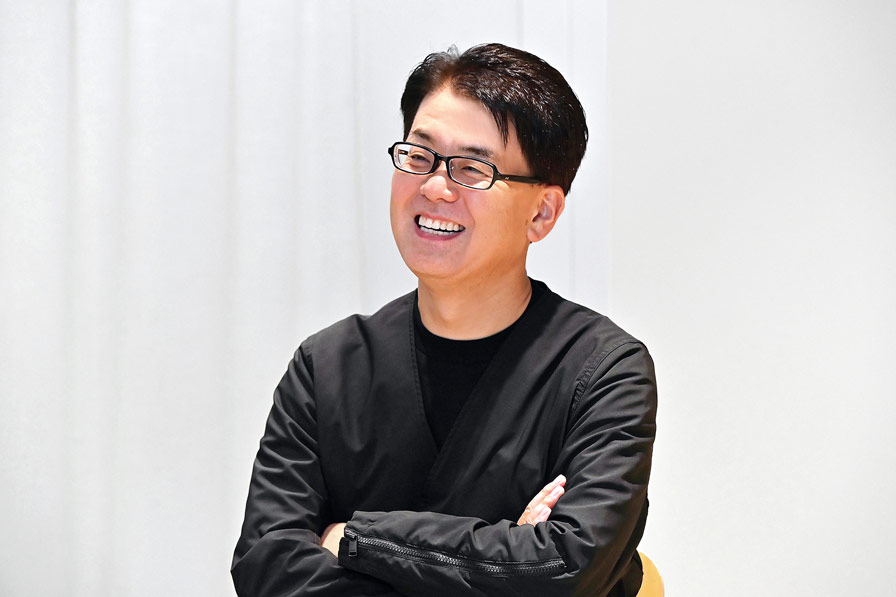
Akihiro Nishizawa, Branding Designer / Representative, Eight Branding Design, Inc.
Under the concept of “energizing Japan through branding design,” Mr. Nishizawa is active in a wide range of fields, including corporate brand development, product development, and store development. He has been involved in a number of consistent branding design projects, including research, planning, and concept development.