

Prologue
Our origins lie with the 26 members of the Temporary Construction Division
It was founded in Meiji 33 (1900).
Some 30-odd years later, in Showa 8 (1933), swept up in the global Great Depression, the Construction Division of Sumitomo Limited Partnership—the successor to the Temporary Construction Department—was forced to carry out a series of layoffs.The two leaders of the Construction Department, Eikichi Hasebe and Kenzo Takekoshi, could not bear to watch the department’s staff disperse. They resolved to leave Sumitomo themselves and, together with 30 department members, strike out on their own to establish an architectural firm. However, setting out on this venture required the resolve of rowing a small boat through the storm of the Great Depression.This marked the founding of the Hasebe & Takekoshi Architectural Office.
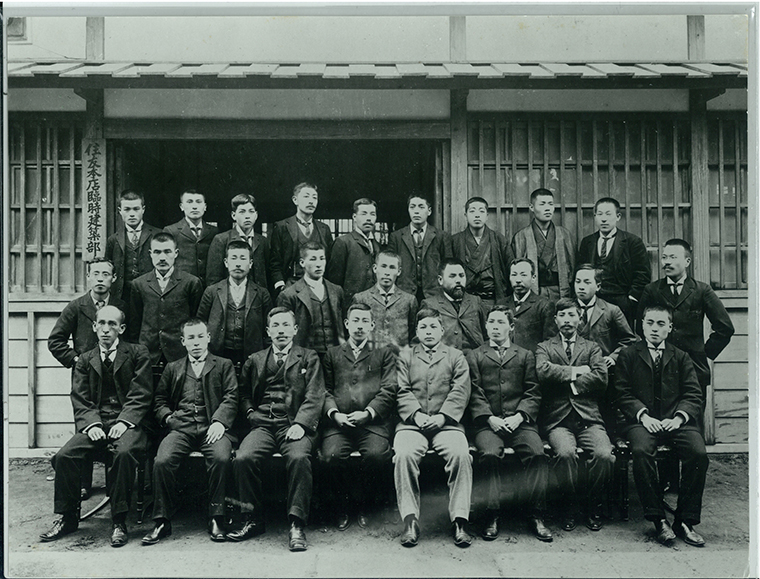 1-1 All Staff Members of the Sumitomo Main Office Temporary Construction Department at the Time of Founding
Immediately after the war, the firm became Nippon Construction Industry, which also included a trading division. But in Showa 25 (1950), as reconstruction from the war’s ruins began in earnest, 92 engineers—descendants of the Temporary Construction Department—set out once again into the chaotic postwar world.This marked the establishment of Nikken Sekkei Construction. People from that era recall that this independence was “a new beginning tinged with a sense of pathos.”
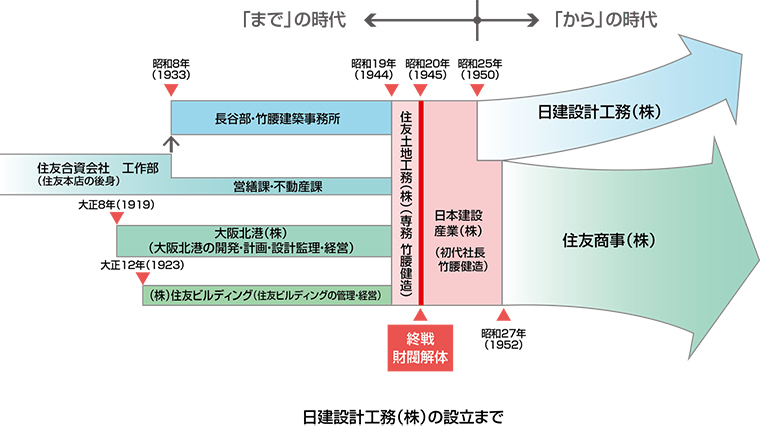 1-2 The year 1950, when Nikken Sekkei Construction was established, is used as the dividing line between “up to” and “from.”
The diagram above will be explained in “Issue 5: From the Postwar Ruins.”
And now
By the end of 2013, the number of executives and employees at Nikken Sekkei and the Nikken Group had exceeded 2,500. Today, together with Nikken Sekkei and seven group companies specializing in specific fields, we operate as a consulting group capable of providing a wide range of services. The Nikken Group organizational chart is shown below.
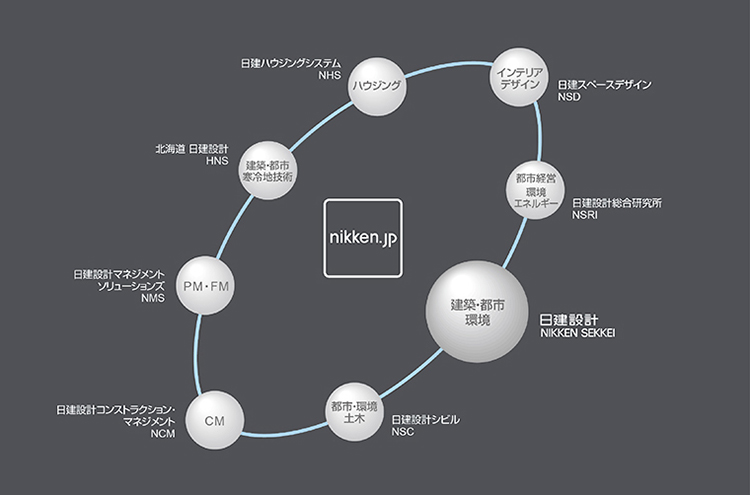 1-3 Nikken Group (as of 2014)
Overseas, the firm is advancing projects in various regions around the world, including China, South Korea, Saudi Arabia and other parts of the Middle East, Russia, and Vietnam and other parts of Southeast Asia.In a global ranking of architectural firms based on the size of their professional staff, published by a British architecture magazine, the firm has consistently ranked among the top five for the past decade. The firm’s contributions to various societies—made possible by the technical expertise and sensibilities cultivated in Japan while respecting the cultures of each country—are now recognized worldwide.
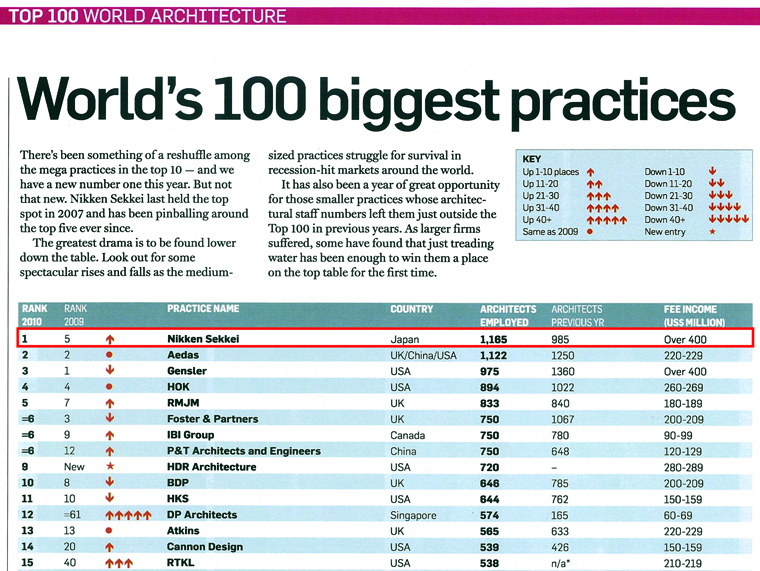 1-4 From BD WORLD ARCHITECTURE: 2010 Rankings
-
 1-5 Development of the Northwest District of St. Petersburg, Russia
-
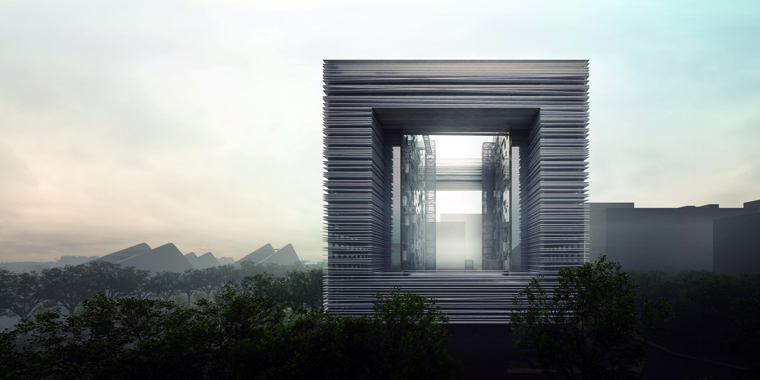 1-6 Chengdu Bank Headquarters, China
-
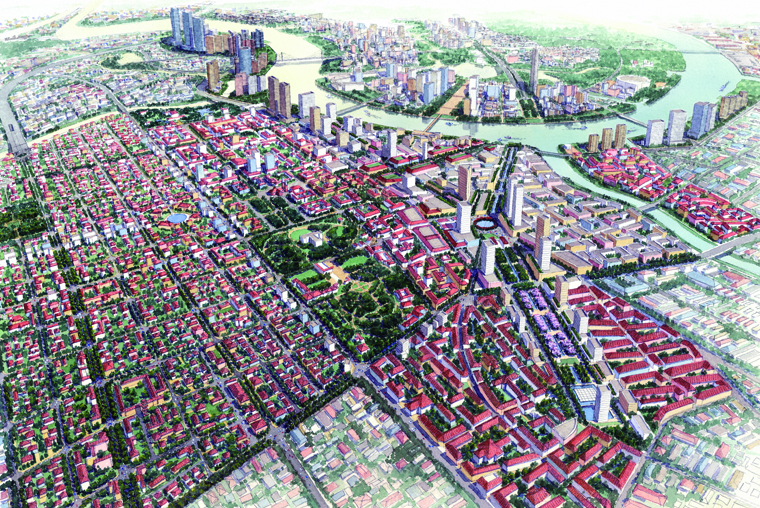 1-7 Urban Planning for Ho Chi Minh City, Vietnam
1-1: From the Sumitomo Historical Archives
1-4: *BD World Architecture, January 2010 Issue*