

2-1 The Cradle of the Meiji Era—From the Besshi Copper Mine—
Although full-scale modernization began after the Meiji Restoration, it is said that the fundamental foundations for that modernization had already been laid during the Edo period. As noted in the prologue, Nikken Sekkei traces its origins to Sumitomo, and Sumitomo’s origins, in turn, lie in the copper smelting industry that began in the early Edo period. Sumitomo’s “copper production,” which traces its origins to the Besshi Copper Mine in Shikoku—opened in 1691—became the foundation for many companies that continue to this day.
The Besshi Copper Mine was a world-class copper mine at the time.
Deep in the mountains, about 10 km southeast of JR Niihama Station in Ehime Prefecture, Shikoku, there was a copper mine containing a massive ore deposit that was rare even on a global scale.This is the Besshi Copper Mine, which played a vital role in Japan’s economy—spanning the transition from the early modern to the modern era—for 282 years, from its opening in 1691 until its closure in 1973.
During the Edo period, Besshi copper served as the raw material for coins, supporting the monetary economy of East Asia, and was known as far away as Europe as a commodity used for settlement in the Nagasaki trade.By the late 18th century, Japan was the world’s largest copper-producing nation, and the Besshi Copper Mine accounted for 1,300 metric tons of the country’s annual copper output of 5,300 metric tons.The Besshi Copper Mine was a large-scale operation; it was a major mining settlement with a population exceeding 10,000 people, including approximately 5,000 individuals directly involved in the mining industry—such as copper miners and smelting craftsmen—as well as their families and associated merchants.During the Meiji period, a steam-powered mining railway was laid through the rugged mountains, transforming the area into a mountain-top town equipped not only with housing and schools but also with a hospital and a theater.
During the Edo period, Besshi copper served as the raw material for coins, supporting the monetary economy of East Asia, and was known as far away as Europe as a commodity used for settlement in the Nagasaki trade.By the late 18th century, Japan was the world’s largest copper-producing nation, and the Besshi Copper Mine accounted for 1,300 metric tons of the country’s annual copper output of 5,300 metric tons.The Besshi Copper Mine was a large-scale operation; it was a major mining settlement with a population exceeding 10,000 people, including approximately 5,000 individuals directly involved in the mining industry—such as copper miners and smelting craftsmen—as well as their families and associated merchants.During the Meiji period, a steam-powered mining railway was laid through the rugged mountains, transforming the area into a mountain-top town equipped not only with housing and schools but also with a hospital and a theater.
-
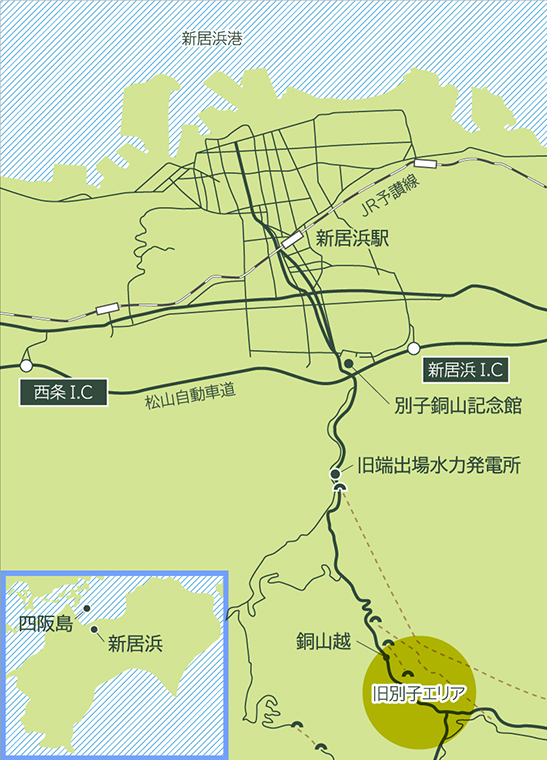 2-1 Map Showing the Location of the Besshi Copper Mine
-
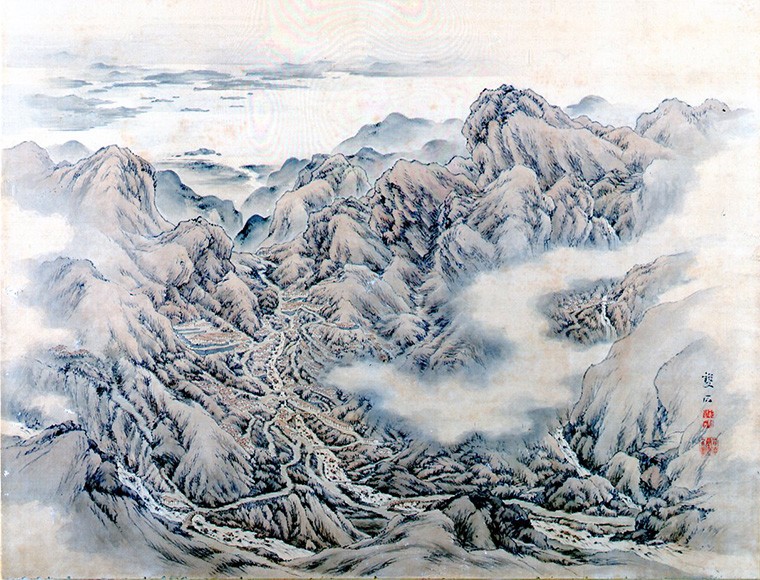 2-2 Map of the Besshi Mine, Meiji 7 (1874), by Murase Sōseki
A view of the Koyama Pass from the former Besshi area, indicated by the circle in Figure 2-1. Shisaka Island is depicted in the Seto Inland Sea at the top of the image. -
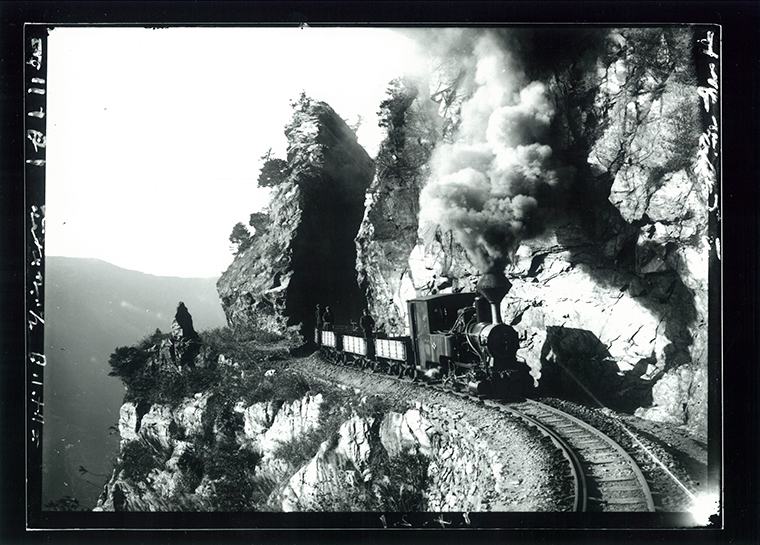 2-3 A Mining Railroad Running Through Rugged Mountain Terrain
-
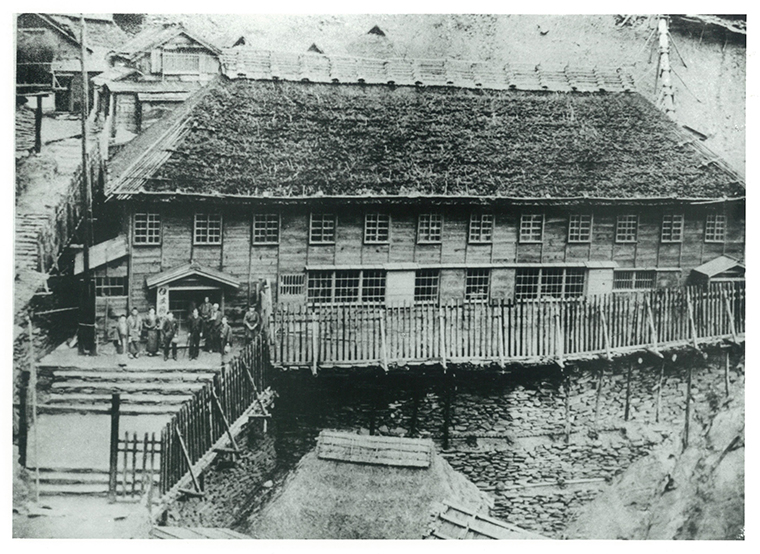 2-4 Besshi Sumitomo Hospital
-
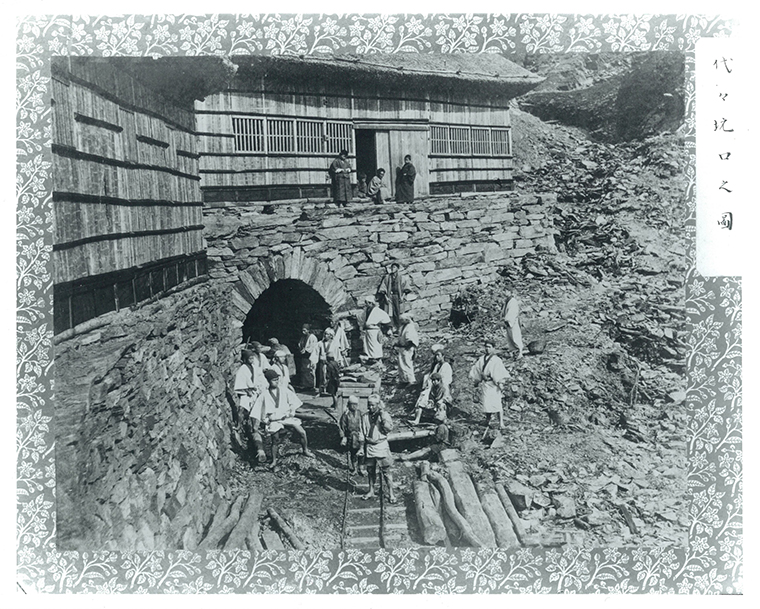 2-5 South Entrance to Daiichi-Tsu-Dō
Corporate Social Responsibility: Environmental Measures and Commercialization
Sumitomo’s “copper production” began in Kyoto approximately 70 years before the discovery of the Besshi Copper Mine.It all began when Sumitomo Tomomochi (1607–1662)—the biological son of Soga Riemon, who had successfully developed the innovative “Nanban-buki” technique for separating and extracting silver and copper from ore, and who had been adopted into the Sumitomo family as a son-in-law—opened a copper smelting workshop in Kyoto.The company later expanded to Osaka, which offered convenient water transport, and grew into a major business with branches in Edo and Nagasaki, covering everything from copper mine management to copper smelting.
However, by the Meiji period, the forests of Besshi had been completely logged to supply fuel for smelting, and serious problems had arisen due to environmental pollution caused by the sulfur dioxide gas generated during the smelting process.To resolve these issues, a major decision was made to relocate the large-scale smelter to the uninhabited island of “Shisaka Island,” located approximately 20 km off the coast of Niihama.After overcoming many difficulties, operations at the state-of-the-art smelter on Shisaka Island finally began in Meiji 38 (1905). However, even after the relocation to Shisaka Island, finding a fundamental solution to the sulfur dioxide gas problem remained difficult.It was not until Shōwa 14 (1939) that a technology was introduced to capture sulfur dioxide gas using ammonia water and use it to produce fertilizer, finally resolving this environmental issue. This technology for producing fertilizer from sulfur dioxide gas is the origin of today’s Sumitomo Chemical.
Meanwhile, between 1 million and 2 million trees were planted each year in the barren mountains of Besshi. This reforestation project is the origin of today’s Sumitomo Forestry.Today, “sustainability” is recognized as a critical issue, and it is advocated that companies should tackle environmental problems with a spirit of enterprise; however, Sumitomo had already been addressing this difficult challenge since the Meiji era.
However, by the Meiji period, the forests of Besshi had been completely logged to supply fuel for smelting, and serious problems had arisen due to environmental pollution caused by the sulfur dioxide gas generated during the smelting process.To resolve these issues, a major decision was made to relocate the large-scale smelter to the uninhabited island of “Shisaka Island,” located approximately 20 km off the coast of Niihama.After overcoming many difficulties, operations at the state-of-the-art smelter on Shisaka Island finally began in Meiji 38 (1905). However, even after the relocation to Shisaka Island, finding a fundamental solution to the sulfur dioxide gas problem remained difficult.It was not until Shōwa 14 (1939) that a technology was introduced to capture sulfur dioxide gas using ammonia water and use it to produce fertilizer, finally resolving this environmental issue. This technology for producing fertilizer from sulfur dioxide gas is the origin of today’s Sumitomo Chemical.
Meanwhile, between 1 million and 2 million trees were planted each year in the barren mountains of Besshi. This reforestation project is the origin of today’s Sumitomo Forestry.Today, “sustainability” is recognized as a critical issue, and it is advocated that companies should tackle environmental problems with a spirit of enterprise; however, Sumitomo had already been addressing this difficult challenge since the Meiji era.
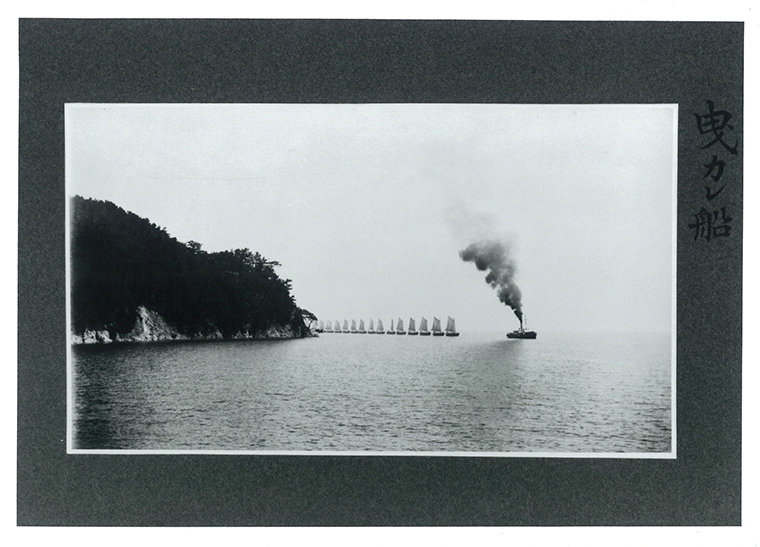 2-6 Tugboats that traveled back and forth between Niihama and Shisakajima to transport ore
Our Roots Lie in Technology and Craftsmanship
In Meiji 7 (1874), in order to introduce Western-style mining technology, the company invited French mining engineer La Rocque to draw up a long-term plan for the Besshi Copper Mine.However, it was Japanese engineers—who had mastered Western techniques through study abroad in France and elsewhere—who carried out the plan. The “Machine Shop” that manufactured the machinery used for excavation and mining is the predecessor of today’s Sumitomo Heavy Industries.
In addition, a hydroelectric power plant with a head of 597 meters—the largest in the Orient—was built on Mt. Besshi, and electricity with a maximum output of 4,800 kW was transmitted to the offshore island of Shisaka via what was then the world’s longest undersea power transmission cable.This power transmission business has been carried on by what is now Sumitomo Electric Industries. Sumitomo Rubber Industries was subsequently spun off from Sumitomo Electric Industries.
In this way, various “state-of-the-art technologies of the time” formed the foundation of the Besshi Copper Mine project.It is noteworthy that these technologies were introduced at a time when only about 30 years had passed since the end of the Edo period. Needless to say, behind this technological adoption lay the sense of crisis felt by the people of the Meiji era—who were determined not to be swallowed up by the Western powers—as well as their “aspiration” to contribute to industrial development and economic growth in the national interest.
At the entrance to the Besshi Copper Mine stands the Oyamazumi Shrine, where it is said miners of that era would always offer a prayer for safety as they entered and exited the mine.To pass on the historical significance of the Besshi Copper Mine to future generations, the Besshi Copper Mine Memorial Museum was built in Showa 50 (1975) along the approach to Oyamazumi Shrine, nestled in the embrace of the Besshi mountains.The interior of the museum is designed to recreate the atmosphere of the former mine tunnels, and as you wander through its quiet halls, the passion of the people of that era—dedicated to “copper production” over the course of 300 years—seems to come alive once more.
In addition, a hydroelectric power plant with a head of 597 meters—the largest in the Orient—was built on Mt. Besshi, and electricity with a maximum output of 4,800 kW was transmitted to the offshore island of Shisaka via what was then the world’s longest undersea power transmission cable.This power transmission business has been carried on by what is now Sumitomo Electric Industries. Sumitomo Rubber Industries was subsequently spun off from Sumitomo Electric Industries.
In this way, various “state-of-the-art technologies of the time” formed the foundation of the Besshi Copper Mine project.It is noteworthy that these technologies were introduced at a time when only about 30 years had passed since the end of the Edo period. Needless to say, behind this technological adoption lay the sense of crisis felt by the people of the Meiji era—who were determined not to be swallowed up by the Western powers—as well as their “aspiration” to contribute to industrial development and economic growth in the national interest.
At the entrance to the Besshi Copper Mine stands the Oyamazumi Shrine, where it is said miners of that era would always offer a prayer for safety as they entered and exited the mine.To pass on the historical significance of the Besshi Copper Mine to future generations, the Besshi Copper Mine Memorial Museum was built in Showa 50 (1975) along the approach to Oyamazumi Shrine, nestled in the embrace of the Besshi mountains.The interior of the museum is designed to recreate the atmosphere of the former mine tunnels, and as you wander through its quiet halls, the passion of the people of that era—dedicated to “copper production” over the course of 300 years—seems to come alive once more.
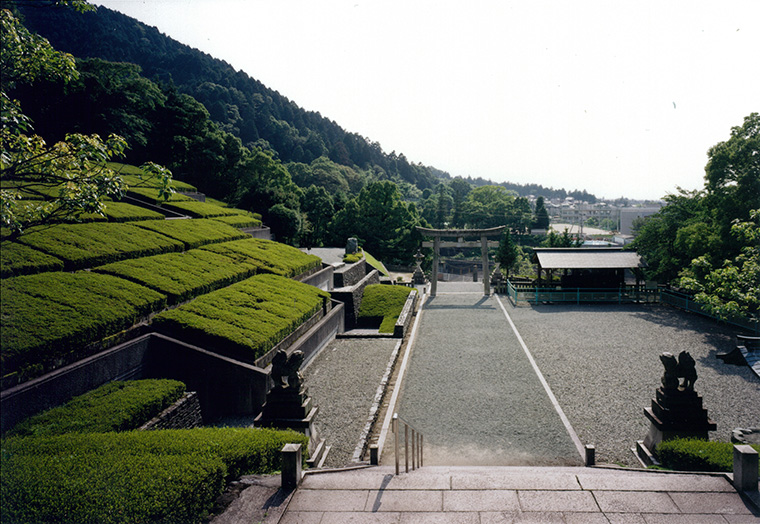 2-7 The Besshi Copper Mine Memorial Hall (designed by Nikken Sekkei), built along the approach to Oyamazumi Shrine
(References)
Supervised by Naohiro Asao; Edited by the Sumitomo Historical Archives (2013), *The History of Sumitomo, Volume 1*, Shibunkaku Publishing
Teruhiro Sueoka, Deputy Director, Sumitomo Historical Archives (2011), “Sumitomo’s Business Spirit and Sustainability—Corporate DNA,”
“Summary of the Issuikai 80th Anniversary Commemorative Lecture,” Issuikai
Sumitomo Corporation Public Relations Office (1985), *The Sumitomo Culture*, Sumitomo Corporation
Tetsuo Fujimoto (1993) *Besshi and Sumitomo in the “Meiji Era”—The Ideals and Actions of Modern Entrepreneurs* Ochanomizu Shobo
Supervised by Naohiro Asao; Edited by the Sumitomo Historical Archives (2013) *The History of Sumitomo, Volume 1*; Shibunkaku Publishing
Supervised by Naohiro Asao; Edited by the Sumitomo Historical Archives (2014), *The History of Sumitomo, Volume 2*, Shibunkaku Publishing
Supervised by Naohiro Asao; Edited by the Sumitomo Historical Archives (2013), *The History of Sumitomo, Volume 1*, Shibunkaku Publishing
Teruhiro Sueoka, Deputy Director, Sumitomo Historical Archives (2011), “Sumitomo’s Business Spirit and Sustainability—Corporate DNA,”
“Summary of the Issuikai 80th Anniversary Commemorative Lecture,” Issuikai
Sumitomo Corporation Public Relations Office (1985), *The Sumitomo Culture*, Sumitomo Corporation
Tetsuo Fujimoto (1993) *Besshi and Sumitomo in the “Meiji Era”—The Ideals and Actions of Modern Entrepreneurs* Ochanomizu Shobo
Supervised by Naohiro Asao; Edited by the Sumitomo Historical Archives (2013) *The History of Sumitomo, Volume 1*; Shibunkaku Publishing
Supervised by Naohiro Asao; Edited by the Sumitomo Historical Archives (2014), *The History of Sumitomo, Volume 2*, Shibunkaku Publishing
Source
2-2–2-6: From the Sumitomo Historical Archives
2-7: Photo by Seigen Kuroda
2-2–2-6: From the Sumitomo Historical Archives
2-7: Photo by Seigen Kuroda