

3-2 BCP in Taishō 12—The Great Kantō Earthquake and the Sumitomo Bank Tokyo Branch—
The morning of September 1, Taisho 12 (1923) began with a muggy heat caused by a low-pressure system that had been passing through since the previous day. That day, Shoichi Hiraga, the chief of the General Affairs Section at the Tokyo Branch of Sumitomo Bank, found himself unexpectedly caught up in the Great Kanto Earthquake.
The Tokyo Branch, whose construction Hiraga had been involved in as a member of the General Affairs Section, featured a Neo-Renaissance exterior lined with stately Ionic columns. Inside the rounded roof on the top floor was a VIP lounge cradled beneath a domed ceiling.The five-story building was constructed of steel-framed brick, and the exterior openings were equipped with manually operated steel fire shutters and fire doors. Completed in Taisho 6 (1917), the building was designed and supervised by the Sumitomo Head Office Maintenance Division, led by Yutaka Hidaka.The Nihonbashi Shirakiya Kimono Store once stood on the site now occupied by COREDO Nihonbashi, and this building was located directly across the street from it.
The Tokyo Branch, whose construction Hiraga had been involved in as a member of the General Affairs Section, featured a Neo-Renaissance exterior lined with stately Ionic columns. Inside the rounded roof on the top floor was a VIP lounge cradled beneath a domed ceiling.The five-story building was constructed of steel-framed brick, and the exterior openings were equipped with manually operated steel fire shutters and fire doors. Completed in Taisho 6 (1917), the building was designed and supervised by the Sumitomo Head Office Maintenance Division, led by Yutaka Hidaka.The Nihonbashi Shirakiya Kimono Store once stood on the site now occupied by COREDO Nihonbashi, and this building was located directly across the street from it.
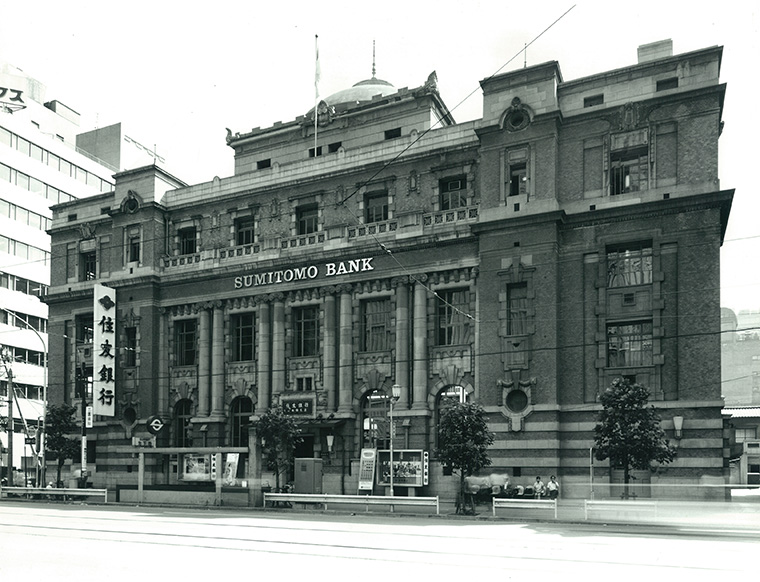 3-7 Sumitomo Bank, Tokyo Branch, Taisho 6 (1917)
The Great Kanto Earthquake
At 11:58 a.m., the Tokyo branch building was suddenly and violently shaken from deep underground, leaving Hiraga utterly stunned. Immediately afterward, a loud thud was followed by a jolt that felt as if the building were being thrust upward from below, only to be instantly slammed downward vertically, and intense vertical shaking began. The tremors grew even more violent, reaching an unimaginable intensity 15 to 16 seconds later. Since it was lunchtime and people were using open flames, fires broke out among the Tokyo residents; fanned by strong southeasterly winds caused by a passing low-pressure system, these fires turned into raging infernos. That raging fire spread over a wide area in the blink of an eye, and while more than 10,000 people were crushed to death, more than 90,000 perished in the flames—the number of fire-related fatalities far outnumbering the others. In total, more than 105,000 lives were lost.
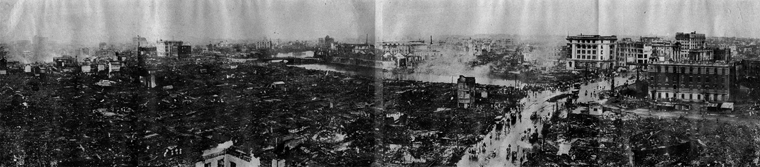 3-8 The Great Kanto Earthquake, Taisho 12 (1923): The Devastation in the Nihonbashi and Kanda Areas, as Seen from Kyobashi
Once the violent shaking subsided, the Sumitomo Bank Tokyo Branch immediately evacuated its regular staff; however, people who had escaped from other collapsed buildings began flocking to the bank for shelter. Hiraga and his team were working to accommodate the evacuees and provide them with hot meals.At the same time, Hiraga and his team were making emergency repairs to the shutters warped by the violent earthquake while going around the entire building to close all the manual fire shutters and fire doors. These actions ultimately saved the Tokyo Branch from being completely destroyed by fire. Around 8:00 p.m., the fire department issued an evacuation advisory, and people began leaving to take shelter in front of the Imperial Palace.
Hiraga stepped outside the building shortly after 9:00 p.m. to try to leave. However, it was already too late; the building was surrounded on all sides by raging flames. He gave up on escaping, steeled his resolve, and returned inside with four of his subordinates.Barricaded in the sales office, Hiraga and his group saw the fire shutters, blackened and charred by the raging flames. Furthermore, the paint on the steel frames installed between the shutters and the glass windows was ablaze, and smoke seeping in from the intense fire outside had filled the building.
Finally, around 2:00 a.m., all the surrounding buildings—including the Shirakiya Kimono Store—had burned to the ground, and the heat and smoke from outside were beginning to subside. Then, around 5:00 a.m., as dawn began to break, he stood outside amid the scorched earth.
Hiraga stepped outside the building shortly after 9:00 p.m. to try to leave. However, it was already too late; the building was surrounded on all sides by raging flames. He gave up on escaping, steeled his resolve, and returned inside with four of his subordinates.Barricaded in the sales office, Hiraga and his group saw the fire shutters, blackened and charred by the raging flames. Furthermore, the paint on the steel frames installed between the shutters and the glass windows was ablaze, and smoke seeping in from the intense fire outside had filled the building.
Finally, around 2:00 a.m., all the surrounding buildings—including the Shirakiya Kimono Store—had burned to the ground, and the heat and smoke from outside were beginning to subside. Then, around 5:00 a.m., as dawn began to break, he stood outside amid the scorched earth.
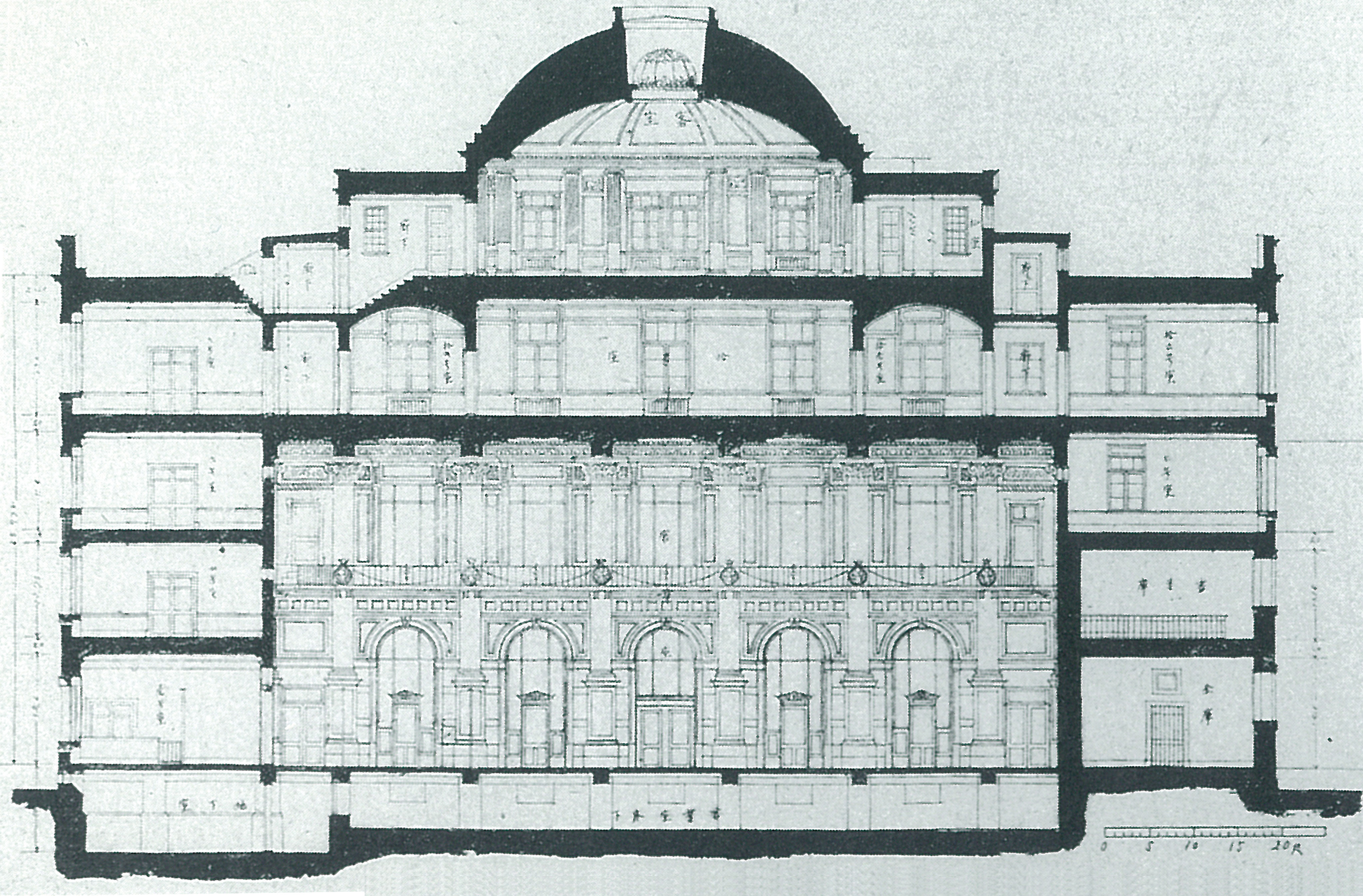 3-9 Cross-Section: The central atrium on the 1st through 3rd floors serves as the sales office.
It was possible to resume operations the day after the major earthquake.
The entire Nihonbashi area had been reduced to a scorched wasteland as far as the eye could see. Many companies found themselves in a situation where it was difficult to continue their business operations, as their buildings had either collapsed or, even if they had withstood the violent tremors, had been gutted by the raging inferno. Yet the Sumitomo Bank Tokyo Branch was in a condition to resume operations the very next day after the Great Kanto Earthquake. The desperate efforts of Shoichi Hiraga and his colleagues, along with Sumitomo’s solid foundation, were widely publicized in newspapers and magazines of the time and later featured in elementary school textbooks. Although Sumitomo had only recently expanded into Tokyo, Teigo Iba, the second General Director of Sumitomo’s Head Office, later recalled in his autobiography: “The reliability of Sumitomo’s architectural designs and the soundness of Sumitomo’s business operations were widely publicized in newspapers and magazines. Sumitomo finally began to make a name for itself in Tokyo’s business world, and the foundation for Sumitomo’s expansion into Tokyo was thus established,” he recalled.
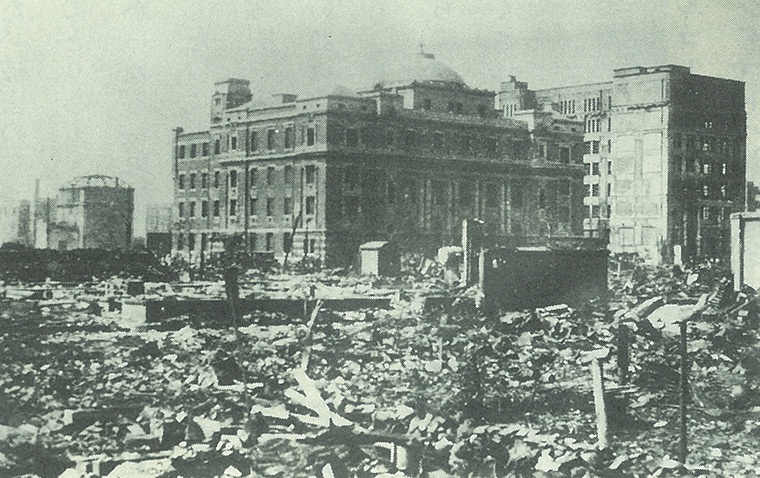 3-10 The Sumitomo Bank Tokyo Branch, Still Standing Amid the Ruins
The Origins of BCP (Business Continuity Planning)
During the Great East Japan Earthquake that struck on March 11, 2011, many companies lost valuable personnel and equipment, putting their very survival at risk. This is still fresh in our memories.In today’s world, where the likelihood of the Tokai, Tonankai, and Nankai earthquakes is increasing, there is a growing recognition of the importance of formulating plans in advance to ensure that, even in the event of an unexpected disaster, business operations can continue at a minimum level and resume as quickly as possible. Such plans are known as BCP (Business Continuity Planning).
The Tokyo Branch of Sumitomo Bank withstood the massive earthquake and great fire caused by the Great Kanto Earthquake, effectively achieving what we would now call a BCP. However, Hidaka Hiroshi emphasized the “importance of human effort in times of crisis,” stating that it was only thanks to the actions of Masakazu Hiraga that the building was preserved.While BCP is widely promoted today, Hidaka’s sentiments likely represent the very origins of BCP.
The Tokyo Branch of Sumitomo Bank withstood the massive earthquake and great fire caused by the Great Kanto Earthquake, effectively achieving what we would now call a BCP. However, Hidaka Hiroshi emphasized the “importance of human effort in times of crisis,” stating that it was only thanks to the actions of Masakazu Hiraga that the building was preserved.While BCP is widely promoted today, Hidaka’s sentiments likely represent the very origins of BCP.
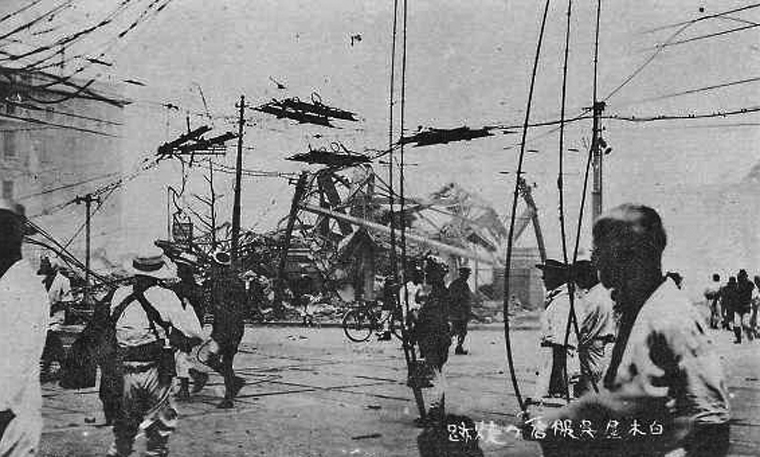 3-11 The Shirakiya Kimono Shop across the street, which collapsed and burned to the ground
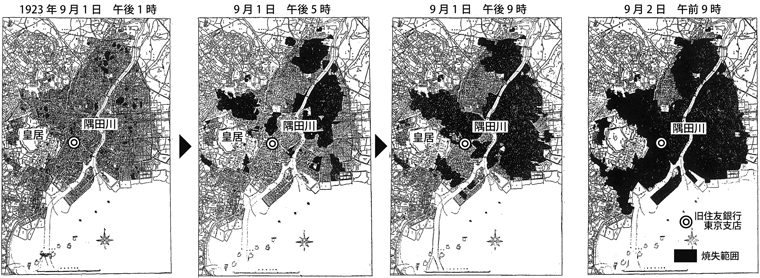 3-12 The Great Kanto Earthquake: The Spread of the Fire
(References)
Sumitomo Bank (ed.) (1979), *Eighty Years of Sumitomo Bank*, Sumitomo Bank History Compilation Committee
Takao Konishi (1991), *Up to 13 Kitahama 5-chome*, Sōgensha
“Sumitomo Shunsui” Editorial Committee (1955), *Sumitomo Shunsui*, Sumitomo Shunsui Editorial Committee
Akira Yoshimura (1973), *The Great Kanto Earthquake*, Bungeishunju
Hiroyuki Suzuki (2007), *The Genes of Architecture*, Oukoku-sha
Terunobu Fujimori (1993) *Modern Japanese Architecture (Vol. 2)*, Iwanami Shoten
Takao Konishi (1993), *Tales of the Hometown of Sumitomo Maintenance*, “Nikken Sekkei In-House Newsletter, Special Issue, March 1993,” Nikken Sekkei
Sumitomo Bank (ed.) (1979), *Eighty Years of Sumitomo Bank*, Sumitomo Bank History Compilation Committee
Takao Konishi (1991), *Up to 13 Kitahama 5-chome*, Sōgensha
“Sumitomo Shunsui” Editorial Committee (1955), *Sumitomo Shunsui*, Sumitomo Shunsui Editorial Committee
Akira Yoshimura (1973), *The Great Kanto Earthquake*, Bungeishunju
Hiroyuki Suzuki (2007), *The Genes of Architecture*, Oukoku-sha
Terunobu Fujimori (1993) *Modern Japanese Architecture (Vol. 2)*, Iwanami Shoten
Takao Konishi (1993), *Tales of the Hometown of Sumitomo Maintenance*, “Nikken Sekkei In-House Newsletter, Special Issue, March 1993,” Nikken Sekkei
Source
3-8 Osaka Mainichi Shimbun (1923), *Illustrated Report on the Kanto Earthquake*
3-9 “Building Modern Japan 1900–1990,” Nikken Sekkei
3-10 Edited by Sumitomo Bank (1998), *A Century of Sumitomo Bank*, Sumitomo Bank History Compilation Committee
3-11 Author Unknown
3-12 Earthquake Prevention Investigation Committee (1925), *Report on the Investigation of Fires in Tokyo Caused by the Great Earthquake*
3-8 Osaka Mainichi Shimbun (1923), *Illustrated Report on the Kanto Earthquake*
3-9 “Building Modern Japan 1900–1990,” Nikken Sekkei
3-10 Edited by Sumitomo Bank (1998), *A Century of Sumitomo Bank*, Sumitomo Bank History Compilation Committee
3-11 Author Unknown
3-12 Earthquake Prevention Investigation Committee (1925), *Report on the Investigation of Fires in Tokyo Caused by the Great Earthquake*