

4-4 Between “up to” and “from” at 13 Kitahama 5-chome —The Great Air Raids on Tokyo, Osaka, and Nagoya, and Hiroshima, Nagasaki, and Okinawa—
The ten-year period from Showa 15 to Showa 25 was a time of great upheaval for Japan. This turbulent era serves as a major dividing line in the history of Nikken Sekkei.Within the Nikken Group, the period from the establishment of the Sumitomo Head Office Temporary Construction Department through World War II is referred to as “the era up to,” while the period from the end of the war through 1991 is called “the era from.”As I will discuss in more detail in the next installment, No. 5, “From the Postwar Ruins,” the devastation of the country caused by the massive air raids and atomic bombings that occurred in Showa 20 (1945)—exactly halfway through this 10-year period—marked a major turning point in all aspects of Japanese society, economy, and culture.
-
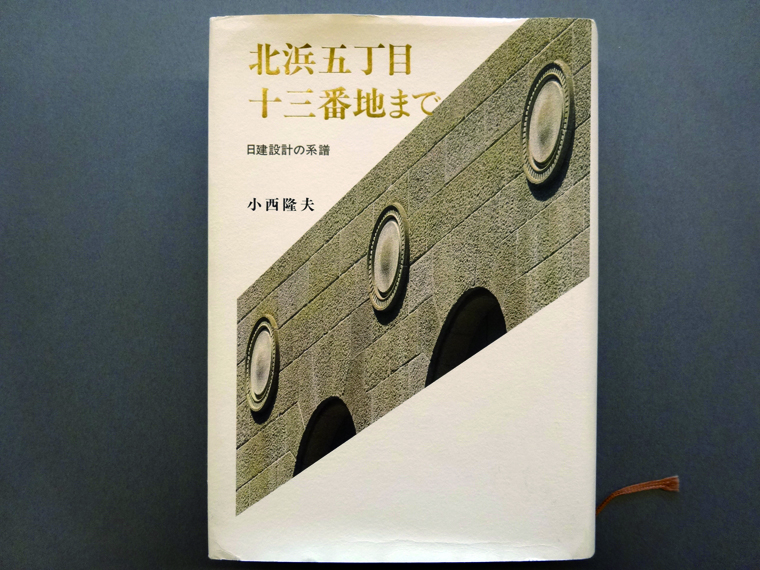 4-27 Takao Konishi, *Up to 13 Kitahama 5-chome*
-
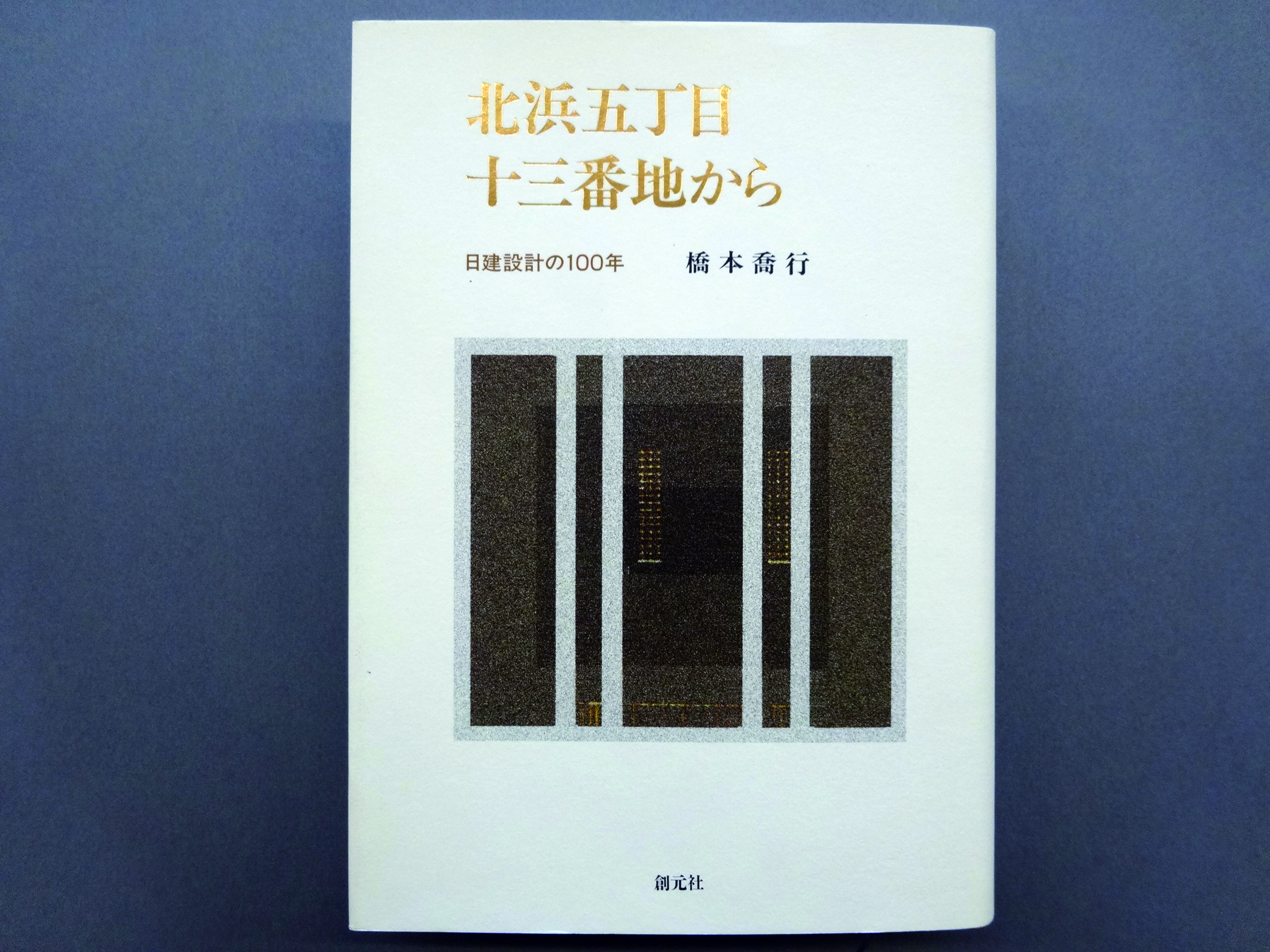 4-28 “From 13 Kitahama 5-chome” by Takayuki Hashimoto
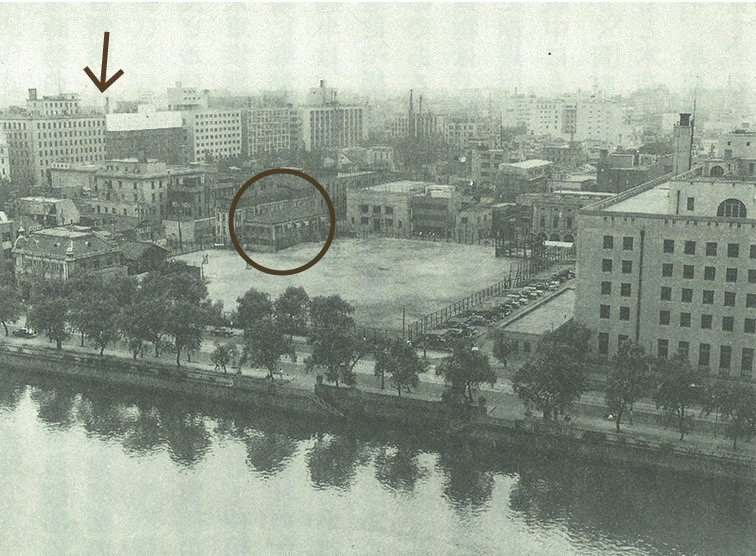 4-29 The fifth floor and rooftop of the Sumitomo Building on the right side of the photograph housed the headquarters of the U.S. First Army until 1952, and the Stars and Stripes flew on the rooftop. On the adjacent lot, rubble from the air raids was cleared away by bulldozers, and a training ground for U.S. Army infantry was constructed. The building that once housed the Hasebe & Takekoshi Architectural Office can be seen in the upper left corner of the training ground. (Marked with a circle). This building was one of the few that had barely survived the air raids intact. In Shōwa 21 (1946), the sawtooth roof, which had been damaged in the air raids, was replaced with a hipped roof during restoration, and the building became the headquarters of the Architecture Division of Nippon Construction Industry—the predecessor of Nikken Sekkei Construction. This location is 13 Kitahama 5-chome. On Midosuji, visible on the far left, the northern half of the Nippon Life Insurance Company headquarters building had been clad in stone, while demolition of the southern half—the former main building—had begun. (↓)
Starting from Scratch
On March 26, 1945, the invasion of Okinawa began, and the air raids on Tokyo—which had started in November 1944—gradually increased in scale, culminating in the largest air raid on Tokyo on March 10, 1945.Large-scale air raids on Osaka and Nagoya also began in March, and Japan’s major cities were reduced to scorched earth by air raids involving the dropping of incendiary bombs from B-29 bombers.Then, on August 6, an atomic bomb was dropped on Hiroshima, and on August 9, one was dropped on Nagasaki. Finally, on August 15, 1945, the day of the “Imperial Radio Address” arrived, in which Emperor Shōwa announced Japan’s surrender to the nation.
At that time, when Japan’s population was just under 75 million, the death toll reached 3.1 million. This meant that one in every 25 people died.For those old enough to remember, it was an era when the death of someone close was a daily reality. At the same time, those who lived through the immediate postwar period were people who experienced firsthand the hardships of surviving amid the scorched earth.
People were forced to fundamentally reexamine the values that had been taken for granted until then. In a sense, they found themselves at “ground zero,” where they had to start all over again—from one, two, three…
-
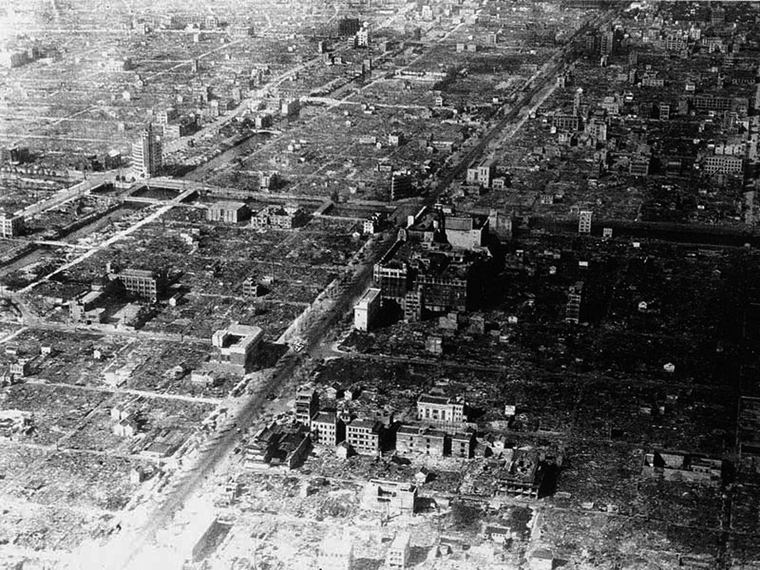 4-30: The Great Osaka Air Raid
March 10–August 14, 1945: Areas near Midosuji, Shinsaibashi-suji, Nagahori River, Nishi-Yokobori River, and Yotsubashi-suji. Among the buildings, Daimaru and the Museum of Electrical Science survived the fire. Deaths and missing persons: 15,000 -
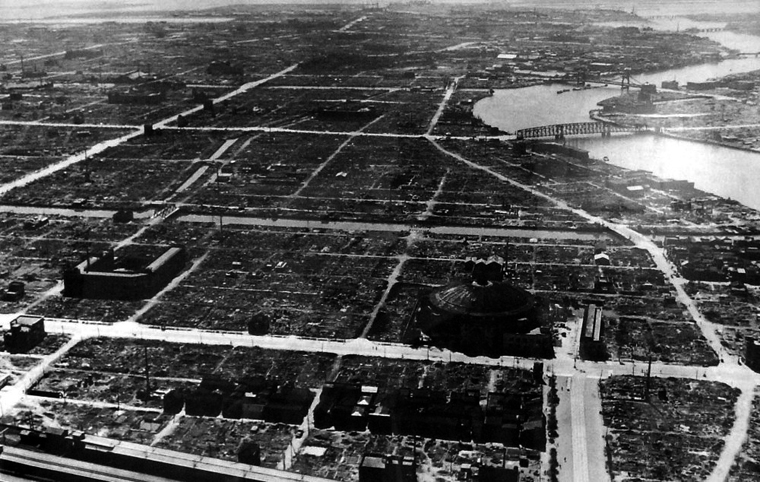 4-31: The Great Tokyo Air Raid
The largest air raid occurred on March 10, 1945. View looking south from above JR Ryogoku Station. The round building in the foreground is the former Ryogoku Kokugikan. Spanning the Sumida River, from the foreground, are the Shin-Ohashi Bridge and the Kiyosu Bridge. Deaths and missing persons: Over 100,000
Two Milestones in the History of Nikken Sekkei
In the history of Nikken Sekkei as well, just as Magoroku Noguchi and Hiroshi Hidaka devoted themselves wholeheartedly to “Western civilization,” the people of the postwar era faced “the starting point” while overcoming difficulties amid the reality of a scorched earth.Building on the technical expertise they had accumulated, they entered a new era that could be called “postwar modernism.” The diverse body of work born of that resilient postwar spirit continues to exert a powerful presence on us today.
The late Shōzō Uchii, an architect who commanded respect from many quarters and served as a professor at Kyoto University and Shiga Prefectural University, compared Nikken Sekkei’s “era up to” and “era from” to the eras of the “Old Testament” and “New Testament” in Christianity during a dialogue held in 2000.Indeed, “until” and “from” represent two starting points in the history of Nikken Sekkei.
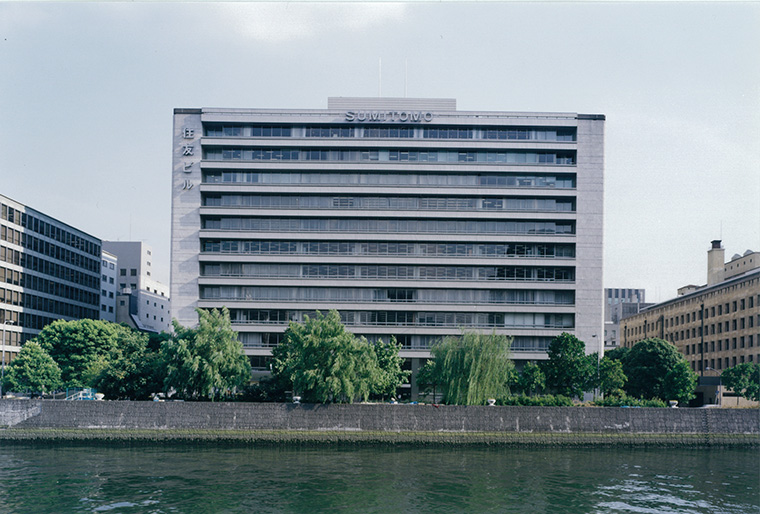 4-32 Shin-Sumitomo Building, Showa 37 (1962)
It was constructed on the grounds shown in the photo above. It has been meticulously maintained to this day, and in 2013—half a century after its completion—it received the 22nd BELCA Award in the Long Life category. It continues to retain its striking presence to this day.
(Note) About the BELCA Award
An award presented by the Building and Equipment Long-life Cycle Association (BELCA), which is administered by the Ministry of Land, Infrastructure, Transport and Tourism. The chair of the selection committee for the 22nd award was Professor Emeritus Yoshiya Uchida of the University of Tokyo.
Takao Konishi (1991), *To 13-chome, Kitahama 5-chome*, Sōgensha
Takayuki Hashimoto (1999), *From 13 Kitahama 5-chome*, Sogensha
(2000) “Nikken Sekkei 100th Anniversary Special Feature (Dialogue between Shōzō Uchii and Hisashi Yosano, et al.)”
*Architecture and Society* (August 2000 issue), Japan Architectural Association
“The Great Tokyo Air Raid,” “The Great Osaka Air Raid,” “The Great Nagoya Air Raid,” “The Battle of Okinawa,” “The Hiroshima Atomic Bombing,” “The Nagasaki Atomic Bombing,” *Wikipedia*
4-27, 29: Takao Konishi (1991), *Up to 13 Kitahama 5-chome*, Sōgensha
4-28 Takayuki Hashimoto (1999), *From 13 Kitahama 5-chome*, Sōgensha
4-30 Hisashi Fukushi (2007), *Osaka in the Shōwa Era: Nostalgic Streets Here and There*, Archives Publishing
4-31 Free Encyclopedia “Wikipedia” (Photo by U.S. military, 1945)
4-32 Photo by Shiyo Kawai