

5-1: Sumitomo Corporation and Nikken Sekkei Construction
 5-1: The Lead-up to the Establishment of Nikken Sekkei Construction
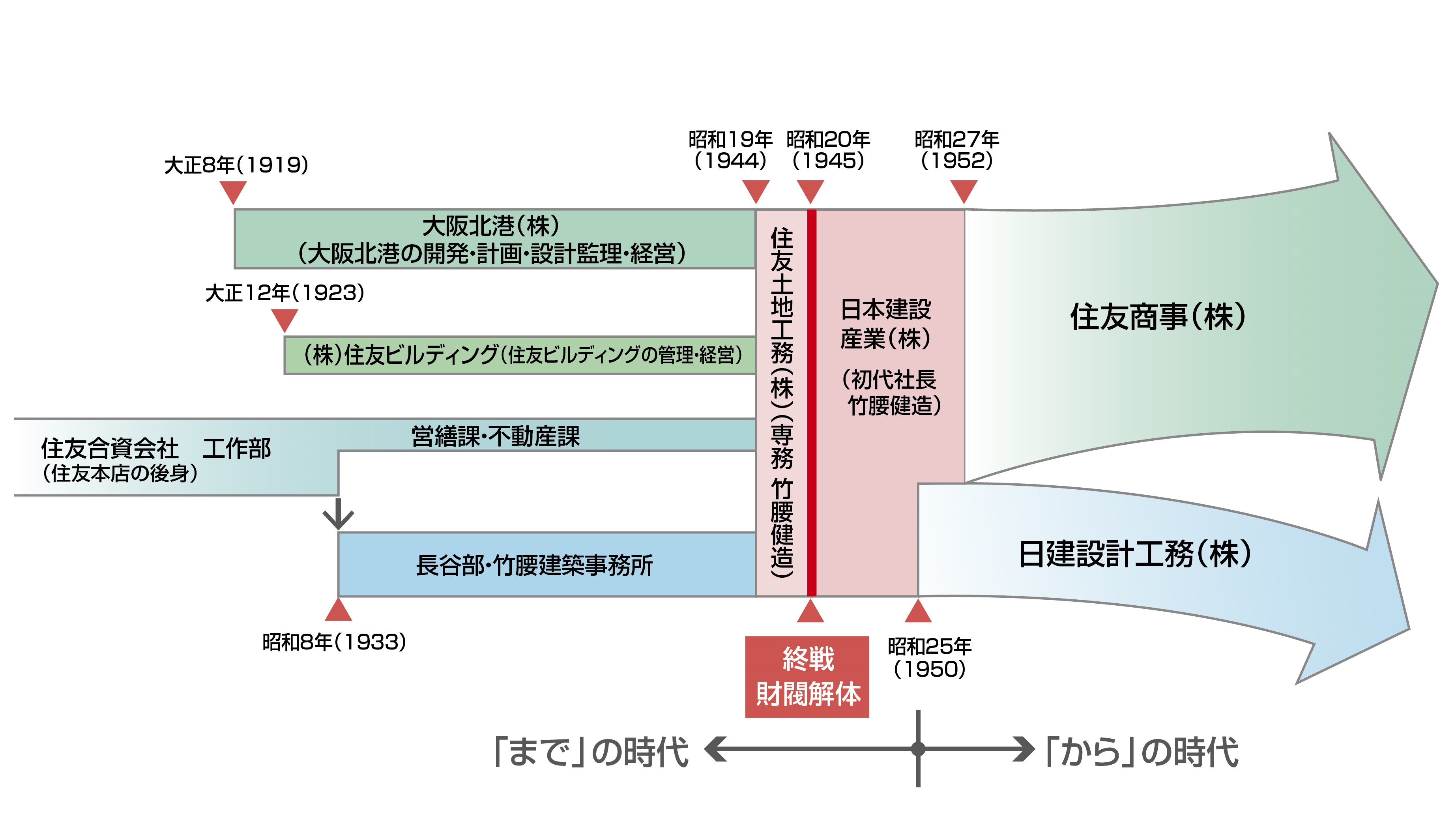
Sumitomo Corporation and Nikken Sekkei share a common origin in Nippon Construction Industry Co., Ltd., which was established after the end of World War II.In Showa 25 (1950), Nikken Sekkei Construction became independent from its parent company, Nippon Construction Industry Co., Ltd. This process unfolded amid the chaotic and complex social conditions surrounding the end of the war. Please refer to the explanatory diagram above.
In this diagram, the year Showa 25 (1950) serves as a dividing line between the “up to” and “from” eras. As explained in the fourth installment, of the two publications chronicling Nikken Sekkei’s history, *Up to 13 Kitahama 5-chome* covers the period up to the establishment of Nikken Sekkei Construction, whilewhile *From 13 Kitahama 5-chome* covers the period following the establishment of Nikken Sekkei Construction. Therefore, Showa 25 (1950)—the year Nikken Sekkei Construction was founded—serves as the dividing line between these two eras. Incidentally, “13 Kitahama 5-chome” refers to the address of the office Nikken Sekkei Construction established upon its founding.
(Note) For clarity, the term “Kabushiki Kaisha” (Ltd.) has been omitted almost entirely throughout the text.
In this diagram, the year Showa 25 (1950) serves as a dividing line between the “up to” and “from” eras. As explained in the fourth installment, of the two publications chronicling Nikken Sekkei’s history, *Up to 13 Kitahama 5-chome* covers the period up to the establishment of Nikken Sekkei Construction, whilewhile *From 13 Kitahama 5-chome* covers the period following the establishment of Nikken Sekkei Construction. Therefore, Showa 25 (1950)—the year Nikken Sekkei Construction was founded—serves as the dividing line between these two eras. Incidentally, “13 Kitahama 5-chome” refers to the address of the office Nikken Sekkei Construction established upon its founding.
(Note) For clarity, the term “Kabushiki Kaisha” (Ltd.) has been omitted almost entirely throughout the text.
Prohibition on the Establishment of Trading Companies by the Third Sumitomo General Director
In Taisho 9 (1920), Masaya Suzuki, then General Director of Sumitomo, stated: “Because Sumitomo has focused exclusively on managing mining and industrial operations, we have not cultivated personnel skilled in commercial activities; a single misstep could result in significant losses and jeopardize the management of our other businesses.”Consequently, a ban on the establishment of trading companies was imposed. From that point on, Sumitomo avoided engaging in any commercial activities other than the sale of its own products.
Toward the end of the war, Sumitomo Land & Construction was established under the government’s “Corporate Reorganization Order.”
In Showa 19 (1944), toward the end of World War II, the government issued the Corporate Reorganization Order, which mandated the consolidation and restructuring of similar businesses operated by zaibatsu and other companies.In compliance with this order, Sumitomo Headquarters requested that the Hasebe & Takekoshi Architectural Office rejoin Sumitomo in order to centralize its real estate-related businesses, and established Sumitomo Land & Construction Co., Ltd., formed primarily around Osaka North Port Co., Ltd.
Osaka North Port Co., Ltd. had been established 25 years earlier, in Taishō 8 (1919), and since the construction of Osaka North Port was carried out under a direct management system, the company handled large-scale purchasing and procurement of construction materials related to civil engineering projects.At the same time, since the Hasebe & Takekoshi Architectural Office had also been purchasing and procuring construction materials for building projects under the direct management system in place since the Meiji era, Sumitomo Land & Construction—formed by the merger of Osaka North Port Co., Ltd. and the Hasebe & Takekoshi Architectural Office—was already an organization with the functions of a trading company that handled the procurement of materials for both civil engineering and building construction projects.
Osaka North Port Co., Ltd. had been established 25 years earlier, in Taishō 8 (1919), and since the construction of Osaka North Port was carried out under a direct management system, the company handled large-scale purchasing and procurement of construction materials related to civil engineering projects.At the same time, since the Hasebe & Takekoshi Architectural Office had also been purchasing and procuring construction materials for building projects under the direct management system in place since the Meiji era, Sumitomo Land & Construction—formed by the merger of Osaka North Port Co., Ltd. and the Hasebe & Takekoshi Architectural Office—was already an organization with the functions of a trading company that handled the procurement of materials for both civil engineering and building construction projects.
Immediately after the end of the war, a trading company was established to accommodate demobilized soldiers and repatriates.
After World War II, the dissolution of Sumitomo Headquarters became inevitable following the General Headquarters’ directive to dismantle the zaibatsu. Sumitomo’s greatest challenge was determining how to handle the employees of Sumitomo Headquarters and how to accommodate the many Sumitomo-affiliated individuals—including demobilized personnel and repatriates who had been scattered across China and various regions in the South.Allowing the talent Sumitomo had nurtured over many years to disperse all at once would have been a serious problem; therefore, Sumitomo concluded that it was its social responsibility to launch new businesses and establish companies to serve as a safety net, so that these employees could play an active role in postwar reconstruction.
In the proposals for new business ventures, salt production, fisheries, cement, publishing, and trading were considered; however, new businesses requiring significant capital investment were deemed impossible due to the urgency of the situation, and the proposal to establish a trading company as the new venture remained the sole option until the very end.Due to the aforementioned directive from Sumitomo’s General Council prohibiting the establishment of a trading company, the matter was carefully deliberated; however, Shunnosuke Furuta, the General Council member at the time who was entrusted with the final decision, concluded, “From a broader perspective, there is no alternative but to enter the trading business.”
In the proposals for new business ventures, salt production, fisheries, cement, publishing, and trading were considered; however, new businesses requiring significant capital investment were deemed impossible due to the urgency of the situation, and the proposal to establish a trading company as the new venture remained the sole option until the very end.Due to the aforementioned directive from Sumitomo’s General Council prohibiting the establishment of a trading company, the matter was carefully deliberated; however, Shunnosuke Furuta, the General Council member at the time who was entrusted with the final decision, concluded, “From a broader perspective, there is no alternative but to enter the trading business.”
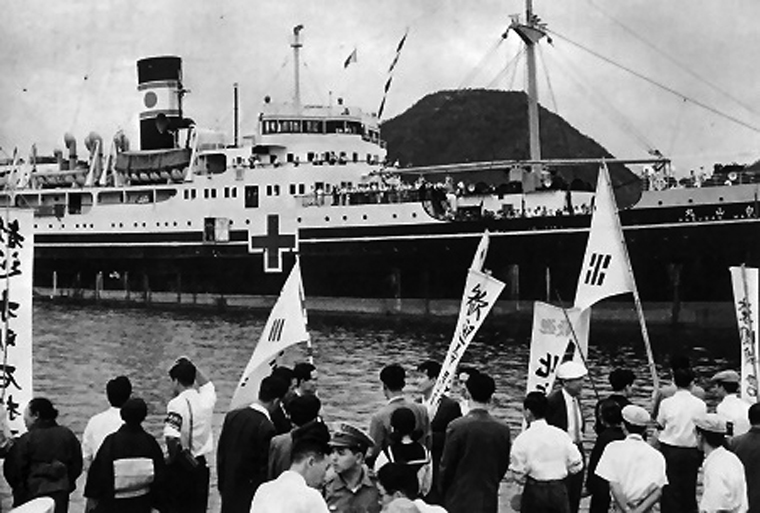 5-2: The Hakusan Maru, the Last Repatriation Ship to Arrive at Maizuru Port—Showa 33 (1958)
After the war, the company established a commercial division and relaunched as Nippon Construction Industries.
Just before it voluntarily dismantled the zaibatsu, Sumitomo Headquarters decided to designate Sumitomo Land & Construction Co., Ltd. as the company that would take over its trading business.However, since the use of zaibatsu names such as “Sumitomo” was prohibited by the General Headquarters (GHQ), Sumitomo Land and Construction Co., Ltd. was relaunched under the new name “Nippon Construction Industry Co., Ltd.” The name “Nippon Construction Industry” was chosen to reflect the ideal of “building a new Japan from the ruins of the postwar landscape.”
Kenzo Takekoshi, who had experience in materials procurement in the United States and had long advocated that “Sumitomo needs a trading company,” was appointed as the first President and CEO of Nippon Construction Industry.However, a year and a half later, after witnessing the birth of the trading company, Takekoshi resigned from President and CEO and left Sumitomo before the public office ban could take effect against him.
Kenzo Takekoshi, who had experience in materials procurement in the United States and had long advocated that “Sumitomo needs a trading company,” was appointed as the first President and CEO of Nippon Construction Industry.However, a year and a half later, after witnessing the birth of the trading company, Takekoshi resigned from President and CEO and left Sumitomo before the public office ban could take effect against him.
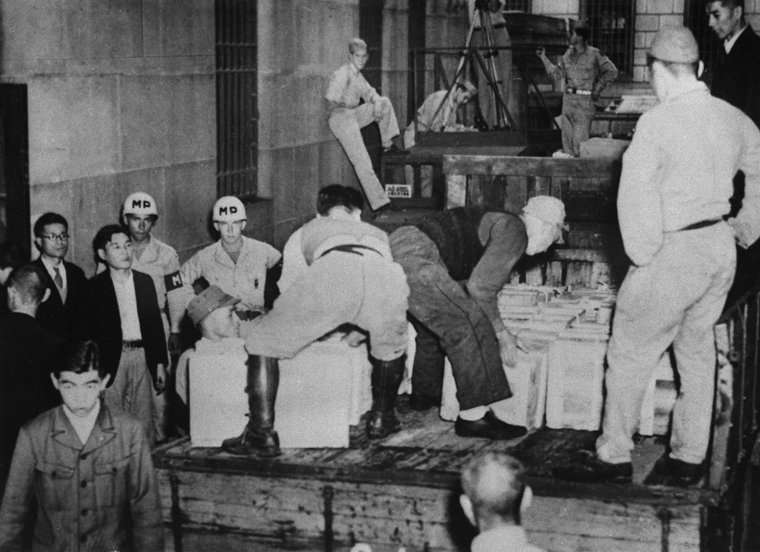 5-3: Stock certificates belonging to a zaibatsu, being transported out of the zaibatsu’s headquarters under the watchful eye of the MP (U.S. Military Police) (1946)
Shunya Taji was appointed as the second President and CEO of the Japanese construction industry and laid the foundation for Sumitomo Corporation.
Shunya Toji, a former director of Sumitomo Metal Industries who later became a managing director at Nippon Construction Industries, succeeded Takekoshi and became the second president of Nippon Construction Industries President and CEO.
In the trading company sector—an area Sumitomo had previously avoided—Toji pursued an aggressive management strategy amid the chaos immediately following the end of the war, raising the company to 16th place in the trading industry in Showa 26 (1951) and to 8th place in Showa 32 (1957).During the difficult postwar era, Tarō boldly laid the foundation for the trading company business.
In the trading company sector—an area Sumitomo had previously avoided—Toji pursued an aggressive management strategy amid the chaos immediately following the end of the war, raising the company to 16th place in the trading industry in Showa 26 (1951) and to 8th place in Showa 32 (1957).During the difficult postwar era, Tarō boldly laid the foundation for the trading company business.
Nikken Sekkei Construction Spun Off and Was Established
After World War II, the Japan Institute of Architectural Design and Supervision (the predecessor of the Japan Institute of Architects) prohibited its members from selling building materials. As a result, within the Japanese construction industry, there was a conflict between performing design and supervision services and carrying out commercial operations involving the procurement and sale of building materials.Meanwhile, the commercial division—which handled steel, steel pipes, electrical wires, and other products manufactured by companies within the Sumitomo Group—experienced rapid growth as postwar reconstruction progressed.
To avoid this conflict—and to ensure it would not be swallowed up by the expanding scale of operations driven by the rapid growth of the commercial division—the design division of the Japanese construction industry Construction Administration Department sought a streamlined management structure and became independent in Showa 25 (1950). This marked the establishment of Nikken Sekkei Construction Co., Ltd.
Kyusuke Ozaki, who had served as deputy director of the Hasebe & Takekoshi Architectural Office, was appointed as the first president President and CEO of Nikken Sekkei Construction Co., Ltd. Additionally, Shunya Taji, who was with Nippon Construction Industry President and CEO, served concurrently as Chairman, and the company was backed by Nippon Construction Industry, which was already widely recognized in society.
The establishment of Nikken Sekkei Construction, which set sail once again amid the chaotic postwar society, was a major decision to become independent from “Sumitomo,” its former parent company. People from that era recall this independence as “a new beginning tinged with a sense of pathos.” Without this decision, Nikken Sekkei as we know it today would not exist.
To avoid this conflict—and to ensure it would not be swallowed up by the expanding scale of operations driven by the rapid growth of the commercial division—the design division of the Japanese construction industry Construction Administration Department sought a streamlined management structure and became independent in Showa 25 (1950). This marked the establishment of Nikken Sekkei Construction Co., Ltd.
Kyusuke Ozaki, who had served as deputy director of the Hasebe & Takekoshi Architectural Office, was appointed as the first president President and CEO of Nikken Sekkei Construction Co., Ltd. Additionally, Shunya Taji, who was with Nippon Construction Industry President and CEO, served concurrently as Chairman, and the company was backed by Nippon Construction Industry, which was already widely recognized in society.
The establishment of Nikken Sekkei Construction, which set sail once again amid the chaotic postwar society, was a major decision to become independent from “Sumitomo,” its former parent company. People from that era recall this independence as “a new beginning tinged with a sense of pathos.” Without this decision, Nikken Sekkei as we know it today would not exist.
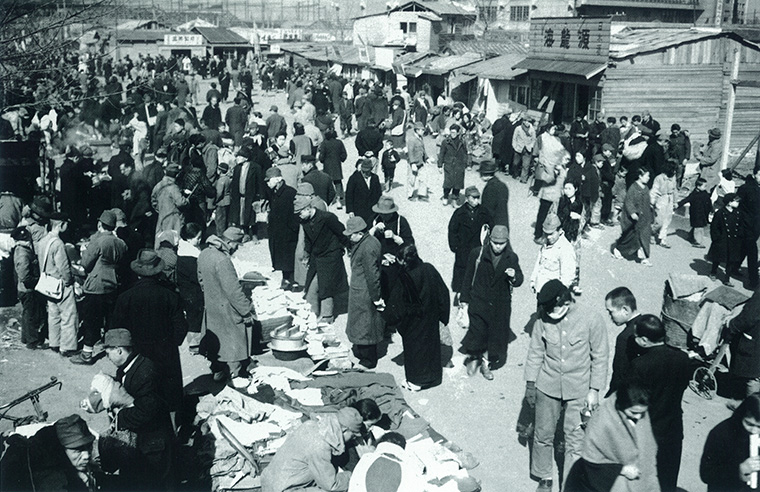 5-4: The Black Market in Front of Osaka Station After the War
(References)
Sumitomo Corporation (1972) 'Sumitomo Corporation History' Sumitomo Corporation
Nikken Sekkei (1970) 'Twenty-Year History' Nikken Sekkei
(At the time of publication on July 1, 1970, the founding year was the establishment of Nikken Sekkei Komu in 1950 (Showa 25).
Currently, the founding year is considered Meiji 33 (1900). )
Takao Konishi (1991) 'Up to Kitahama 5-chome 13-ban' Sogensha
Takao Konishi (1993) 'The Hometown Story of Sumitomo Seijo' (Nikken Sekkei, In-house Newsletter, Special Issue, March 1993) Nikken Sekkei
Yoshifusa Funakoshi (1968) 'Hisasuke Ozaki: His Life and Achievements' Nikken Sekkei Komu
Kenzo Takekoshi (1978) 'Nostalgia' Kenzo Takekoshi
Kenzo Takekoshi (1980) 'Yusen Autobiography' Sogensha
Sumitomo Corporation (1972) 'Sumitomo Corporation History' Sumitomo Corporation
Nikken Sekkei (1970) 'Twenty-Year History' Nikken Sekkei
(At the time of publication on July 1, 1970, the founding year was the establishment of Nikken Sekkei Komu in 1950 (Showa 25).
Currently, the founding year is considered Meiji 33 (1900). )
Takao Konishi (1991) 'Up to Kitahama 5-chome 13-ban' Sogensha
Takao Konishi (1993) 'The Hometown Story of Sumitomo Seijo' (Nikken Sekkei, In-house Newsletter, Special Issue, March 1993) Nikken Sekkei
Yoshifusa Funakoshi (1968) 'Hisasuke Ozaki: His Life and Achievements' Nikken Sekkei Komu
Kenzo Takekoshi (1978) 'Nostalgia' Kenzo Takekoshi
Kenzo Takekoshi (1980) 'Yusen Autobiography' Sogensha
Source
5-2 Collection: Maizuru Repatriation Memorial Museum
5-3 Held by: Mainichi Shimbun
5-4 Held by: Osaka Urban Association
5-2 Collection: Maizuru Repatriation Memorial Museum
5-3 Held by: Mainichi Shimbun
5-4 Held by: Osaka Urban Association