

7-4 What It Means to Build a City — Osaka Business Park —
A city is a living organism. If we consider the lives of the people unfolding within the city to be its life force, then the city’s road system might be likened to its circulatory system, and its energy system to its digestive system.Furthermore, a city’s information and communications system can be likened to the nervous system. And the characteristics of life—self-organization and self-replication—manifest themselves in projects such as urban redevelopment and new city center plans.
At Nikken Sekkei’s offices in Tokyo, Osaka, and Nagoya, we began steadily working on urban planning projects in Showa 45 (1970) and have gradually built a track record. Here, we present Osaka Business Park as an example of our urban development work.
At Nikken Sekkei’s offices in Tokyo, Osaka, and Nagoya, we began steadily working on urban planning projects in Showa 45 (1970) and have gradually built a track record. Here, we present Osaka Business Park as an example of our urban development work.
From the Ruins
From the Meiji Restoration through the pre-war period, Osaka Castle was regarded as a key national military stronghold. Adjacent to Osaka Castle stood the Osaka Artillery Arsenal, which was Asia’s leading weapons factory in terms of both production capacity and technological capability; this land would later become the site of Osaka Business Park (OBP).
On August 14, Showa 20 (1945)—the very day before Japan’s defeat was finalized—716.5 metric tons of bombs were dropped on this artillery arsenal, causing catastrophic damage.For the next 20 years, the ruined factory lay in a state of neglect, with burnt-out, collapsed structures and twisted steel beams left jutting out of the river’s surface.This land was requisitioned by the occupying forces for seven years after the war, but in Showa 27 (1952), the requisition was lifted, and the site was sold to the private sector as part of Osaka’s efforts to rebuild itself as an economic hub. As a result, the 26-hectare site came to be owned by four major corporations.
Initially, the plan was for each company to proceed with construction independently. However, Nikken Sekkei—which gained the opportunity to participate through an introduction by Sumitomo Life Insurance, one of the four companies—continued to make passionate proposals, arguing that “the site of this former artillery arsenal is a location of immense social significance where urban development should be undertaken collaboratively.”Consequently, the four major corporations owning the land agreed to allow Nikken Sekkei, in collaboration with Maki & Associates and the Development Planning Division of Takenaka Corporation, to prepare an independent master plan proposal.
On August 14, Showa 20 (1945)—the very day before Japan’s defeat was finalized—716.5 metric tons of bombs were dropped on this artillery arsenal, causing catastrophic damage.For the next 20 years, the ruined factory lay in a state of neglect, with burnt-out, collapsed structures and twisted steel beams left jutting out of the river’s surface.This land was requisitioned by the occupying forces for seven years after the war, but in Showa 27 (1952), the requisition was lifted, and the site was sold to the private sector as part of Osaka’s efforts to rebuild itself as an economic hub. As a result, the 26-hectare site came to be owned by four major corporations.
Initially, the plan was for each company to proceed with construction independently. However, Nikken Sekkei—which gained the opportunity to participate through an introduction by Sumitomo Life Insurance, one of the four companies—continued to make passionate proposals, arguing that “the site of this former artillery arsenal is a location of immense social significance where urban development should be undertaken collaboratively.”Consequently, the four major corporations owning the land agreed to allow Nikken Sekkei, in collaboration with Maki & Associates and the Development Planning Division of Takenaka Corporation, to prepare an independent master plan proposal.
-
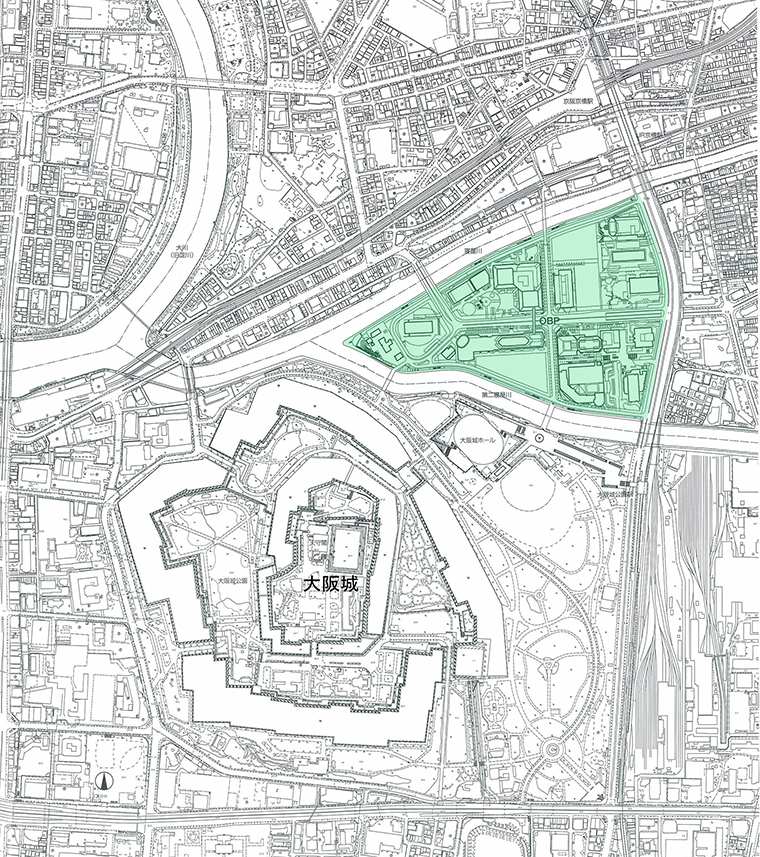 7-22 Osaka Business Park Location Map
-
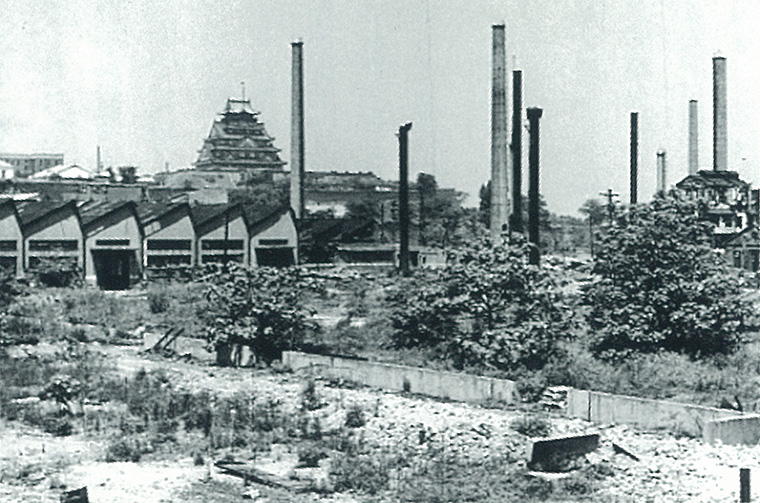 7-23 The site of the former artillery arsenal, still in ruins from the bombing
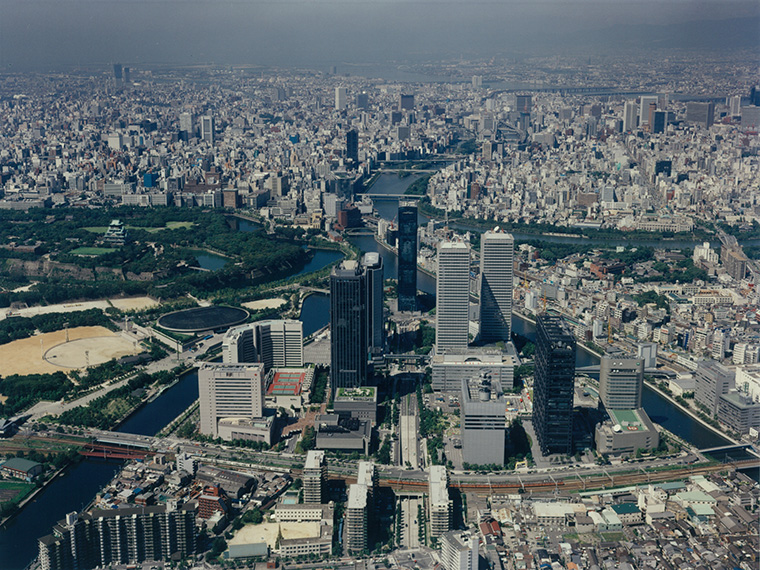 7-24 Osaka Business Park
Creating an East-West Axis in Osaka
The city of Osaka had a north-south urban structure in which two urban centers with distinct characteristics—"Kita" and "Minami"—were situated along the major axis of Midosuji, completed in Showa 12 (1937), which served as the city’s backbone. Kimei Yakubukuro(Kimia Minai), who later became part of Nikken Sekkei’s President and CEO, proposed that in addition to the urban axis connecting Kita and Minami, two new cores—“Higashi” and “Nishi”—were necessary, and that an east-west axis linking “Higashi” and “Nishi” was essential for Osaka’s development.As a first step toward this goal, he proposed to the City of Osaka and other relevant parties that it was necessary to create an “East” core centered on Osaka Castle.
The master plan for the 26-hectare urban development project on the site of the former Artillery Arsenal was drawn up based on this grand vision.
The master plan for the 26-hectare urban development project on the site of the former Artillery Arsenal was drawn up based on this grand vision.
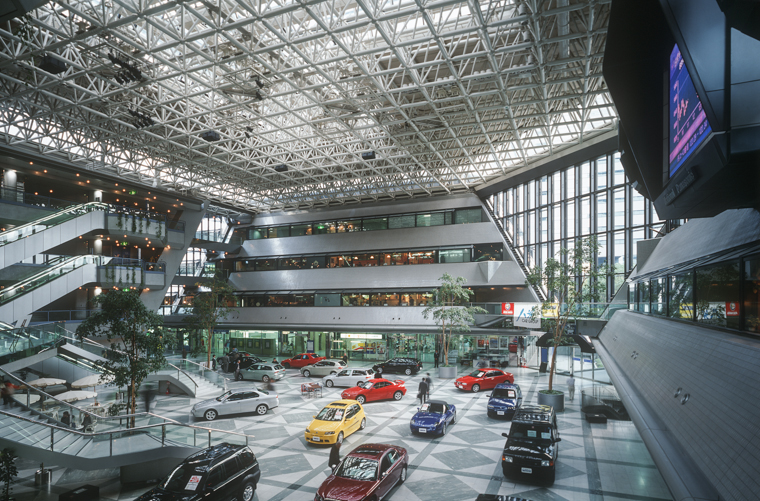 7-25 Twin 21 Gallery Atrium
Without strong will, nothing will come of it.
The master plan, which was voluntarily proposed in Showa 44 (1969), received approval from the four land-owning companies, leading to the establishment of a development council by those companies in Showa 45 (1970). This marked the start of the development project.
However, the economic stagnation caused by the oil crisis of Showa 48 (1973) led to a significant decline in the general public’s enthusiasm for construction. Furthermore, as this was the first large-scale development project undertaken by the private sector, obtaining approval from the relevant government agencies proved difficult, and the project faced numerous crises that nearly brought it to a halt.
Nevertheless, the Development Council’s resolve remained strong. Coupled with the bold decision of then-Osaka Mayor Yasushi Oshima, the City of Osaka spared no effort in providing the necessary governmental cooperation and ultimately entrusted the development entirely to the private sector.
In Showa 51 (1976), the land readjustment project, implemented under the “Private” (Joint), was approved by the Mayor of Osaka, and the OBP project finally got on track.
However, the economic stagnation caused by the oil crisis of Showa 48 (1973) led to a significant decline in the general public’s enthusiasm for construction. Furthermore, as this was the first large-scale development project undertaken by the private sector, obtaining approval from the relevant government agencies proved difficult, and the project faced numerous crises that nearly brought it to a halt.
Nevertheless, the Development Council’s resolve remained strong. Coupled with the bold decision of then-Osaka Mayor Yasushi Oshima, the City of Osaka spared no effort in providing the necessary governmental cooperation and ultimately entrusted the development entirely to the private sector.
In Showa 51 (1976), the land readjustment project, implemented under the “Private” (Joint), was approved by the Mayor of Osaka, and the OBP project finally got on track.
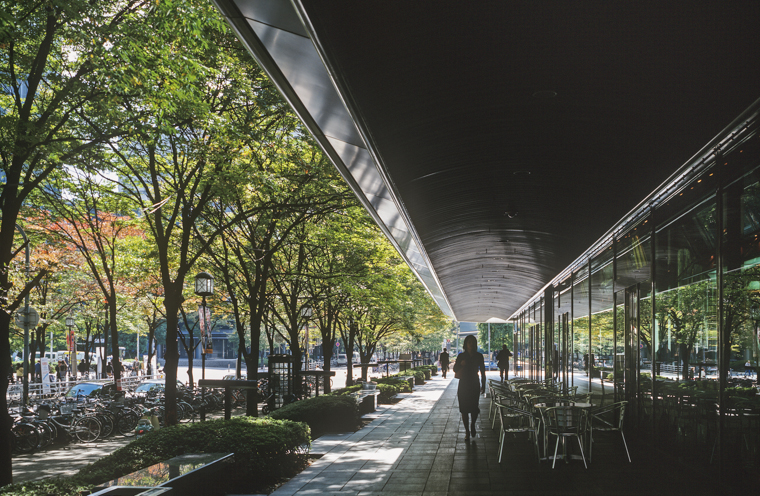 7-26 The Zelkova Tree-Lined Avenue on Park Avenue
A town surrounded by greenery has been built
Today, in addition to office buildings, the area features the Hotel New Otani Osaka, the Izumi Hall concert venue, and the Twin 21 complex—which integrates commercial facilities such as restaurants—with its atrium flooded with natural light. As a result, it has become a vibrant district where people want to work.The creation of an office district enveloped in greenery—best exemplified by Park Avenue, a beautiful avenue lined with zelkova trees running east to west through the center of the district—was made possible by a “system” devised specifically to build a wonderful city.
These “mechanisms” included organizing the entire area into five large superblocks rather than dividing the land into small, fragmented lots, and establishing a building agreement among all OBP landowners to preserve the urban landscape.
This city, imbued with the aspirations of a diverse range of people, continues to thrive magnificently to this day.
These “mechanisms” included organizing the entire area into five large superblocks rather than dividing the land into small, fragmented lots, and establishing a building agreement among all OBP landowners to preserve the urban landscape.
This city, imbued with the aspirations of a diverse range of people, continues to thrive magnificently to this day.
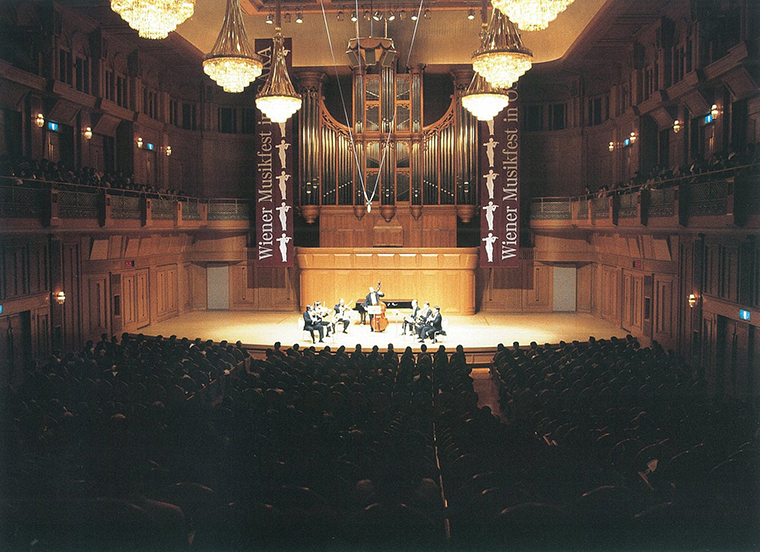 7-27 Izumi Hall, Equipped with a Pipe Organ Dedicated to Classical Music
To this day, Nikken Sekkei has continued to undertake urban planning projects within the diverse cultures and societies of China, Russia, Vietnam, Saudi Arabia, and other countries in the Middle East. No matter what kind of urban planning project we undertake, we strive never to forget that a city is the vessel that sustains the lives of its residents. After all, a city is a living organism.
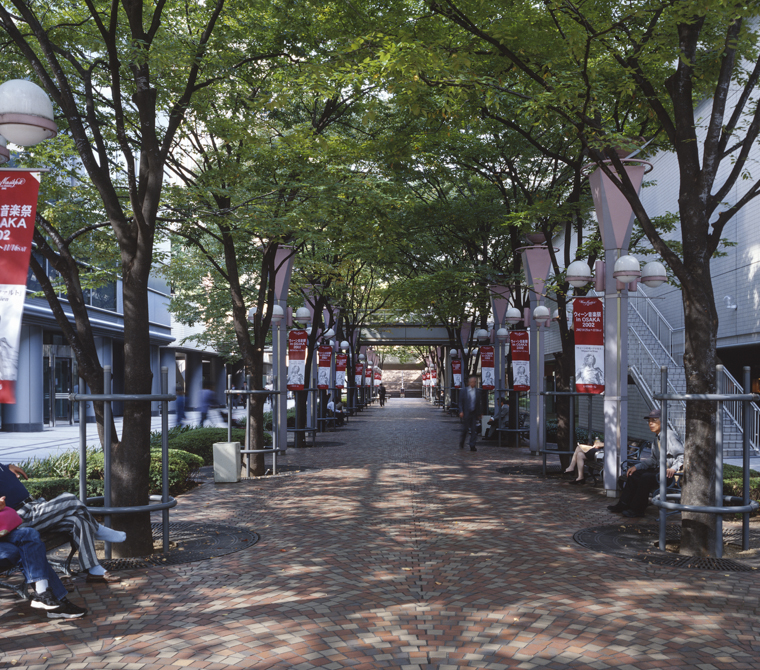 7-28 A park with a row of zelkova trees located between the OBP Castle Tower Building and the Hotel New Otani Osaka.
It also serves as the approach to Izumi Hall.
(References)
Nikken Sekkei (2003), *Nikken Sekkei Library: OBP—Osaka Business Park*, Nikken Sekkei
Nikken Sekkei (2003), *Nikken Sekkei Library: OBP—Osaka Business Park*, Nikken Sekkei
7-23 Collection: Osaka Urban Association
7-24 Photograph by Photo Kyodo Pro
7-25, 26, 28: Photographed by Photo Kyodo Pro
7-27 Courtesy of Izumi Hall
7-24 Photograph by Photo Kyodo Pro
7-25, 26, 28: Photographed by Photo Kyodo Pro
7-27 Courtesy of Izumi Hall