

8-4 Organizational Design for Company-Wide Centralization and Group Management
From the 1990s through the early 21st century, two major changes have been occurring at an accelerating pace in Japan. One is the concentration of power in Tokyo, with social infrastructure, human resources, and activities—including those in the political, economic, and cultural spheres—becoming increasingly concentrated in the Tokyo metropolitan area. The other is the increasing sophistication and diversification of society, the economy, technology, and culture.Although these two major changes present various problems and challenges, they show no signs of slowing down.
Nikken Sekkei, which is committed to creating value in architecture, urban planning, and the environment, has decided to redesign its own organizational structure to respond to these major changes surrounding Japan. This involves the unification of Nikken Sekkei under a single corporate structure and the implementation of group-wide management as the Nikken Group.
Nikken Sekkei, which is committed to creating value in architecture, urban planning, and the environment, has decided to redesign its own organizational structure to respond to these major changes surrounding Japan. This involves the unification of Nikken Sekkei under a single corporate structure and the implementation of group-wide management as the Nikken Group.
Nikken Sekkei's Company-wide Centralization
While there are various statistics on the world’s urban populations, one thing that can generally be said is that the population of the Tokyo Metropolitan Area is by far the largest in the world.According to a 2013 survey, the Tokyo metropolitan area had a population of approximately 33 million, while Jakarta, in second place, and Seoul, in third, each had around 25 million, and New York—the largest metropolitan area in Europe and the Americas—had approximately 21 million.Although the concentration of population in Tokyo presents various problems—such as vulnerability to risks like major earthquakes and the decline of regions outside the metropolitan area—it is now difficult to avoid this concentration in economic activities, including corporate management.
At Nikken Sekkei as well, among our offices in Tokyo, Osaka, Nagoya, and Kyushu, the scale of operations at the Tokyo office became by far the largest; consequently, in 2004, we relocated our head office—which had been registered in Osaka since the company’s founding—to Tokyo. This occurred 54 years after the establishment of Nikken Sekkei Construction and 104 years after the establishment of the Temporary Construction Department.
Another major change in the early 21st century was the high degree of diversification across various fields and sectors. Nikken Sekkei’s company-wide integration in 2004 was an effort to respond to this change.Until then, Nikken Sekkei had tended to operate on a regional basis—in Tokyo, Osaka, and Nagoya—adopting a model in which departments such as design, construction supervision, and urban planning collaborated within each region while operating with a certain degree of independence.
However, to respond to the increasingly diverse and sophisticated nature of Japan’s social systems and technologies, we restructured the company-wide organizational design to centralize intellectual and human resources and create a system capable of assembling the optimal team for each project. Today, we are able to assemble the optimal team for overseas projects as well, operating in a way that is no longer confined to traditional regional boundaries.
At Nikken Sekkei as well, among our offices in Tokyo, Osaka, Nagoya, and Kyushu, the scale of operations at the Tokyo office became by far the largest; consequently, in 2004, we relocated our head office—which had been registered in Osaka since the company’s founding—to Tokyo. This occurred 54 years after the establishment of Nikken Sekkei Construction and 104 years after the establishment of the Temporary Construction Department.
Another major change in the early 21st century was the high degree of diversification across various fields and sectors. Nikken Sekkei’s company-wide integration in 2004 was an effort to respond to this change.Until then, Nikken Sekkei had tended to operate on a regional basis—in Tokyo, Osaka, and Nagoya—adopting a model in which departments such as design, construction supervision, and urban planning collaborated within each region while operating with a certain degree of independence.
However, to respond to the increasingly diverse and sophisticated nature of Japan’s social systems and technologies, we restructured the company-wide organizational design to centralize intellectual and human resources and create a system capable of assembling the optimal team for each project. Today, we are able to assemble the optimal team for overseas projects as well, operating in a way that is no longer confined to traditional regional boundaries.
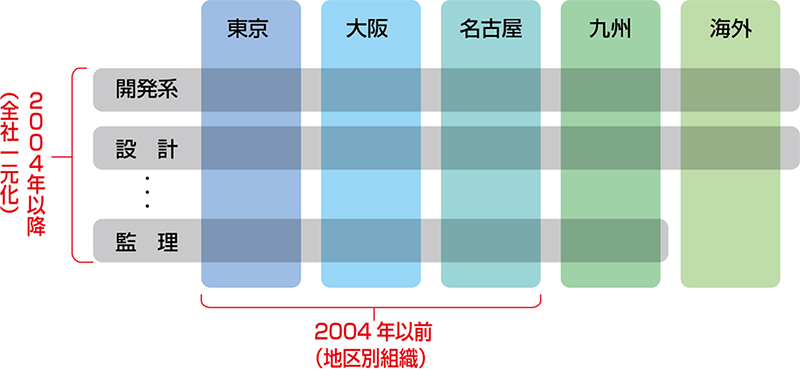 8-26 Organizational Restructuring to Establish a Company-Wide Unified System Heisei 16 (2004)
Group Management as the Nikken Group
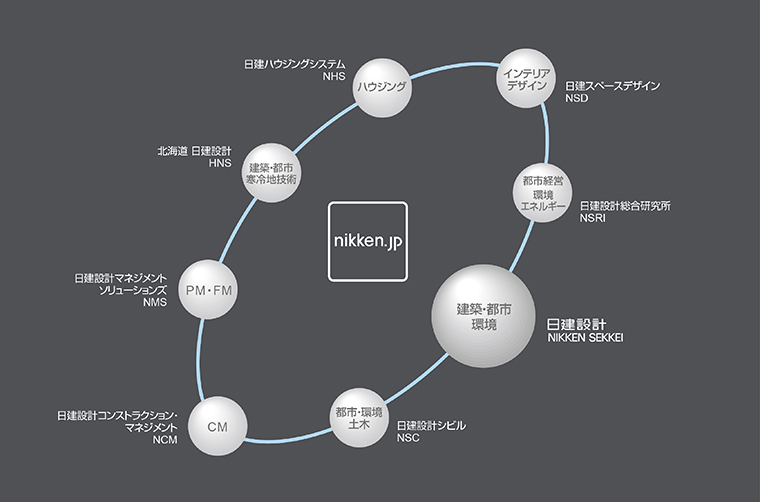 8-27 Nikken Group Organization Chart (as of 2014)
In a 1992 internal report in which we (Nikken Sekkei) asked ourselves, “Who are we?” and “Where are we headed?”, a clear vision was established: “A group of professionals pioneering the cutting edge of social environment design” (Issue No. 7). That report set forth three goals, with “Expanding and Advancing the Scope of Design Services” listed as the first. Subsequently, to become a corporate group capable of contributing as consultants—from both the “hard” and “soft” perspectives—to the creation of architecture, cities, and the environment within Japan’s increasingly diverse and sophisticated society, we established the Nikken Group by 2006, comprising Nikken Sekkei and seven group companies. Today, the Nikken Group’s activities extend beyond Japan to overseas markets as well.
- Founded in 1956, Hokkaido Nikken Sekkei (HNS) has continued to create environments rooted in the people and climate of Hokkaido, drawing on its expertise in architecture and urban planning for cold climates.
- Founded in 1970, Nikken Housing Systems (NHS) has built up a strong track record in the construction of facilities where people come together to live.
- Founded in 1994, Nikken Space Design (NSD) is a diverse group of professionals comprising more than 70 designers and creators active in a wide range of interior design fields.
- In 2001, Nikken Sekkei Civil (NSC) was spun off as an independent company, taking over the civil engineering division of Nikken Sekkei. Building on its civil engineering expertise, the company is active in the fields of urban infrastructure development and urban planning, not only in Japan but also overseas in countries such as China and Vietnam.
- Also in 2001, Nikken Sekkei Management Solutions (NMS) was established, and the company has continued to provide consulting services aimed at maximizing the value of corporate real estate assets and enhancing intellectual productivity by accommodating the diverse work styles of office workers.
- In 2005, Nikken Sekkei Construction Management (NCM) was established. Against the backdrop of increasingly complex construction project structures and a growing need for transparency in decision-making processes, it has become Japan’s largest construction management firm, providing expert support to project owners.
- Then, in 2006, the Nikken Sekkei Research Institute (NSRI) was established with the goal of “building a sustainable society.” The institute continues to provide consulting services that integrate urban design with environmental engineering, and is active not only in Japan—where it takes on projects commissioned by both the public and private sectors—but also overseas in countries such as China and Vietnam.
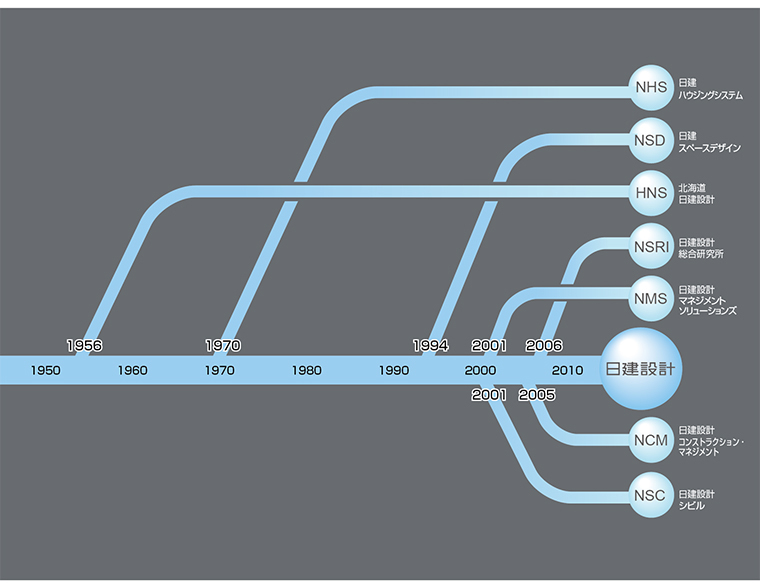 8-28 Nikken Group (as of 2014)
(References)
Wikipedia, “Ranking of Metropolitan Areas by Population Worldwide”
Wikipedia, “Ranking of Metropolitan Areas by Population Worldwide”