

10-3: Toward Sustainable Cities—The Development of the Yujiapu Financial District in Tianjin, China, and “Tokyo Midtown”—
Social studies textbooks used by children around 1965 stated, “The total population of this Earth we live on is approximately 3.5 billion.” Forty-six years later, in 2011, news reports stated, “According to a United Nations announcement, the world population has surpassed 7 billion.”In less than half a century, the world’s total population had doubled. The United Nations publishes annual reports on the world population and also provides projections on urban population trends.It is projected that the urban population—which stood at 732 million, or 29 percent of the world’s total population, in 1950—will reach 3.2 billion, or 49 percent of the world’s total population, by 2005, and 4.9 billion, or 60 percent of the world’s total population, by 2030.Furthermore, it is projected that by 2050, more than 6 billion people—two-thirds of the world’s population—will live in cities or towns. Sustainable planning in urban areas is becoming increasingly important.
Development of the Yujiapu Financial District in Tianjin, China
In China, despite the government’s institutional efforts to control the flow of people from rural to urban areas, the concentration of the population in cities shows no signs of stopping. Some projections estimate that China’s urbanization rate will reach approximately 73 percent by 2050, and it appears that urbanization is proceeding at a pace that exceeds the global average in this densely populated country.There are also concerns about the negative global impacts of this trend.
Amid these circumstances, the Nikken Group has joined an urban development project in Tianjin, led by a Chinese state-owned enterprise, as a consultant for “low-carbon city and building development,” and is currently taking comprehensive responsibility for measures to reduce environmental impact.
We are moving forward by formulating concrete solutions to various challenges, including reducing regional and building energy consumption; creating systems to utilize untapped and recycled energy; developing green spaces that promote biodiversity and create “cool spots”; achieving a waste recovery rate of 80% or higher; and reducing CO₂ emissions.
When we applied temperature and airflow simulations to these proposed solutions, the results showed that, during the daytime in August, we could create a wide area where temperatures would be approximately 2°C lower compared to the original plan prior to implementing these solutions. The figure below illustrates this.
This world-first initiative to realize a low-carbon CBD (Central Business District) has been selected as the first project under the “Low-Carbon Model City Project” of the Asia-Pacific Economic Cooperation (APEC).
Amid these circumstances, the Nikken Group has joined an urban development project in Tianjin, led by a Chinese state-owned enterprise, as a consultant for “low-carbon city and building development,” and is currently taking comprehensive responsibility for measures to reduce environmental impact.
We are moving forward by formulating concrete solutions to various challenges, including reducing regional and building energy consumption; creating systems to utilize untapped and recycled energy; developing green spaces that promote biodiversity and create “cool spots”; achieving a waste recovery rate of 80% or higher; and reducing CO₂ emissions.
When we applied temperature and airflow simulations to these proposed solutions, the results showed that, during the daytime in August, we could create a wide area where temperatures would be approximately 2°C lower compared to the original plan prior to implementing these solutions. The figure below illustrates this.
This world-first initiative to realize a low-carbon CBD (Central Business District) has been selected as the first project under the “Low-Carbon Model City Project” of the Asia-Pacific Economic Cooperation (APEC).
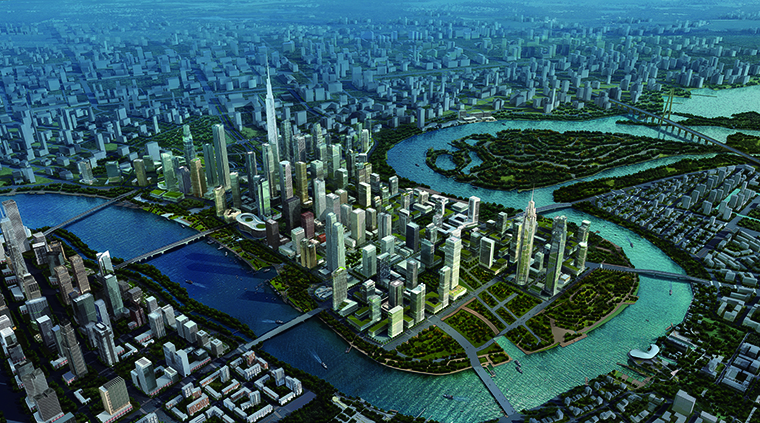 10-12 Development of the Yujiapu Financial District
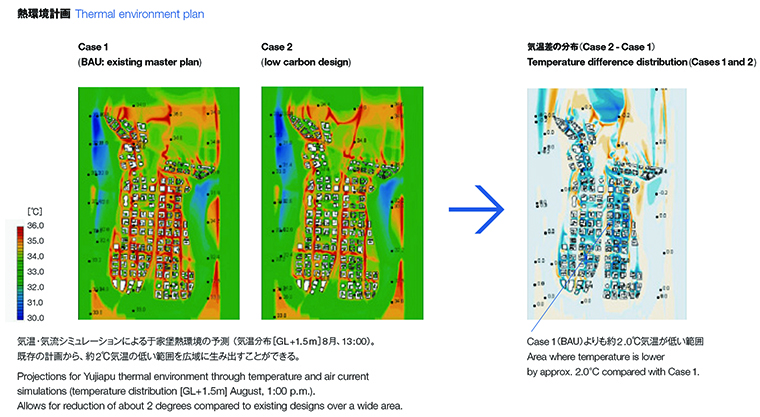 10-13 Thermal Environment Plan for the Development of the Yujia堡 Financial District
Smart Urban Development in Tokyo: Tokyo Midtown
In recent years in Tokyo, there has been an increase in heatstroke cases due to the rising number of tropical nights, as well as a rise in localized torrential downpours within the city. The primary causes cited include a decrease in green spaces, an increase in the area covered by materials that easily trap heat—such as paved surfaces and building facades—and a rise in artificial heat emissions from vehicles and buildings.
Furthermore, small and medium-sized buildings are densely clustered together, and each building consumes energy inefficiently and releases waste heat in a disorganized manner. As Tokyo has become a major global metropolis, there is a need to consolidate urban functions and secure large-scale green spaces.
Furthermore, small and medium-sized buildings are densely clustered together, and each building consumes energy inefficiently and releases waste heat in a disorganized manner. As Tokyo has become a major global metropolis, there is a need to consolidate urban functions and secure large-scale green spaces.
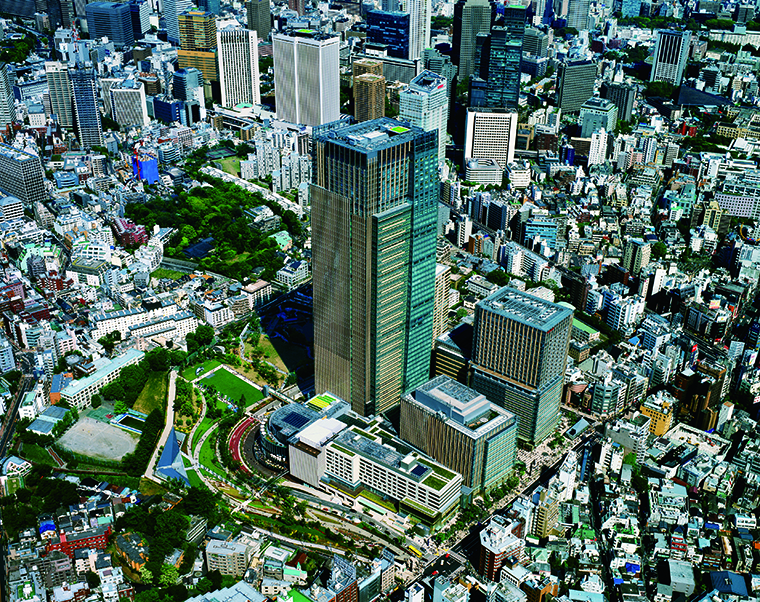 10-14 Tokyo Midtown Heisei 19 (2007)
Tokyo Midtown Opened in 2007, it is a concentrated urban mixed-use complex with a total floor area of 560,000 square meters, comprising a shopping center, offices, a hotel, an art museum, and apartment buildings, all located within a 10.2-hectare planned district.The large-scale green space created by consolidating urban functions generates significant airflow within the densely populated urban area through its cooling effect. This green space has become a vital part of the green belt stretching from Aoyama through Roppongi to Akasaka, playing a key role in mitigating the urban heat island effect in Tokyo.
In terms of energy supply, we have implemented a “district heating and cooling system” that centrally supplies heat sources such as hot water, cold water, and steam, creating a highly efficient heat supply system that minimizes heat distribution losses through various measures.In addition, a cogeneration system has been installed as an on-site power generation solution. This system not only supplies electricity but also promotes the efficient use of energy by utilizing the waste heat generated during power generation for heating and cooling. A “water thermal storage system” has also been adopted, which uses off-peak electricity to cool water and store it in a thermal storage layer, allowing that cooled water to be used during the day.
-
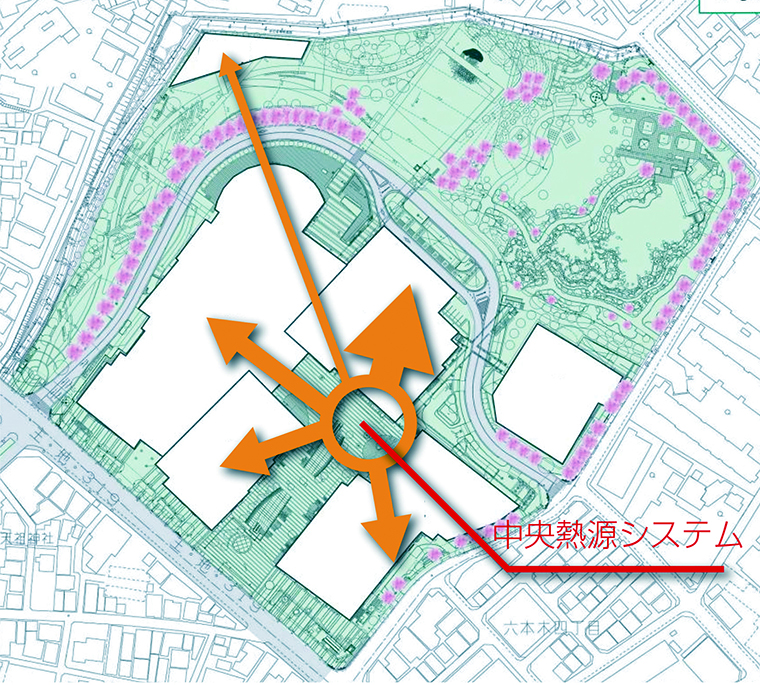 10-15 Energy Supply Area
-
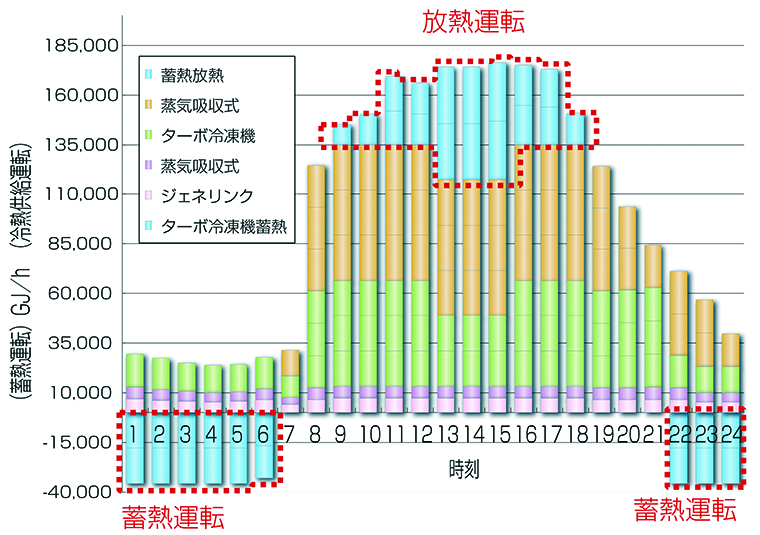 10-16 Operating Patterns by Time of Day
-
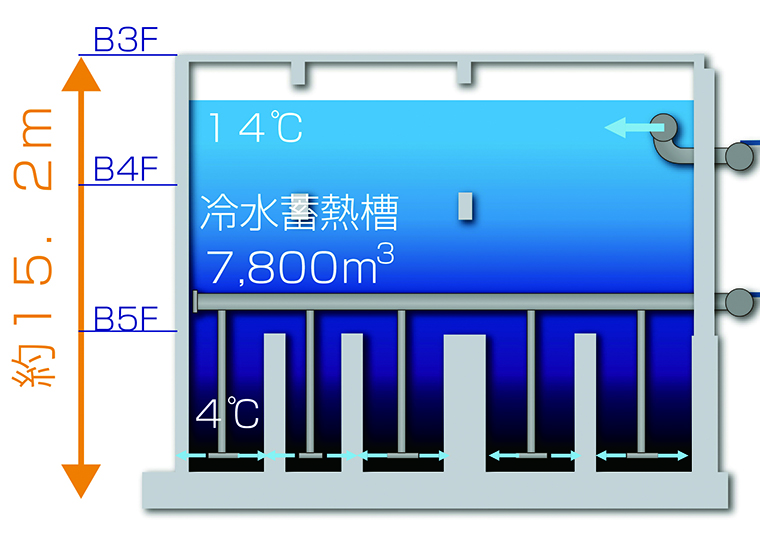 10-17: Schematic Diagram of a Cold Water Thermal Storage Tank
I’ve introduced two initiatives aimed at creating sustainable cities, but in order to tackle this issue on a broader scale, we’ll need to build social commitment to sustainability and establish a new economic system that supports environmentally friendly businesses. Recently, it seems that many people are beginning to realize that “what’s truly needed is a shift in people’s lifestyles and values.”
(References)
Wikipedia, United Nations, World Urbanization Prospects Report
Mitsui Fudosan Tokyo Midtown Website
Shinji Yamamura (2007), “Urban Green Environments and the Urban Heat Island Effect,” *Nikken Sekkei Quarterly Spring*, Nikken Sekkei
Shuji Moriyama (2009), *Nikken Sekkei Quarterly Summer*, “Improving the Efficiency of Urban Functions Through Consolidation and Ensuring Safety and Security,” Nikken Sekkei
Wikipedia, United Nations, World Urbanization Prospects Report
Mitsui Fudosan Tokyo Midtown Website
Shinji Yamamura (2007), “Urban Green Environments and the Urban Heat Island Effect,” *Nikken Sekkei Quarterly Spring*, Nikken Sekkei
Shuji Moriyama (2009), *Nikken Sekkei Quarterly Summer*, “Improving the Efficiency of Urban Functions Through Consolidation and Ensuring Safety and Security,” Nikken Sekkei
Source
10-12—Courtesy of Tianjin New Financial Investment Co., Ltd.
10-14 Photo by: Kawasumi・Kobayashi Kenji Photograph Office
10-12—Courtesy of Tianjin New Financial Investment Co., Ltd.
10-14 Photo by: Kawasumi・Kobayashi Kenji Photograph Office