
Bringing greenery back into our daily lives through urban and regional design. “Nikken Green Initiative”

Scroll Down

At Nikken Sekkei, we believe that it is necessary to actively adopt a Nature Based Solutions approach, which solves problems by integrating landscape, cities, infrastructure and architecture. To help urban dwellers reconnect with nature, we have set specific goals that make use of the Nikken Group's areas of expertise under the theme of “Green Recovery,” and have started research titled “Nikken Green Initiative” (NGI). Here, we will introduce this research, which is intended to become an initiative for the realization of a society in which everyone can enjoy rich nature.

CATEGORY

Why is it necessary to recover greenery in cities now?

Global warming, the heat island effect, sudden heavy rain and flooding, ecosystem destruction, water pollution, air pollution—in order to solve global environmental issues, the Paris Agreement of 2020 set a goal of achieving “carbon neutrality” by 2050, which means reducing greenhouse gas emissions to virtually zero. Additionally, the 2021 G7 Summit set the goal of “30 by 30,” which means preserving more than 30% of the national land as natural environment areas by 2030.

Furthermore, even though cities cover only 2% of the Earth's surface, they are said to be responsible for 78% of greenhouse gas emissions. Even if one is not an expert in urban planning, most people probably have a sense that it is more pleasant to have greenery around them. With 70% of the world's population expected to live in cities by 2050, the importance of greenery is increasing from the perspective of the well-being of the people living there.
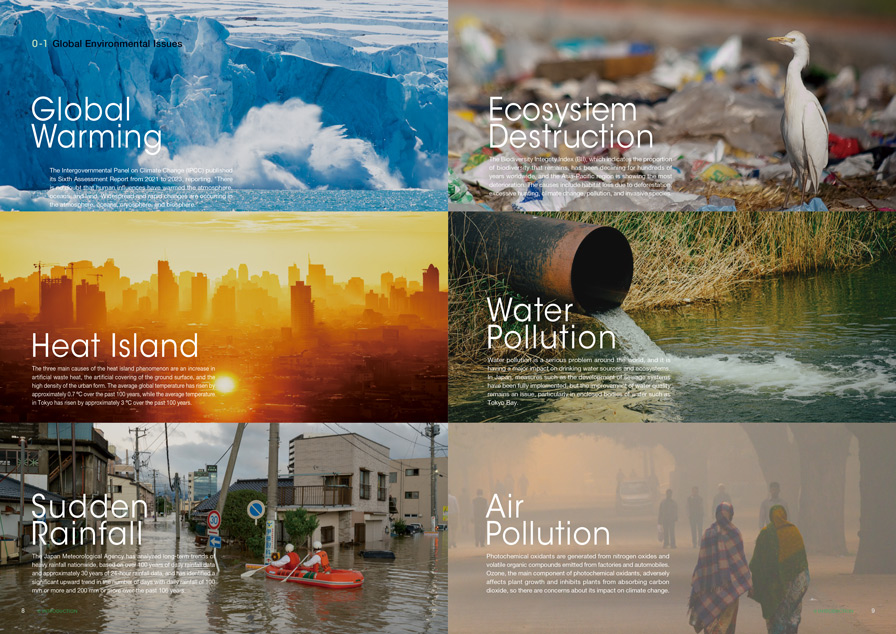
Global Environmental Issues

In Japan too, urban development that began during the period of rapid economic growth has resulted in the surface of the land being covered in asphalt and concrete, and over the last few decades, much of the green has disappeared. In addition, Japan is an “issue-oriented country” that faces issues such as a declining population, low birthrate and aging population, and aging infrastructure.

The reason we at Nikken Sekkei started research forNGI was that we felt a sense of crisis: if we don't recover the greenery urgently, the appeal of the city itself would be lost. The question is, “How do we recover greenery while maintaining the functions of the city (HOW), and what kind of greenery do we recover (WHAT)?” We believe that the raison d'être of landscape architects in society is to connect the HOW and WHAT and to quantify and visualize the value of greenery, so we took over three years to put together this NGI.

From here, we will introduce the three goals that we have set at NGI, in order.
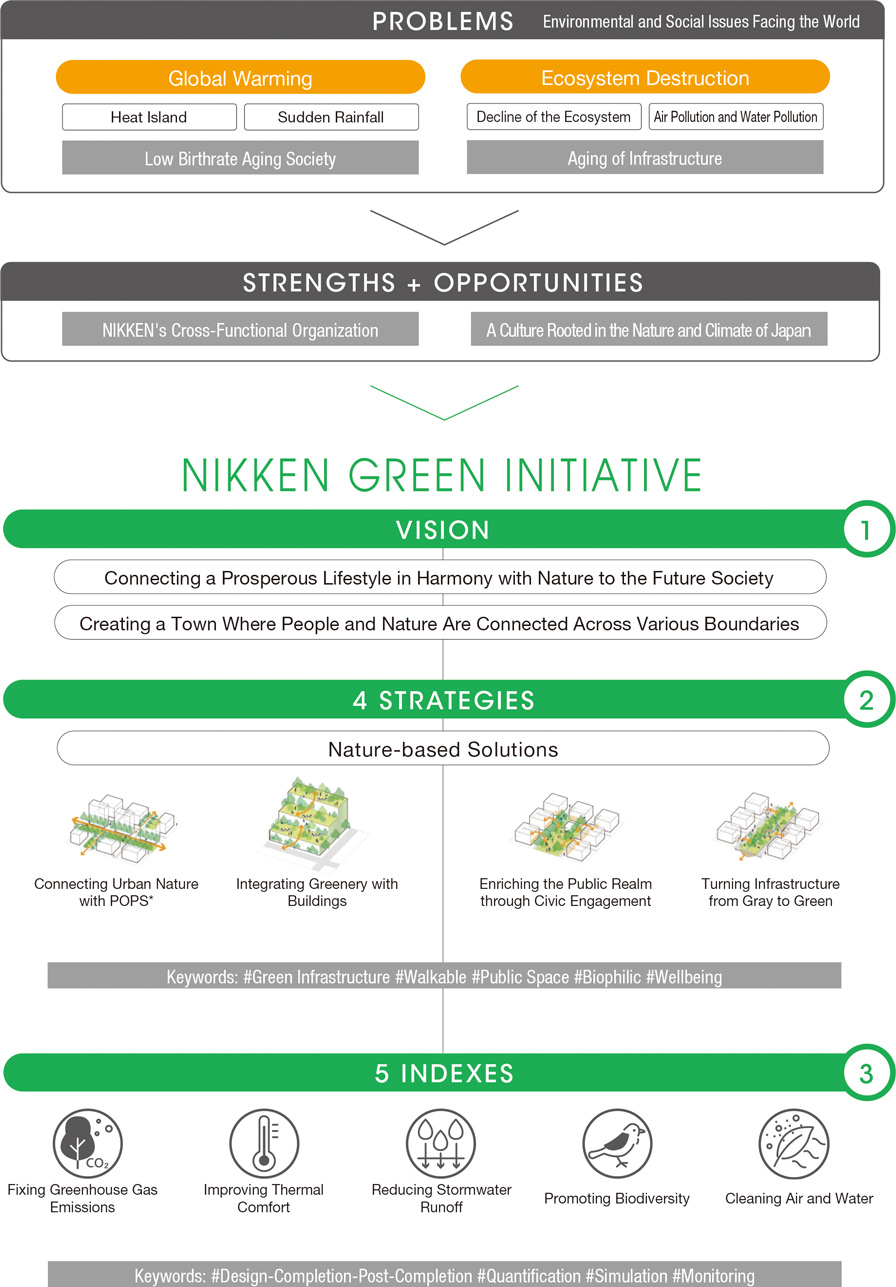
Three Goals of NGI

1 NIKKEN's Vision for Green Cities
Recovering greenery while maintaining and updating social, economic, cultural and urban functions
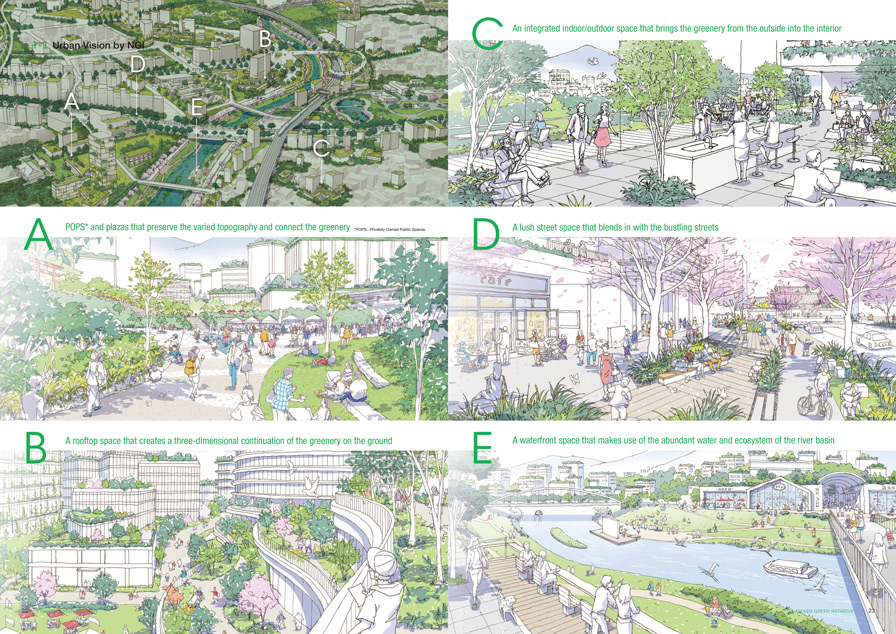
When we began our research for NGI, the first thing we tried to envision was an image of the kind of nature-friendly city that Nikken Sekkei was aiming to achieve. This illustration incorporates five scenes: 1. Privately owned public spaces(POPS) and plazas that preserve the varied topography and connect the greenery; 2. A rooftop space that creates a three-dimensional continuation of the greenery on the ground; 3. An integrated indoor/outdoor space that brings the greenery from the outside into the interior; 4. A lush street space that blends in with the bustling streets; and 5. A waterfront space that makes use of the abundant water and ecosystem of the river basin.

Urban Vision by NGI

Two-thirds of Japan's land area is covered in forest, and the country boasts one of the world's highest levels of biodiversity. In the Edo period (1603-1868), Japan was able to provide for almost all of its own needs in terms of goods and energy, and a society was fostered in which cities and rural areas worked together in a recycling-oriented, locally produced and locally consumed system.

The basic strategy for revitalizing Japan's traditional characteristics and local natural resources is to open up, connect and expand the greenery. We thought it was important to revitalize the greenery through individual developments and projects, and to “connect the dots” by opening it up to the surrounding environment, and to expand it as a “surface” across the region and the entire city.
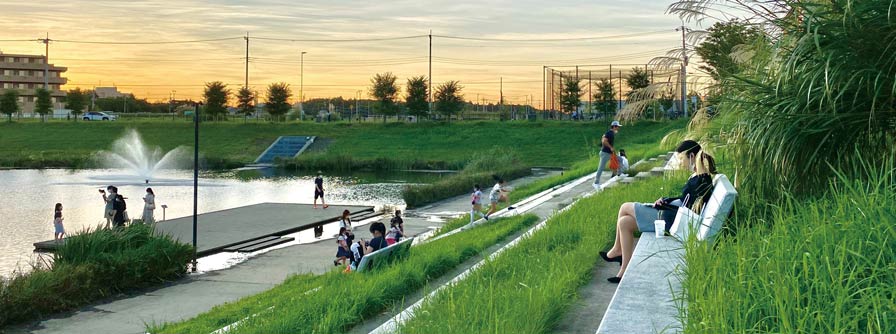
Case by Turning Infrastructure from Gray to Green: Kashiwanoha Aqua Terrace©forward stroke inc.

2 Strategies for Bringing Nature Back to Cities
Four approaches that fuse landscape architecture, civil engineering, and architecture
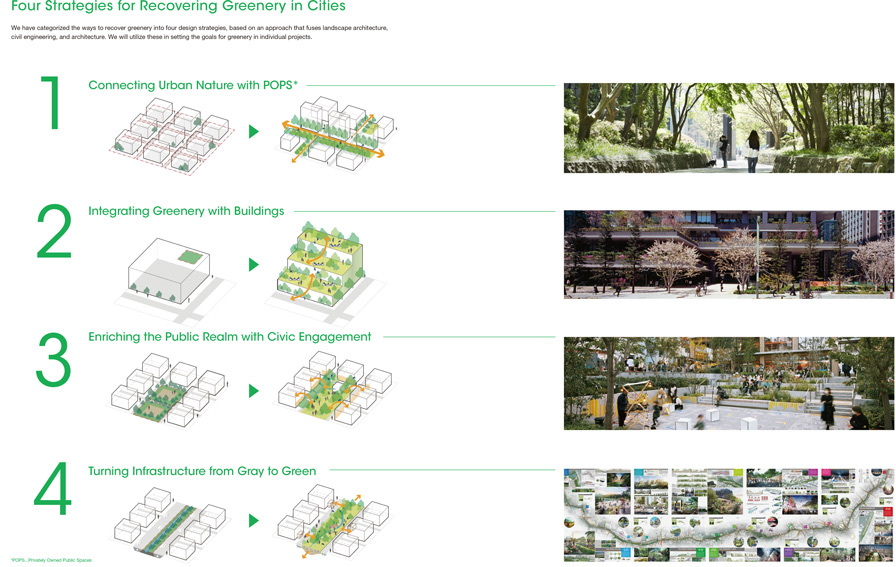
So, how exactly should we go about recovering the greenery? This corresponds to the “HOW” mentioned above, and NGI has categorized the methods using an approach that fuses landscape, infrastructure and architecture into four design strategies.

Four Strategies for Recovering the Greenery
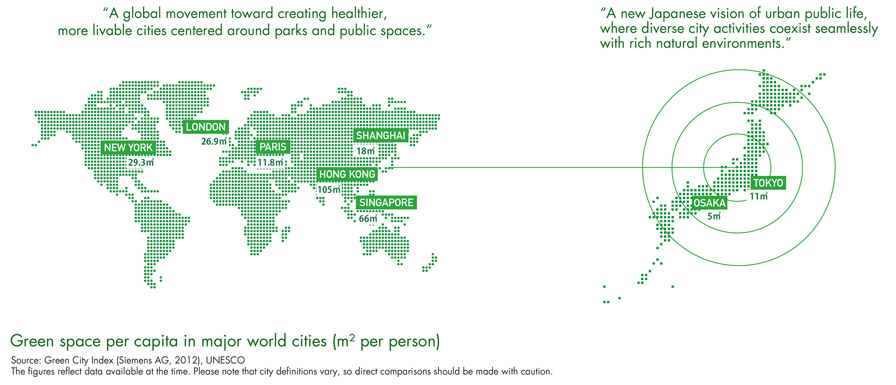
The state of Japan's green spaces from a global perspective

It is said that Tokyo and other Japanese cities have less green space for public use than major cities around the world. Even with private development, if the first item, “1. Connecting Urban Nature with POPS,” is not done, then continuous, rich green spaces will not be created within the city.

In addition to public open spaces, it is also important to create three-dimensional greenery through rooftop and indoor greening, etc., to achieve the second and third items, “2. Integrating Greenery with Buildings” and “3. Enriching the Public Realm with Civic Engagement.” This is because various people become involved in the area and diverse activities are born, which in turn connects the greenery with the city. Furthermore, it is also important to carry out the fourth item, “4. Turning Infrastructure from Gray to Green.” Converting “grey infrastructure” like railway sites and road spaces that have served their purpose into public space that will have a significant impact on the city.

NGI introduces projects that Nikken Sekkei has worked on in Japan and overseas, divided into these four design strategies.
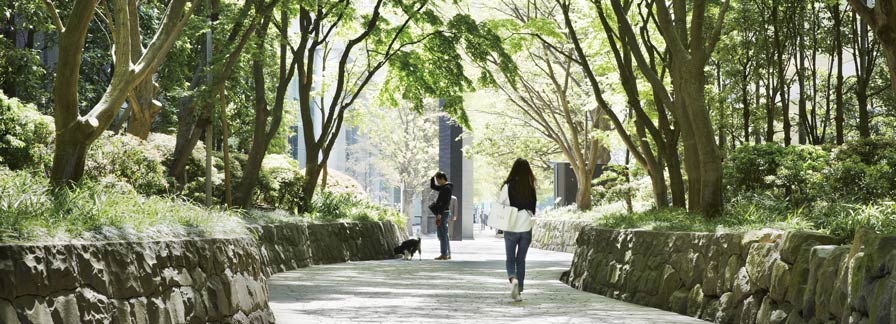
Case of Connecting Urban Nature with POPSI-GARDEN AIR©forward stroke inc.

3 Evidence Based Planning + Design
The “Green Metric” — five indexes for quantifying and visualizing values
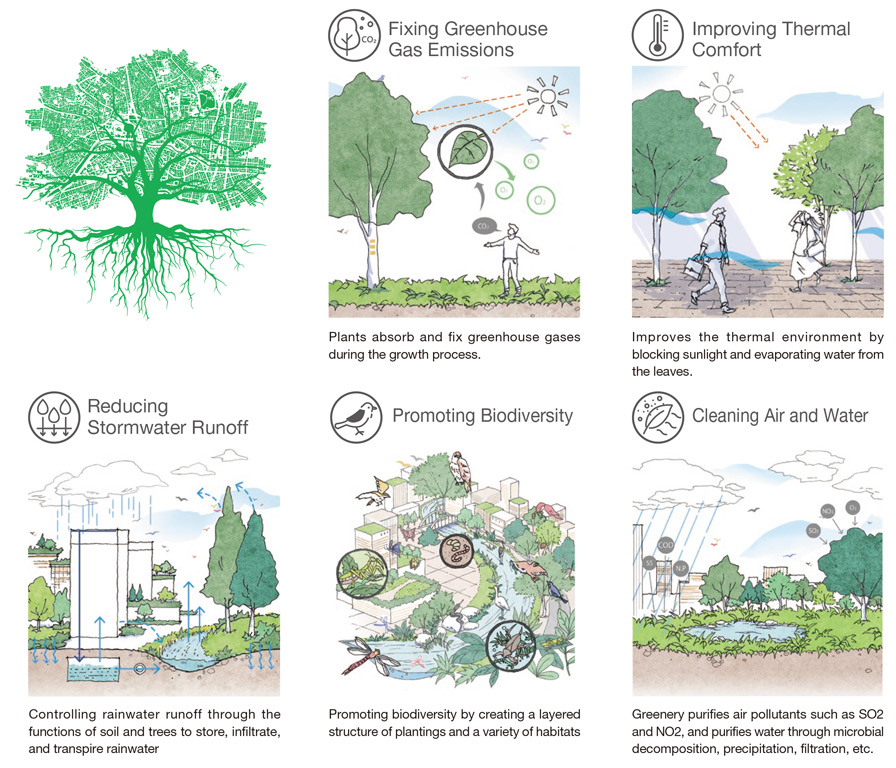
Next, we need to consider what kind of greenery we should be recovering. The value of greenery includes both social value, such as increased productivity and community building, and economic value, such as increased land and real estate value and strengthened urban competitiveness. NGI focuses on the environmental value that forms the basis of these other values. In order to quantify and visualize these, we have formulated the “Green Metric” which is made up of five indexes: 1. Fixing Greenhouse Gas Emissions, 2. Improving Thermal Comfort, 3. Reducing Stormwater Runoff, 4. Promoting Biodiversity and 5. Cleaning Air and Water.

“Green Metric” Items for Evaluating the Environmental Value of Greenery.

Creation of High-Quality Green Spaces

The important thing to remember is that even if two areas have the same 100 square meters of greenery, their environmental value is not the same. A simple lawn area will not fix carbon dioxide, and it will not have sufficient capacity to absorb rainwater. By ensuring a sufficient thickness of soil and creating a layered structure of plants, we can enhance their individual functions. Rather than just creating green space, we aim to create “high-quality greenery” that contributes to the environment.

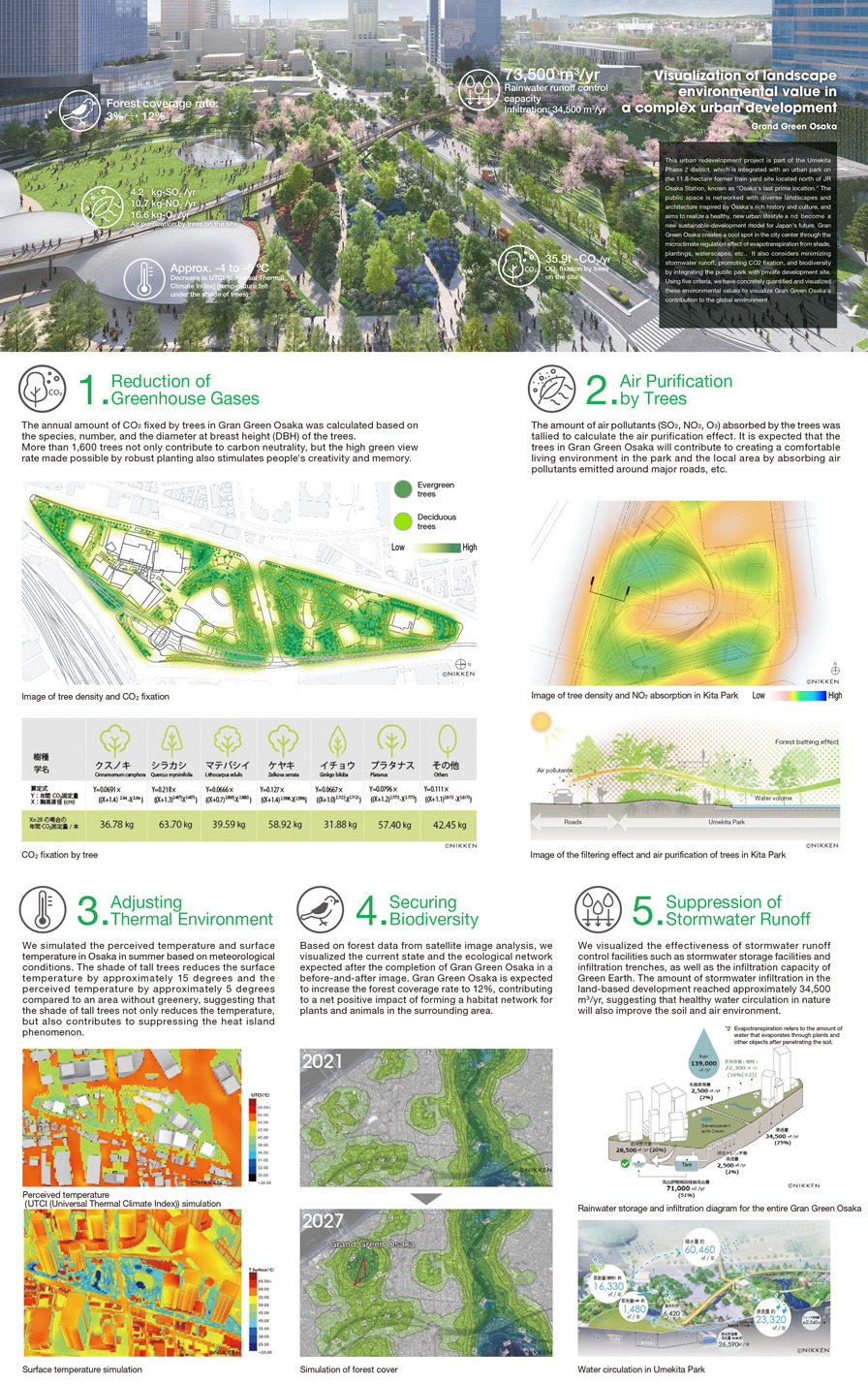
Visualization of Environmental Value at Grand Green Osaka
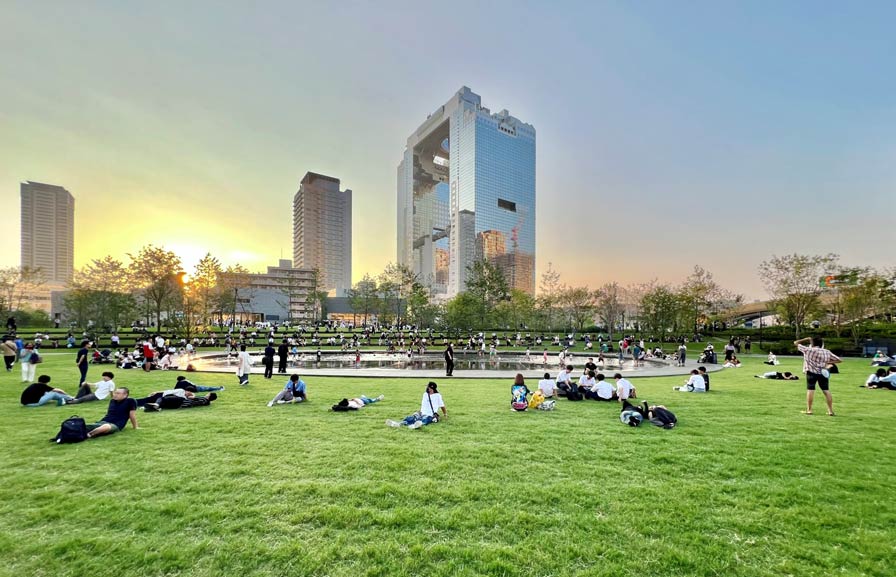
At Grand Green Osaka, which was completed in 2024 they are using this “Green Metric” to measure how much the greenery created by the development is contributing to the environment. In addition, TOKYO MIDTOWN conducted a survey on the amount of carbon dioxide fixed in 2021, 14 years after it was completed. As you can see, one of the features of the Green Metric is that it can be used to quantify the value of greenery at not only the time of design and construction, but also 10 or 20 years later, when the greenery has grown. The need to visualize the value of greenery is increasing year by year.

An Example of creating a Lush Public Space in front of a Terminal Station, Grand Green Osaka @ Nikken Sekkei

Creating a movement and presenting a new platform for the environmental age to the world
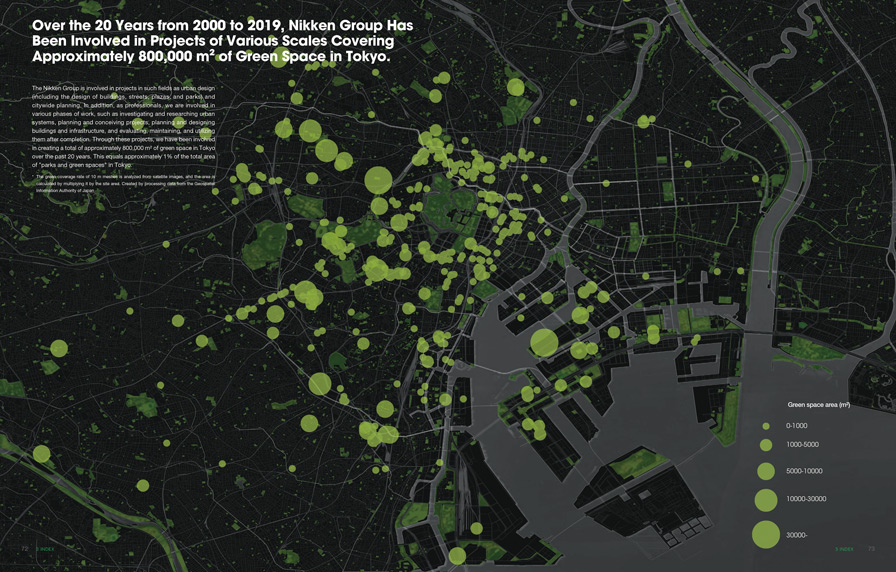
Nikken Sekkei employs professionals in a range of fields, including landscaping, civil engineering, urban planning and architecture, and each of these professionals is involved in projects while working across their specialist fields. The scale of the projects we handle also varies widely, from product design (e.g., benches) to the formulation of master plans on a national scale, and over the 20 years from 2000 through 2019, we have been involved in projects for approx. 800,000 m² of green space in Tokyo. This is approx. 1% of the total “parks and green spaces” area of Tokyo.

Amount of Greening in Tokyo over the Past 20 Years in Which Nikken Sekkei Has Been Involved

In urban design, it used to be common to think that architecture was the main focus and landscaping was secondary, but in the last 10 years or so, with the rise in public interest in public spaces, landscape design has taken center stage. No matter how attractive the architecture is, it is meaningless if it does not spread out into the city. To achieve this, it is not enough to think in terms of individual sites, but rather it is necessary to transcend various “boundaries.” The strength of landscaping lies in its ability to connect individual projects with the city.

The “Nikken Green Initiative” is just a starting point. Also, what the research team of NGI can do is limited. The team hopes “create a movement to re-recognize the value of greenery.” It is important that initiatives like this become a starting point for discussion among various stakeholders, and eventually spread as a shared sense of value.

By making use of the “Green Metric,” we will work with various development companies and experts to create a database of each project. We will also carry out simulations on an urban scale to clarify the effects of increasing greenery. We hope that NGI, which is being developed in Japan, an issue-oriented country, will become a new platform for the environmental era that can contribute to cities around the world that are currently undergoing development.
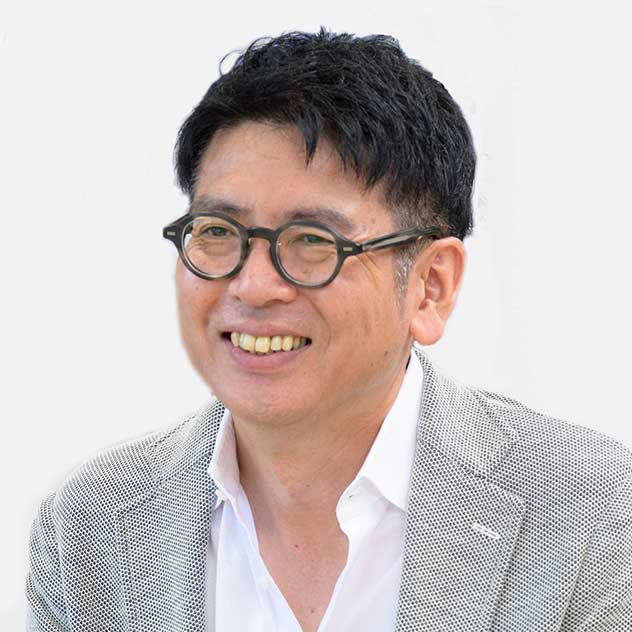
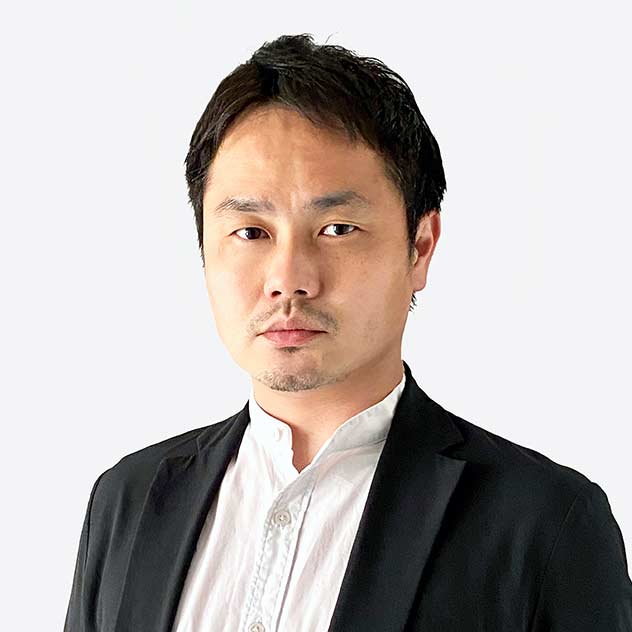
  • Yoshiaki Komatsu

    Yoshiaki Komatsu

    Executive Officer
    Principal, Landscape Design Group, Urban and Civil Project Department

    Since joining Nikken Sekkei, Yoshiaki Komatsu has actively participated in landscape design projects for offices, educational facilities, hotels, commercial complexes, etc., as well as environmental architecture that utilize specialized greening techniques and biophilic design projects. He strives to create landscapes unique to each region and location, working to develop pleasant spaces that enrich people's lives. He is a recipient of numerous landscape and environmental awards, including the IFLA AAPME Award, the Japan Institute of Landscape Architects Award, and the Good Design Award. He is a certified engineer, Registered Landscape Architect (RLA), and a certified arborist. He also lends his time as a part-time lecturer at Kindai University, and as a design workshop instructor at Osaka Metropolitan University.

  • Shoji Kaneko

    Shoji Kaneko

    Landscape Architect
    General Manager
    Urban Design and Planning Group
    Urban and Civil Project Department

    Shoji Kaneko is an urban designer and landscape architect graduated from the Kyoto Institute of Technology (B.Arch) and University of Washington (MLA). Prior to joining Nikken in 2012, he was trained for a decade in the United States. In recent years, he has led a wide range of projects in Japan and abroad, such as the Rail Corridor in Singapore, Kashiwanoha Aqua Terrace, and Takanawa Gateway City. He works to create sustainable cities, public spaces, and landscapes through interdisciplinary design, integrating the fields of urban design, architecture, landscape, and civil engineering. He has received awards from the Japan Institute of Landscape Architecture (JILA) (in the works category) and the Civil Engineering Design Prize of the Japan Society of Civil Engineers (JSCE), among others. He is a director of the Japan Landscape Architects Union (JLAU), and a visiting professor at Ritsumeikan University.

This website uses cookies. By continuing to use this website, you agree to the use of cookies. Our cookie policy.