
A new urban development based on a “landscape first” approach
Umekita Phase 2 District Development Project “Grand Green Osaka”

Scroll Down

Following on from the development of the Grand Front Osaka area on the north side of JR Osaka Station, the largest terminal station in western Japan, the second phase of the Umekita development, Grand Green Osaka, is now under way.
This project will create an integrated development of offices, commercial facilities, hotels and residential properties, centered on Umekita Park, one ofthe world's largest urban park directly connected to a large-scale terminal station. The development of Grand Green Osaka alone covers 9.1 hectares, and the entire Umekita Phase 2 area of approx. 11.8 ha, including the surrounding roads that have been developed this time, is being developed with a “landscape first” approach. We will introduce the progress made so far, focusing on the landscape initiatives for this project, which had its preliminary opening on September 6, 2024.

CATEGORY
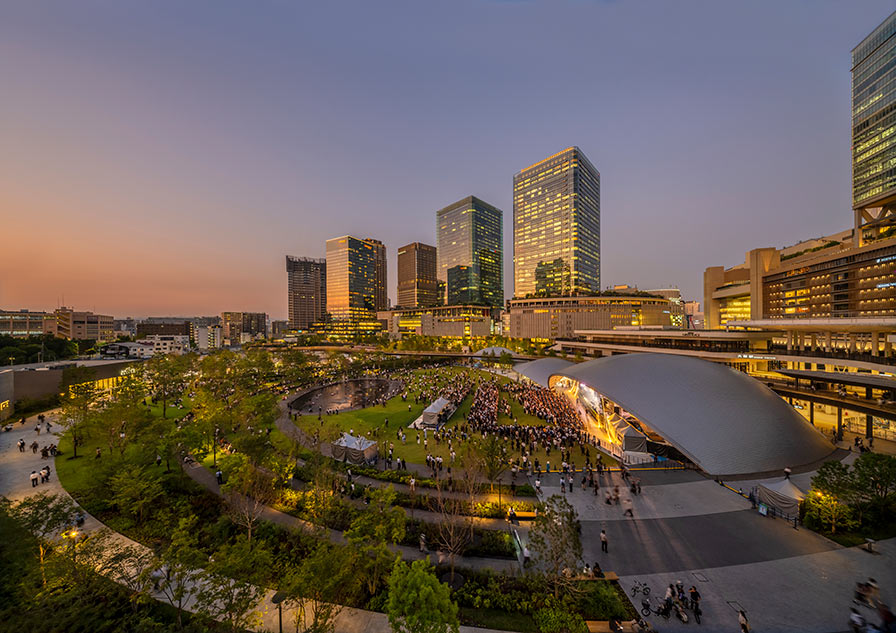
The 1st phase of Grand Green Osaka, Umekita Park South Park (Evening Scene) ©Akira Ito (aifoto)

“Osaka MIDORI LIFE” creates a natural, open space in the center of a city.
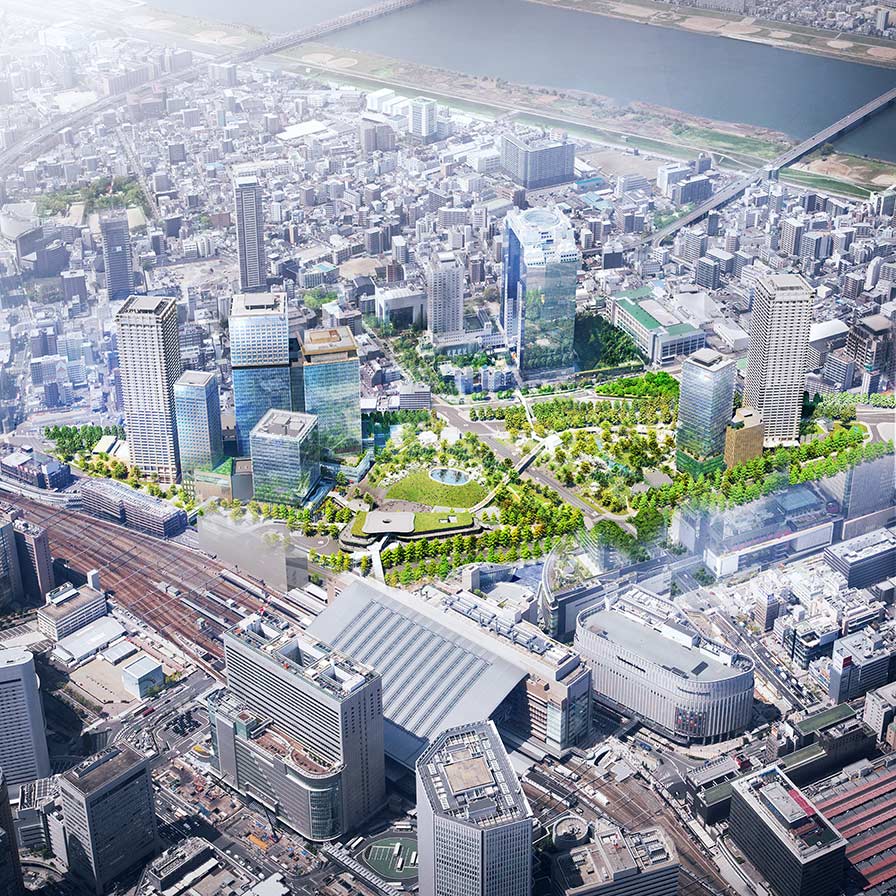
Development of the Umekita district began in 2002. In 2013, the area designated for early development opened as “Grand Front Osaka,” and the following year, a private sector proposal (first round) was made for the second phase of development, which is located to the west of the first phase. The idea that emerged from this was to develop the area, including the surrounding areas such as the advanced development zone, as a public space that would become the core of the Osaka city center. This idea was realized in 2017 by the development company as an urban vision called “Osaka MIDORI LIFE,” and landscape-first development was launched with the aim of creating a lush, open space that is accessible to all, welcoming to everyone, and that fosters range of human activities.

Grand Green Osaka - Complete Image
©Umekita Phase 2 Development Company

In addition to Nikken Sekkei, GGN, Mitsubishi Jisho Sekkei, Takenaka Corporation, Obayashi Corporation, Nikken Housing System, SANAA, Tadao Ando and others were involved in the design of Grand Green Osaka. It was a very complex scheme that requires the development of various facilities, including commercial and residential buildings, in addition to the urban park divided into north and south. For this reason, the world-renowned landscape design firm GGN was given the lead on the design, and Nikken Sekkei was responsible for the landscape design of the majority of the park, private land, roads, etc. Three workshops were held where all the relevant parties gathered to discuss and resolve various issues.

In particular, in collaboration with GGN, thorough research was conducted into the history and culture of the area, with the aim of achieving a design that was both distinctly Japanese and unique to Umekita. The landscape concept that emerged from this was “the naturally rich and fertile land of Osaka,” and the Japanese-ness and Umekita-ness of the area were sublimated down to the smallest details of the landscape design. The area around Umekita was once a rich and fertile land where rivers flowed, and a diverse range of living creatures lived. The major goal was to express this vital land across the entire 12-ha area of Umekita.

A large-scale urban park directly connected to a major terminal station, spreading across an invisible boundary

The concept for Grand Green Osaka was a large-scale green space that would be integrated with the urban park and Nishiguchi Square of Umeda Station. The aim was to create an urban space that would be open to the surrounding area by creating a total of 8 ha of “midori” (greenery)* in the urban park and private housing area and arranging the buildings within it without any visible boundaries. The "Landform, Core, Place and Path" framework was adopted as the landscape planning approach.
*“Midori” (greenery)” refers to public spaces rich in greenery that are open and accessible to everyone.
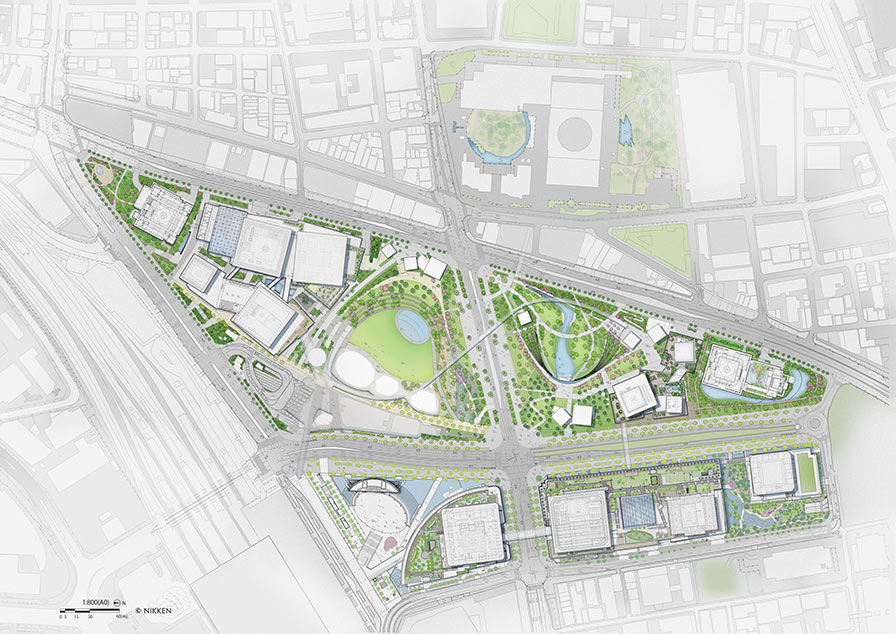
Grand Front Osaka, Grand Green Osaka Master Plan
The site of Grand Green Osaka is made up of a northern and southern area, as well as an urban park that connects the two. In order to integrate these areas as a single space, including the surrounding area, a “landform” with a maximum height difference of 3 m was created, and three “cores” were created by making the most of this shape. Furthermore, the building groups with square volumes that are placed throughout the site without any back sides create “places,” and these diverse spaces are connected by “paths” that form the main traffic routes. This basic planning creates continuity across all areas within the site and its surrounding environment, and forms a community where visitors are naturally drawn into the site, and encounters and discoveries can occur.

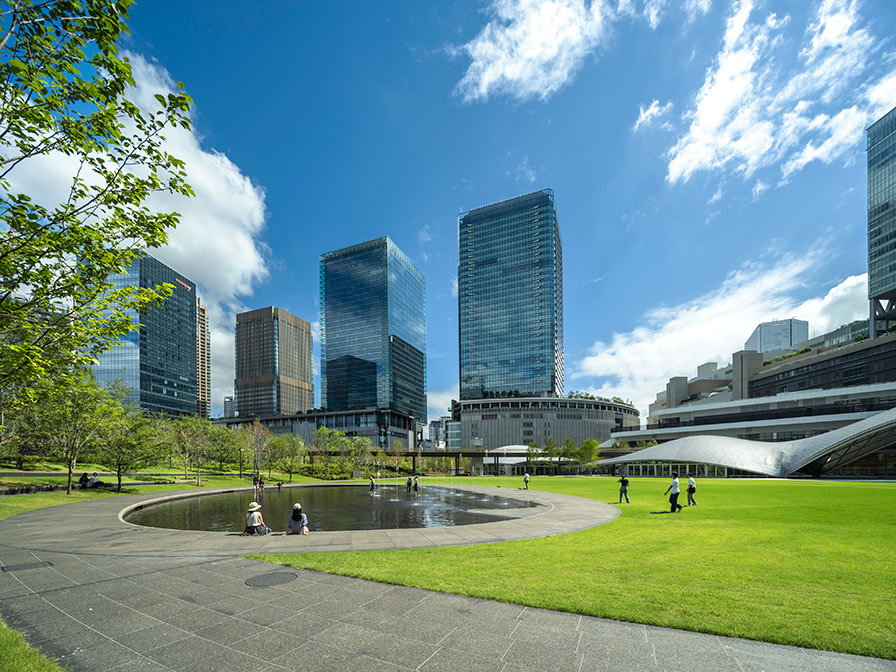
The Water Basin Where People Can Enjoy the Lawn and Fountain of South Park
©Akira Ito (aifoto)
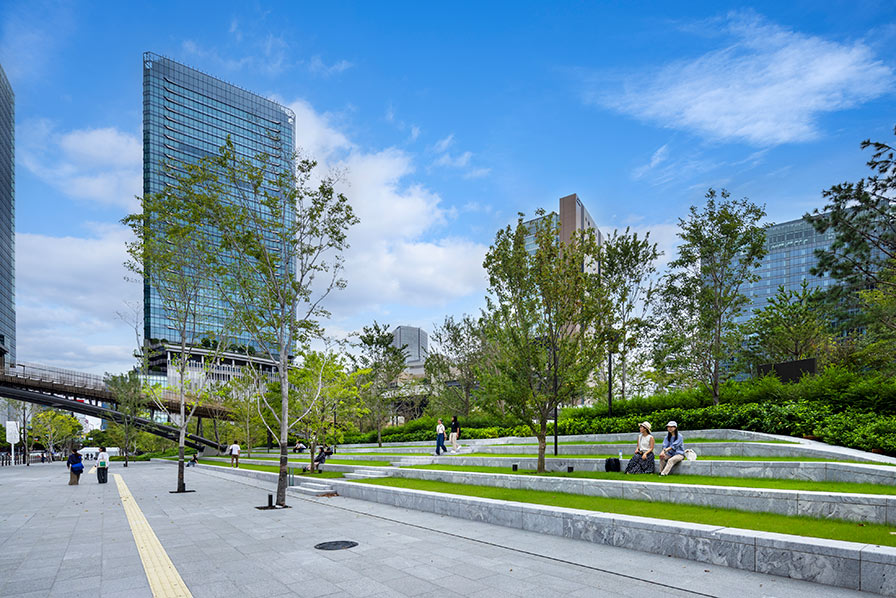
Step Plaza, Which is Integrated with the Walkway Space
©Akira Ito (aifoto)
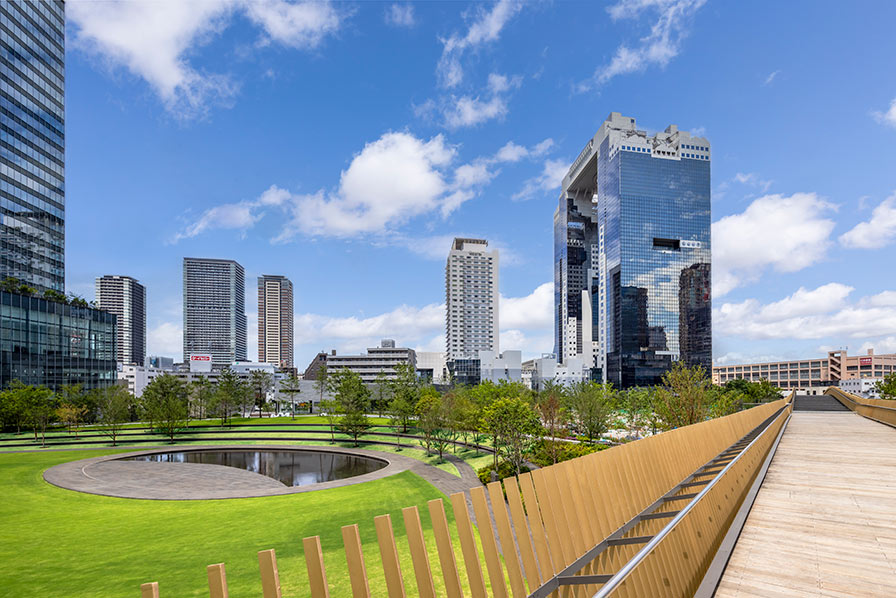
One of the mechanisms that help to achieve this is Hirameki Road (Path of Inspiration). This pedestrian walkway, located on the opposite side of the rise of the “landform,” seamlessly connects the various “places” created by the succession of buildings, as well as the three“core” areas:the Lawn Plaza in South Park, Umekita-no-Mori in North Park, and the Step Plaza,a series of terraced plazas along the road that crosses the north-south district. As people walk along the pedestrian walkway, they will see a variety of different scenes appear and disappear, and the depth and three-dimensionality of the scenery will create a sense of space, allowing everyone to find his or her own personal third place.

View of the Umeda Sky Building from the Hirameki Road in South Park
©Akira Ito (aifoto)

Evaluation and visualization of environmental value using the “Green Metric”

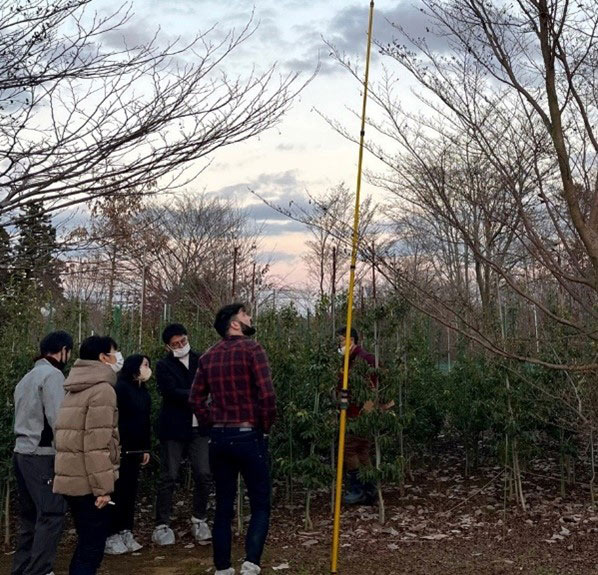
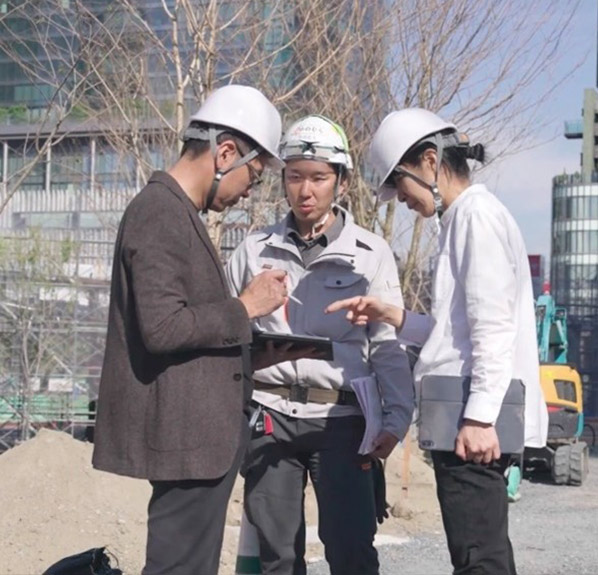
In the landscape design for Grand Green Osaka, of course we also focused on the overall planting plan for the site. The total number of trees planted in the entire district exceeds 1,600. After thorough research into the history, culture and natural environment of Osaka, we worked with GGN to finalize the planting design over the course of more than a year of discussions, and during the construction phase, we visited nurseries all over Japan to select trees that would achieve the ideal shape and coloring. At the same time, we carefully selected native flowering trees in order to create a garden with native species with targedted color scheme.
  • Inspection of Tree Materials

  • On-site Inspection of Tree Planting

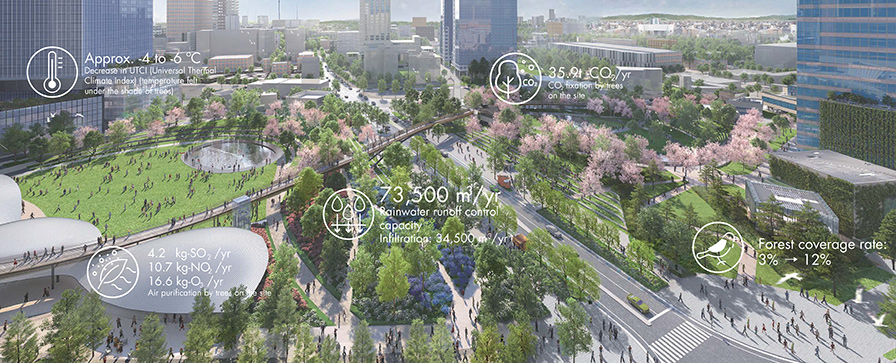
During the design stage, we conducted simulations such as research and analysis of sunlight, wind and pedestrian traffic, as well as detailed research into the impact of the natural environment. In addition, we used our own framework called the " Green Metric" to visualize the environmental value of “greenery,” which is difficult to evaluate quantitatively. We established evaluation methods for five items: “Greenhouse Gas Mitigation,” “Air Purification,” “Thermal Comfort Improvement,” “Biodiversity Improvement,” and “Stormwater Runoff Management.”

Grand Green Osaka: Visualization of Environmental Value Using a Green Metric
©NIKKEN SEKKEI LTD

What this “Green Metric” revealed was the extent of Grand Green Osaka's contribution to the environment. The results of the data collection and simulations showed that the annual fixed amount of CO₂ was 35.9 tons, and the annual absorption of air pollutants was 4.2 kg of SO₂, 10.7 kg of NO₂ and 16.6 kg of O₃. The results also showed a reduction in the perceived summer temperature and the effect of rainwater runoff control. In particular, the forest coverage rate is predicted to increase from 3% to 12%, and it was found that, despite being in a prime location in the city center, it contributes to the creation of an environment where a diverse range of living creatures can live.

The aim of Grand Green Osaka was to create a place in the heart of Osaka where everyone can feel close to nature by integrating private urban development and urban park development. The backbone of this project was a landscape-first master plan that considered the harmony of buildings and spaces based on the concept of open spaces, rather than buildings. From this, both the environmental value created by greenery and a vibrant, creative way of life filled with people's energy will emerge.

Following the 1st phaseopening in September 2024, the full opening is scheduled for 2027. From here on, we will continue to convey the value of “landscape-first” development from Umekita.
■Private land
Design:
Overall supervision Nikken Sekkei, Mitsubishi Jisho Sekkei
North Wing Nikken Sekkei, Takenaka Corporation
South Wing Mitsubishi Jisho Sekkei, Nikken Sekkei, Obayashi Corporation, Takenaka Corporation
Grand Green Osaka
THE NORTH RESIDENCE Takenaka Corporation, Nikken Housing System
South Town Condominium Takenaka Corporation, Nikken Housing System
Landscape:
Design lead GGN
Designer Nikken Sekkei (South Wing: Mitsubishi Jisho Sekkei, Nikken Sekkei)
Supervision:
North Wing Nikken Sekkei
South Wing Mitsubishi Jisho Sekkei, Nikken Sekkei
Grand Green Osaka
THE NORTH RESIDENCE Nikken Housing System
South Town Condominium Nikken Housing System
Construction: Umekita 2nd Phase Joint Venture (Takenaka Corporation, Obayashi Corporation)
■Urban Park
 General Parkland (Main body of development: Osaka City, Urban Renaissance Agency *Upgrade: JV of businesses)
Design:
〇Base grade (public)
Basic design Nikken Sekkei, Mitsubishi Jisho Sekkei
Detailed design Nikken Sekkei
〇Upgrade
Design proposals, etc. JV of businesses
Design lead GGN
Designer Nikken Sekkei
Lighting designer Uchihara Satoshi Design Office
Sign designer Rian Ihara Design Office
Sign project
management MEC Design International
Construction:
Obayashi Corporation, Takenaka Corporation, Takenaka Civil Engineering & Construction Joint Venture
■Park facilities (main contractor: JV of companies)
Design:
〇Overall park facilities (excluding the large roof)
Basic design and detailed design Nikken Sekkei Ltd. * VS. Design supervision: Tadao Ando Architect & Associates
〇Large roof
Basic design and detailed design SANAA Office
Construction: Umekita Phase 2 Joint Venture (Takenaka Corporation and Obayashi Corporation)

  • Yoshiaki Komatsu

    Yoshiaki Komatsu

    Executive Officer
    Principal, Landscape Design Group, Urban and Civil Project Department

    Since joining Nikken Sekkei, Yoshiaki Komatsu has actively participated in landscape design projects for offices, educational facilities, hotels, commercial complexes, etc., as well as environmental architecture that utilize specialized greening techniques and biophilic design projects. He strives to create landscapes unique to each region and location, working to develop pleasant spaces that enrich people's lives. He is a recipient of numerous landscape and environmental awards, including the IFLA AAPME Award, the Japan Institute of Landscape Architects Award, and the Good Design Award. He is a certified engineer, Registered Landscape Architect (RLA), and a certified arborist. He also lends his time as a part-time lecturer at Kindai University, and as a design workshop instructor at Osaka Metropolitan University.

  • Tomoko Hirayama

    Tomoko Hirayama

    Associate
    Landscape Design Group, Urban and Civil Project Department

    After working at a landscape design firm, she joined Nikken Sekkei in 2016. She has been engaged in a wide range of landscape design projects, including educational facilities, offices, hotels, hospitals, and public spaces. She was in charge of the design of the urban park in the second phase of the Umekita project.

    She is a professional engineer (design division), a registered landscape architect (RLA) and a part-time lecturer at Mukogawa Women's University.

  • Mitsunori Ono

    Mitsunori Ono

    Associate
    Landscape Design Group, Urban and Civil Project Department

    He joined the company in 2011. He works on landscape design for hotels, educational facilities, hospitals, etc.

    He has worked on projects such as Grand Green Osaka, and strives to design with an awareness of connections to the outside world, not just within the site.

This website uses cookies. By continuing to use this website, you agree to the use of cookies. Our cookie policy.