
To view the report, please select the industry or sector to which your company belongs.

Selecting this option will display the next level of industry/sector selection.

Cost Management Report, October–December 2026 Issue

October–December 2026 issue.
「Middle East Tensions Persist, Construction Prices Continue to Rise」

SCROLL DOWN

The “Cost Management Report” (quarterly) provides an overview of domestic and international economic conditions and, drawing on a wealth of cost data derived from our track record as the leading architectural firm in market share, delivers timely, independent analyses of the construction market from a neutral perspective.

*This report has been prepared by the Cost Management Group of the Architectural Design Dept. of Nikken Sekkei Ltd for information purposes. While the information herein is current as of the date of publication, its completeness is not guaranteed. The contents are subject to change without notice. Unauthorized reproduction of this report is prohibited.

Middle East Tensions Persist, Construction Prices Continue to Rise

The impact of the Middle East situation has shifted from raw materials to finished product prices

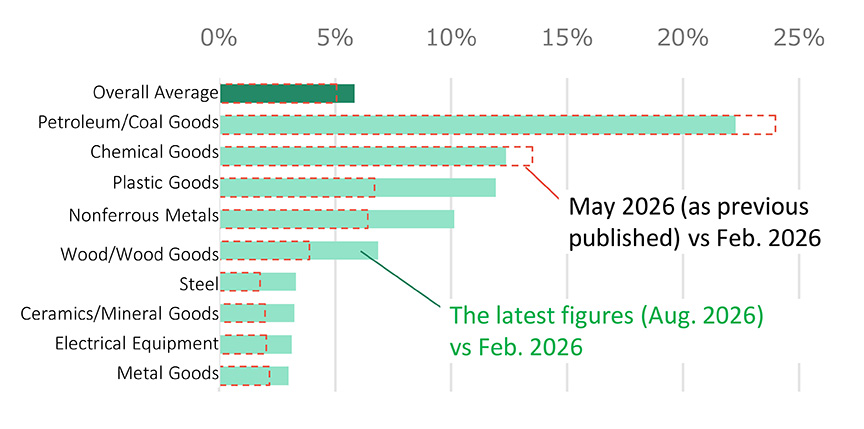
Due to the deteriorating situation in the Middle East, prices for raw materials such as petroleum, coal, and chemical products surged sharply through May, as reported in the previous issue of the Cost Management Report. However, they have since stabilized, and the rate of increase has slowed. On the other hand, the rate of increase for products such as plastics -- which use the same raw materials that experienced sharp price hikes -- has accelerated recently (Fig. 1). It appears that the upward price trend has shifted from raw materials to finished goods.

Prices for construction materials such as plywood and insulation have risen

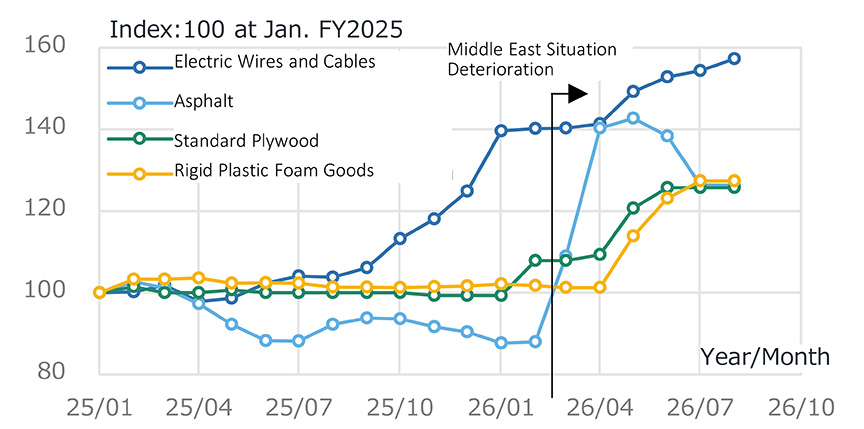
The same trend is evident in construction materials. While asphalt prices surged in March and April, prices for standard plywood (adhesives) and rigid plastic foam products (resins) rose in May and June (Fig. 2). Prices for electrical wires and cables had been rising since 2025 due to soaring copper prices, driven by expanding demand for power infrastructure, but began rising anew in May, 2026 as the Middle East situation deteriorated. This continues to impact prices for construction materials.
  • Fig. 1: Rate of Increase in the CPI Before & After the Middle East Situation Deterioration Fig. 1: Rate of Increase in the CPI Before & After the Middle East Situation Deterioration
    Compiled from the Bank of Japan’s Corporate Goods Price Index.

  • Fig. 2: Trends in Major Construction Materials Price Indices Affected by the Middle East Situation Fig. 2: Trends in Major Construction Materials Price Indices Affected by the Middle East Situation
    Compiled from the Bank of Japan’s Corporate Goods Price Index.

Although wages for skilled workers continue to rise, total payrolls have decreased due to shorter working hours 

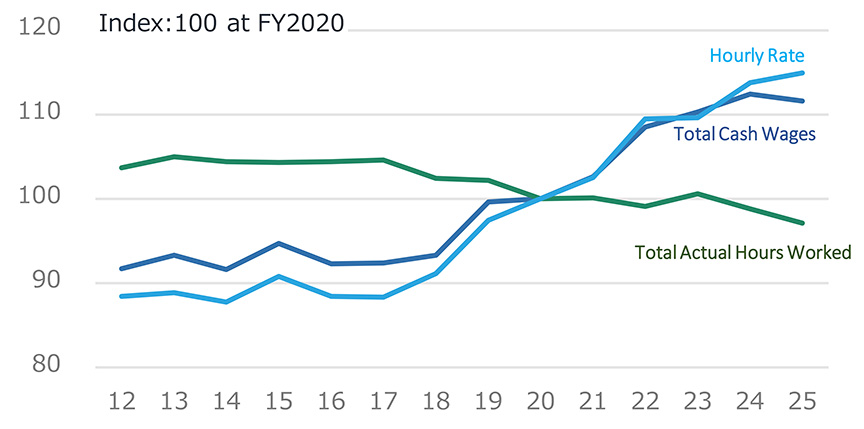
Hourly rates continue to rise, due to efforts to secure workforces. At the same time, however, total wages for FY2025 decreased as measures to address overtime work (Fig. 3) affecting working hours. It is expected that efforts to improve wages will expand across the board, and that strong upward pressure on labor costs is likely to persist.

The NSBPI*1has remained flat vs. the same period last year

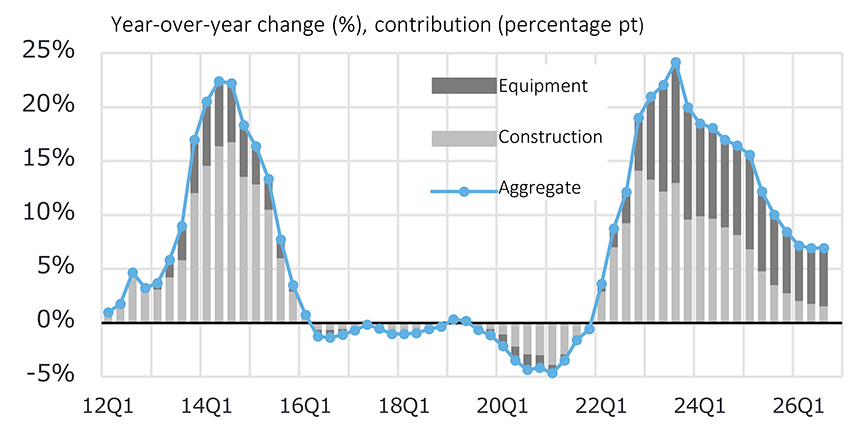
Since the beginning of 2026, the NSBPI has remained flat year-over-year. The trend toward a convergence in the rate of increase observed since 2025 has weakened (Fig. 4). Risks related to the situation in the Middle East remain high, as evidenced by the temporary surge in crude oil prices (WTI) above $100 in September. While construction prices may once again trend toward convergence, there is also a possibility that the rate of increase could accelerate, warranting continued close monitoring.
  • Fig. 3: Trends in Total Cash Wages, Total Working Hours, and Hourly Wages by Trade in the Construction Industry Fig. 3: Trends in Total Cash Wages, Total Working Hours, and Hourly Wages by Trade in the Construction Industry
    Compiled from the Ministry of Health, Labor and Welfare’s Monthly Labor Force Survey.

  • Fig. 4: Year-over-Year Trends in the NSBPI Fig. 4: Year-over-Year Trends in the NSBPI
    Compiled by Nikken Sekkei.

Construction Prices Continue to Rise

Nikken Sekkei Standard Building Price Index*1

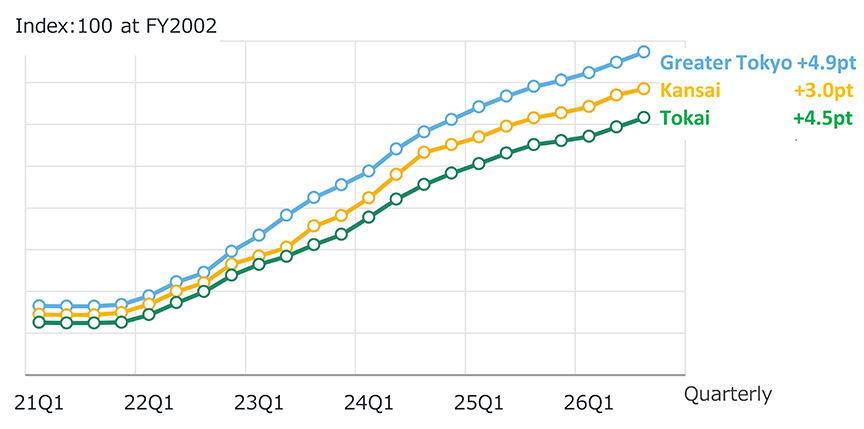
In the construction sector, there were signs that rising material prices, driven by the deteriorating situation in the Middle East, were being reflected in bid prices. Prices rose primarily for steel and finishing materials, resulting in slight rises compared to the previous reporting period.
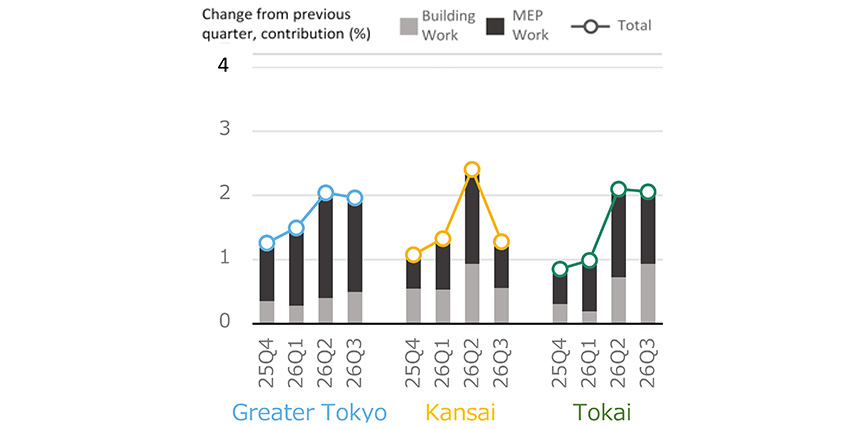
In the construction equipment sector, in addition to rising prices for copper-related materials and piping materials, increases in the costs of specialized work (such as automatic control and fire suppression systems), labor costs, and overhead expenses were reflected in price quotes; the contribution of construction equipment costs continued to exceed building construction costs (Figs. 5 and 6).
  • Fig. 5: Change in NSBPI Fig. 5: Change in NSBPI

  • Fig. 6: Percent Change in NSBPI & Building Work, MEP Work Contributions Fig. 6: Percent Change in NSBPI & Building Work, MEP Work Contributions

Steel prices turn upward; ready-mix concrete prices set to rise

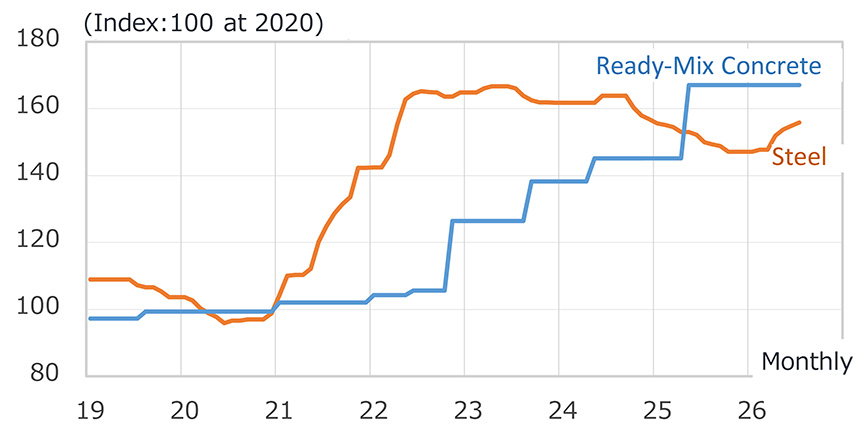
Steel prices had been falling continuously since October 2024, but began to rise again in February 2026 due to increases in energy prices and logistics costs (Fig. 7). While ready-mix concrete prices in Tokyo have remained flat, the Tokyo District Ready-Mix Concrete Cooperative plans to raise list prices by 20% starting in April 2027*2; market prices are expected to rise. 2...and market prices are expected to rise.

Rising interest rates heightens the risk of fluctuations in construction costs

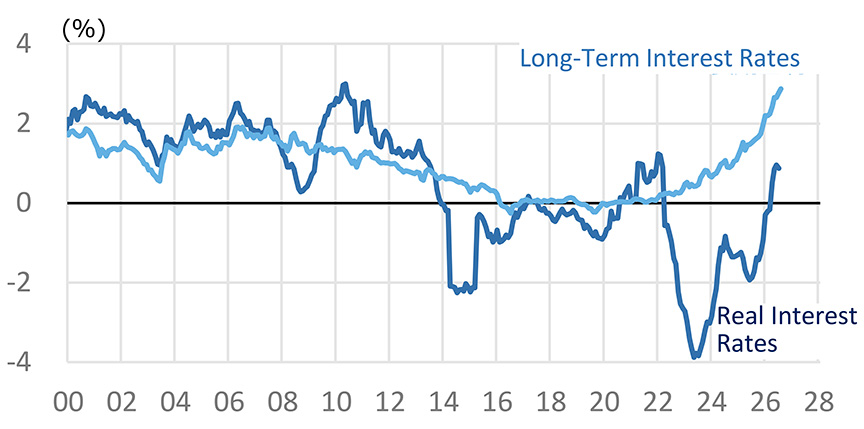
As long-term interest rates continue to rise, the real interest rate**3As long-term interest rates have continued to rise, real interest rates*3 have turned positive (Fig. 8). Construction investment, which relies heavily on borrowing, is more significantly affected by rising interest rates than other forms of capital investment, which could lead to a slowdown. Furthermore, the increased interest payment burden on contractors may be reflected in overhead costs for construction projects -- a situation that requires close monitoring.
  • Fig. 7: Trends in Steel and Ready-Mix Concrete Prices Fig. 7: Trends in Steel and Ready-Mix Concrete Prices
    Compiled from the Economic Research Association’s Cost Estimation Data index for Tokyo.

  • Fig. 8: Trends in Long-Term Interest Rates and Real

           Interest Rates Fig. 8: Trends in Long-Term Interest Rates and Real            Interest Rates
    Compiled from the Ministry of Finance’s Government Bond Yield Information and the Ministry of Internal Affairs and Communications’ Consumer Price Index. See *3 for the calculation method.

*1: Nikken Sekkei Standard Building Cost Index (NSBPI):  
An index calculated independently by Nikken Sekkei that tracks fluctuations in construction prices. Using a standard rental office as a quantity model, it calculates construction costs that incorporate actual market prices obtained through proprietary surveys and then indexes these figures.
Using a standard rental office as a quantity model, it calculates construction costs that incorporate actual market prices obtained through proprietary surveys and then indexes these figures.
Q1 refers to Jan–Mar, Q2 to April–June, 3Q to July–Sep, and 4Q to Oct–Dec. 
*2: In July 2026, the rate of increase was raised from 12% to 20%.
​*3: In this report, the real interest rate is calculated by subtracting the year-over-year change in the Consumer Price Index (national, all items excluding fresh food and energy) from the long-term interest rate (10-year government bond yield). 
 (national, all items excluding fresh food and energy) from the long-term interest rate (10-year government bond yield). 
*This report is based on information as of noon on September 30, 2026.
This site uses cookies. By continuing to use this website, you consent to the use of cookies.Our policy.