

One Year Since the Launch of “PYNT,” Which Accelerates Collaboration Among Diverse Individuals and Organizations: Reporting on Achievements and Future Prospects
Setting New Goals and Tackling Complex Social Issues Through “Co-creation” That Transcends Organizational and Positional Boundaries
PRESS RELEASE
2024.04.15
Nikken Sekkei Ltd. (Headquarters: Chiyoda-ku, Tokyo; Representative Director: President and CEO: Atsushi Omatsu; hereinafter “Nikken Sekkei”) is pleased to report on the insights and achievements gained through one year of activities by “PYNT,” an initiative established last year in conjunction with the renovation of its Tokyo headquarters office to accelerate collaboration with external partners and enhance internal communication, as well as its future outlook.
Background of the Initiative
In recent years, social issues—including climate change, lifestyles focused on a circular economy, public transportation and mobility, and the creation of environments that foster an inclusive society—have become increasingly complex, making it difficult to resolve them through the efforts of Private or individual companies alone.As a company deeply involved in the urban environment and people’s daily lives, we believe it is Nikken Sekkei’s critical role and responsibility to develop more effective initiatives—starting from the fields of architecture and urban planning—to address these challenges and implement them broadly throughout society.
Against this backdrop, we have established “Evolution Toward a Social Environment Design Platform” as the vision for our Mid-Term Management Plan (2021–2025). As part of our efforts to achieve the goals of this management vision, we aimed to “build an open platform” and renovated our offices last April.Under the guiding principle of “Connecting the vision of Private to the organization and making an impact on society,” the newly established PYNT within our office serves as a “space for co-creation” to accelerate collaboration among diverse individuals and organizations and address social and environmental challenges.
Since PYNT’s launch, the number of co-creation partners—including practitioners and experts from industry, government, academia, and the general public—has grown exponentially. To mark the first anniversary of PYNT’s opening, we would like to reflect on this past year and introduce examples of ongoing co-creation projects that exemplify PYNT’s role and its implementation in society.
*You can view the newly redesigned PYNT website at the URL below.
Against this backdrop, we have established “Evolution Toward a Social Environment Design Platform” as the vision for our Mid-Term Management Plan (2021–2025). As part of our efforts to achieve the goals of this management vision, we aimed to “build an open platform” and renovated our offices last April.Under the guiding principle of “Connecting the vision of Private to the organization and making an impact on society,” the newly established PYNT within our office serves as a “space for co-creation” to accelerate collaboration among diverse individuals and organizations and address social and environmental challenges.
Since PYNT’s launch, the number of co-creation partners—including practitioners and experts from industry, government, academia, and the general public—has grown exponentially. To mark the first anniversary of PYNT’s opening, we would like to reflect on this past year and introduce examples of ongoing co-creation projects that exemplify PYNT’s role and its implementation in society.
*You can view the newly redesigned PYNT website at the URL below.
PYNT's Initiatives and Features as a "Space for Co-Creation"
PYNT is located on the third floor of our Tokyo headquarters. It was established with the goal of fostering “co-creation” by accelerating collaboration through encounters that transcend organizational boundaries and roles, as well as supporting employees’ “passions” and promoting active communication.By connecting “Private”—individuals with diverse perspectives on urban living—with experts in architecture and urban planning, PYNT serves as a “co-creation platform that creates new options for the future of our cities.” It aims to solve complex social issues by engaging not only internal employees but also external co-creation partners—including companies, universities, government agencies, and NPOs—and providing support from initial matching to social implementation.
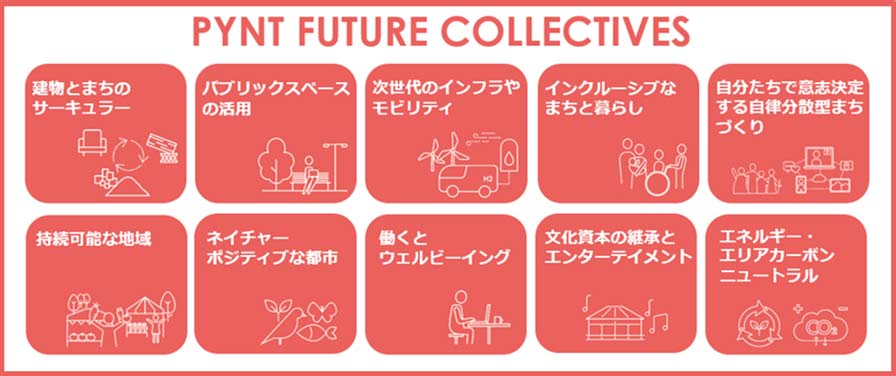 <Figure 1: Ten themes "FUTURE COLLECTIVES" set forth to realize the desired future>
Currently, PYNT has identified 10 themes, including “Sustainable Regional Management,” “Nature-Positive Cities,” and “Autonomous, Decentralized Community Development Driven by Citizens Themselves.” We refer to the communities where people interested in these themes work together to create their “desired future” as “FUTURE COLLECTIVES” (Figure 1).We have established the “PYNT Co-CREATION STEP” (MEET, CROSS, FOCUS,TRY, INSTALL)” (Figure 2). Specifically, it performs three functions: “connecting” members who share a common awareness of challenges; “envisioning” the future by supporting the development of visions and hypotheses with an eye toward social implementation; and “implementing” projects through matching with pilot sites and tool development.
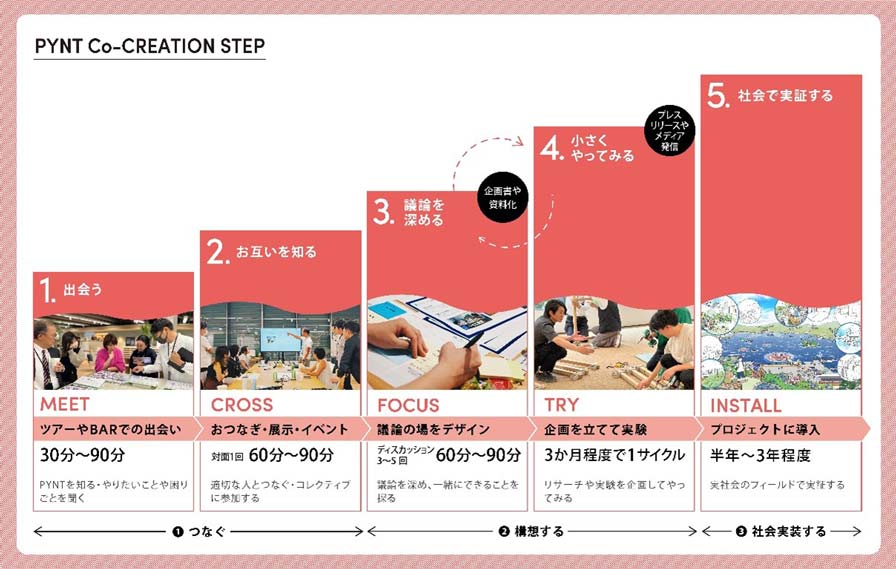 <Figure 2: The five-stage co-creation step to social implementation "PYNT Co-CREATION STEP">
Results of Initiatives in Fiscal Year 2023 and Examples of Ongoing Co-Creation Projects
During the first fiscal year (April 2023–March 2024), we focused on building relationships with internal and external co-creation partners. We welcomed approximately 6,000 visitors,62 cases that evolved into themed discussions, 30 projects that were formalized into plans, 6 projects that resulted in concrete actions such as pilot tests and events, and 1 project that has entered the early stages of the social implementation phase, including commercialization feasibility studies. Below, we introduce the co-creation projects initiated by PYNT.
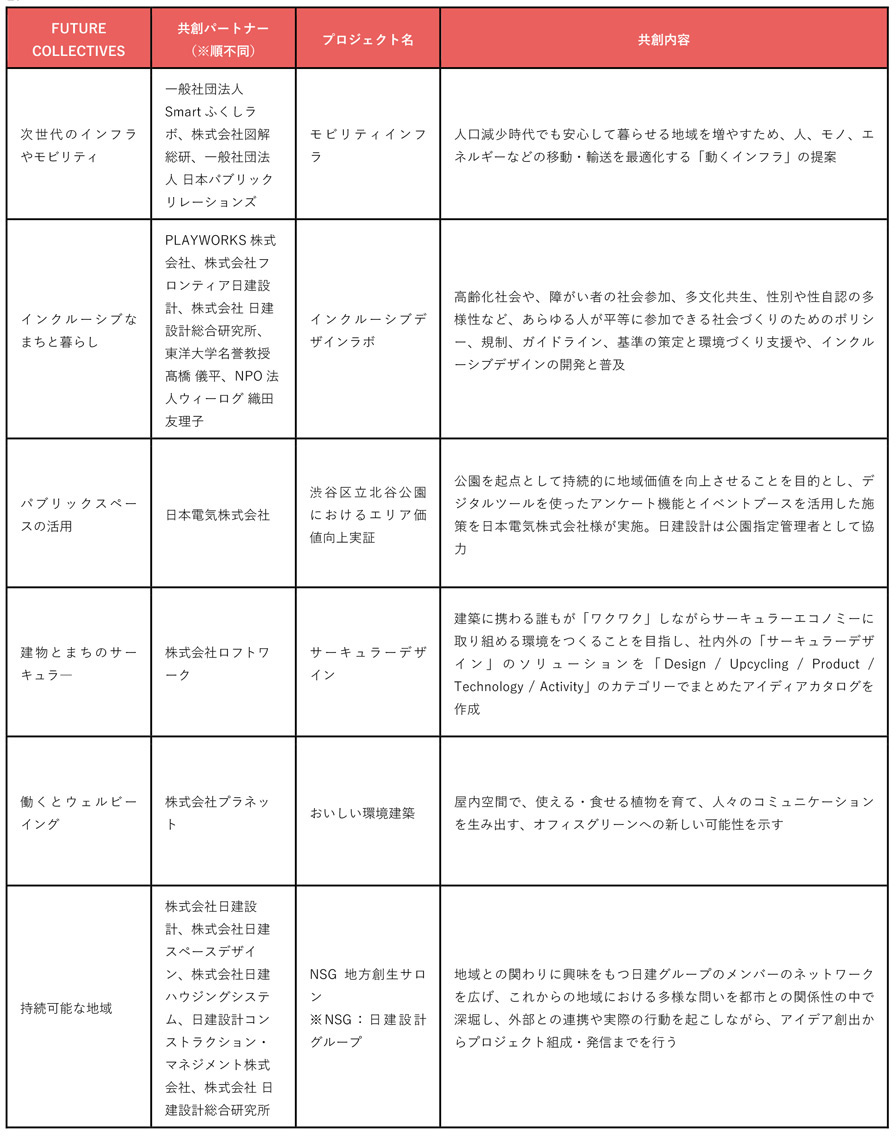
1. List of Co-creation Projects
2. Details of Co-creation Case Studies
[Case Study 1: Skyscape Design Lab (Co-creation with Local Governments and Government Ministries)]
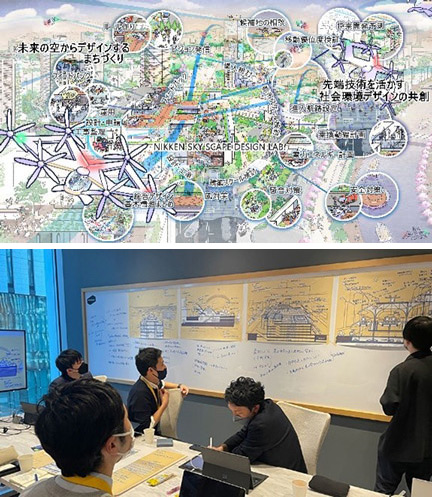
FUTURE COLLECTIVES: Next-Generation Infrastructure and Mobility
Key Issue: As next-generation air-based transportation—such as “flying cars” and “drones”—is emerging as a new form of public transportation, current cities and buildings are not yet equipped to accommodate the operation of flying cars.
Idea: Creating cities and buildings that make the most of future technologies such as air mobility
What PYNT Made Possible / Initiatives Toward Social Implementation: Through PYNT, we were able to establish connections with government agencies and local authorities, gaining access to the latest information on trends in regulatory development in Japan and the status of flying car vehicle development.We continue to participate in the Takeoff and Landing Site Working Group of the “Public-Private Council for the Air Mobility Revolution” organized by the Ministry of Land, Infrastructure, Transport and Tourism and the Ministry of Economy, Trade and Industry. In fiscal year 2023, we were commissioned by Osaka Prefecture to compile the “Flying Car Takeoff and Landing Site Guidebook” (Nikken Sekkei is involved in its creation as a member of a joint venture alongside Kanematsu, Skyports,ANA Research Institute) as part of a consortium. We have expanded our activities to include projects such as exploring the implementation of flying car facilities in private buildings. We are deepening the scope of our proposals, moving from conceptual planning for flying car- and drone-friendly urban development to practical implementation studies.
Key Issue: As next-generation air-based transportation—such as “flying cars” and “drones”—is emerging as a new form of public transportation, current cities and buildings are not yet equipped to accommodate the operation of flying cars.
Idea: Creating cities and buildings that make the most of future technologies such as air mobility
What PYNT Made Possible / Initiatives Toward Social Implementation: Through PYNT, we were able to establish connections with government agencies and local authorities, gaining access to the latest information on trends in regulatory development in Japan and the status of flying car vehicle development.We continue to participate in the Takeoff and Landing Site Working Group of the “Public-Private Council for the Air Mobility Revolution” organized by the Ministry of Land, Infrastructure, Transport and Tourism and the Ministry of Economy, Trade and Industry. In fiscal year 2023, we were commissioned by Osaka Prefecture to compile the “Flying Car Takeoff and Landing Site Guidebook” (Nikken Sekkei is involved in its creation as a member of a joint venture alongside Kanematsu, Skyports,ANA Research Institute) as part of a consortium. We have expanded our activities to include projects such as exploring the implementation of flying car facilities in private buildings. We are deepening the scope of our proposals, moving from conceptual planning for flying car- and drone-friendly urban development to practical implementation studies.
[Case Study 2: Mobility Infrastructure (Co-creation with Expert Organizations)]
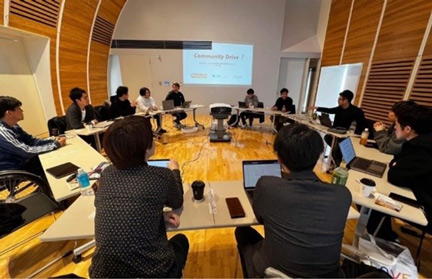
FUTURE COLLECTIVES: Next-Generation Infrastructure and Mobility
Key Challenge: Population decline is making infrastructure maintenance difficult, leading to an increase in the number of “cities at risk of disappearing” in the future.
Idea: To increase the number of communities where people can live with peace of mind even in an era of population decline, we propose “mobile infrastructure” that optimizes movement and transportation by carrying a mix of people, goods, water, gas, electricity, and more.
What PYNT Made Possible / Initiatives Toward Social Implementation: PYNT facilitated collaboration with specialized organizations that have deep relationships with stakeholders directly facing local mobility challenges.We are currently preparing for a pilot project in a municipality facing severe mobility challenges. Starting with efforts to solve mobility-related issues, this project will also address various closely related social problems, such as long-term care, logistics, gas delivery, and water infrastructure.
Key Challenge: Population decline is making infrastructure maintenance difficult, leading to an increase in the number of “cities at risk of disappearing” in the future.
Idea: To increase the number of communities where people can live with peace of mind even in an era of population decline, we propose “mobile infrastructure” that optimizes movement and transportation by carrying a mix of people, goods, water, gas, electricity, and more.
What PYNT Made Possible / Initiatives Toward Social Implementation: PYNT facilitated collaboration with specialized organizations that have deep relationships with stakeholders directly facing local mobility challenges.We are currently preparing for a pilot project in a municipality facing severe mobility challenges. Starting with efforts to solve mobility-related issues, this project will also address various closely related social problems, such as long-term care, logistics, gas delivery, and water infrastructure.
[Case Study 3: Inclusive Lab (Co-creation with Expert Advisors and Stakeholders Aware of the Issues)]
FUTURE COLLECTIVES: Inclusive Communities and Lifestyles
Key Issues: While efforts are underway to amend relevant laws and regulations to build a society where everyone can participate—addressing issues such as an aging society, social inclusion for people with disabilities, multicultural coexistence, and diversity in gender and gender identity—the foundational elements—recognition and understanding of diversity, shifts in organizational and societal attitudes, and spatial design—have not kept pace.
Ideas: Formulating guidelines to promote inclusion; creating supportive environments; and developing and implementing design solutions.
Key Issues: While efforts are underway to amend relevant laws and regulations to build a society where everyone can participate—addressing issues such as an aging society, social inclusion for people with disabilities, multicultural coexistence, and diversity in gender and gender identity—the foundational elements—recognition and understanding of diversity, shifts in organizational and societal attitudes, and spatial design—have not kept pace.
Ideas: Formulating guidelines to promote inclusion; creating supportive environments; and developing and implementing design solutions.
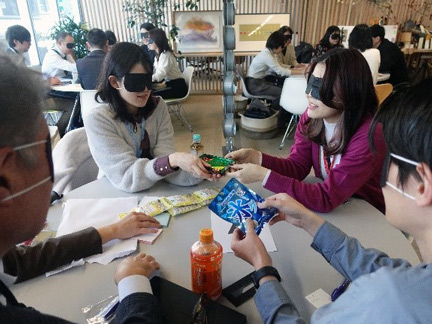
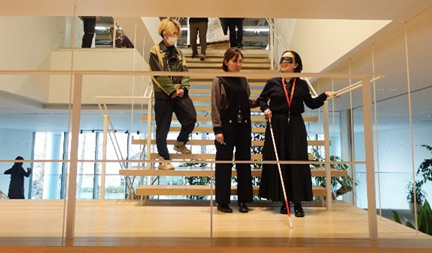
What PYNT Has Made Possible / Initiatives for Social Implementation: We have expanded our connections with expert advisors—who provide the insights and networks needed to solve problems and bring ideas to life—as well as with those directly affected by the issues. Guided by our vision of “designing urban spaces, activities, and lifestyles for everyone, together with everyone,” we will launch our full-scale activities in 2024.For our first initiative, centered on the theme “Visual Impairment × Architecture and Urban Planning,” we conducted workshops and experiential activities—such as walking around the city and dining—simulating the experience of being blind or visually impaired.
[Other: Company Tours and Workshops at PYNT (Collaborative Projects with Middle and High School Students)]
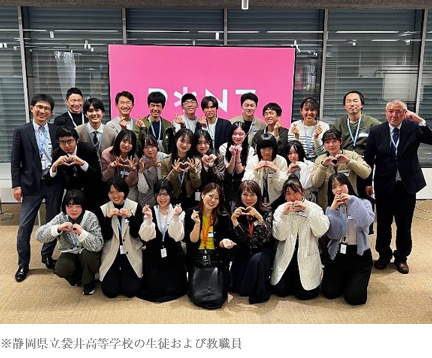 *Students and faculty/staff of Shizuoka Prefectural Fukuroi High School*
At PYNT, we host company tours and workshops for middle and high school students—the next generation—to support the sharing of ideas and actions regarding the “future we want to see” and to foster a sense of empathy.On March 18 for students and faculty from Seifu Nankai High School, and on March 26 for students and faculty from Shizuoka Prefectural Fukuroi High School, we held a lecture on co-creation and a workshop themed “How to Make School a Better Place Than It Is Now.” Using the ideas from Private. We received many positive comments from participants who enjoyed the experience and shared that, starting with the ideas from this website, they gained a real sense that things they thought were impossible to achieve alone became more feasible by involving others, and that by expanding their ideas with a shared vision among peers, their “wishful thinking” began to take concrete form.
Future prospects
Nikken Sekkei aims to become a “Social and Environmental Design Platform” that tackles social challenges across disciplines and industries. We will continue to build relationships with internal and external partners through PYNT, while providing even greater support for co-creation to realize the future we envision for our communities and daily lives.As we enter our second year since launch, we will strengthen our support programs leading to social implementation by enhancing matchmaking with partners who share our commitment to addressing these issues, developing new tools, and rolling out programs designed to refine project details.
[PYNT 1st Anniversary Seminar Series]
On Tuesday, May 7, 2024, PYNT will host a seminar titled “NIKKEN NEXT MISSION 1st SEMINAR: ‘Society and Business in 2050’” to commemorate the first anniversary of its launch.We are pleased to welcome two guests: Kazuya Ogawa, a futurist who proposes visions for the future through an interdisciplinary approach grounded in technology, and Yuichi Kori, Managing Director at Edelman Global Advisory Japan and a PA/PR professional. This panel discussion, which will incorporate participant input, will explore what society (cities, the environment,Earth, space, and more), and what kinds of businesses will be needed at that time—incorporating input from participants.
Event Overview
・開催日時:2024年5月7日(火)18:00~20:00
・形式:ハイブリット(リアル・オンライン)
・定員:50名
・費用:参加費無料
・概要ページ/お申込みURL:https://peatix.com/event/3908215
・形式:ハイブリット(リアル・オンライン)
・定員:50名
・費用:参加費無料
・概要ページ/お申込みURL:https://peatix.com/event/3908215
About Nikken Sekkei
Nikken Sekkei is a professional services firm specializing in architectural and civil engineering design and supervision, urban design, and related research, planning, and consulting services. For 120 years since its founding in 1900, Nikken Sekkei has been committed to creating value through "social environment design," which aims to solve both explicit and implicit social issues, in order to meet the demands of society and the diverse needs of its clients. To date, it has been involved in various projects in Japan, China, ASEAN, and the Middle East, and in recent years has expanded into India and Europe.
Contact information regarding this matter
株式会社日建設計 広報室 Tel. 03-5226-3030 e-mail:webmaster@nikken.jp
SHARE