

The "Community Drive Project" is a regional co-creation project originating in Kurobe City, Toyama Prefecture.
Starting this spring, we will begin rolling out our "Community Drive Program" to various regions across Japan!
Over 70% of municipalities nationwide face a serious "mobility" problem; a team of experts will work alongside them to support community-led solutions.
PRESS RELEASE
2025.02.12
The Community Drive project (SMART Fukushi Lab, Nikken Sekkei Ltd., and Zukai Soken Inc.), which aims to solve local transportation and welfare issues, conducted a demonstration experiment in Kurobe City, Toyama Prefecture, as a model project of the Ministry of Land, Infrastructure, Transport and Tourism in FY2024 (Co-creation MaaS Demonstration Project/Mobility Human Resource Development Project), promoting resident-led initiatives and local consensus building, and achieved certain results. Based on these results, we are pleased to announce that we will begin offering the "Community Drive Program," a regional co-creation project aimed at discovering and nurturing "community drivers" who drive local communities, to partner regions throughout Japan starting in FY2025.
Community Drive Program Overview
| Program Name | "Community Drive Program" |
|---|---|
| Activity details | To foster residents' initiative and discover and cultivate individuals (community drivers) who can promote consensus building within the community, we are implementing initiatives such as "dialogue," "surveys," and "visualization." (Examples: conducting surveys on actual mobility patterns, holding community driver workshops, and visualizing mobility challenges.) |
| Start time | April 2025 |
| Target areas | Regions across Japan facing challenges related to transportation *Requires individuals who are enthusiastic about solving mobility challenges. |
| Participants | Local residents, local governments, companies, NPOs, etc. |
| Implementation period | 6 months or older (to be decided upon consultation) |
| Implementation costs | To be discussed depending on population size and system. |
| Contact information | info@cdpj.jp |
With the projected 2025 problem, where one in five people will be 75 years of age or older, and the ongoing aging of the population and declining birthrate, transportation challenges in terms of welfare and disaster prevention are becoming increasingly serious in rural areas. More than 70% of the 1,718 municipalities nationwide face similar challenges to Kurobe City, which has a population of approximately 40,000 and an aging rate of 32% (national average 29%) (Statistics Bureau of the Ministry of Internal Affairs and Communications, 2020 National Census). This situation undermines the safety and convenience of daily life for local residents and also affects access to medical and nursing care services. In the midst of accelerating population decline, the creation of sustainable systems is urgently needed.
The "Community Drive Program" is a program that, through repeated "dialogue" with diverse sectors, clarifies the current state of the region through "survey," visualizes challenges and data to make them easily shareable, and identifies and nurtures individuals (community drivers) who can play an active role in the region. Through this process, it fosters initiative and consensus-building in the region, and by accumulating small "actions," it cultivates the ability to solve local problems themselves and achieve sustainable development. Our goal is to combine these four elements—"dialogue," "survey," "visualization," and "action"—to create individuals and systems that can act proactively in the region.
The "Community Drive Program" is a program that, through repeated "dialogue" with diverse sectors, clarifies the current state of the region through "survey," visualizes challenges and data to make them easily shareable, and identifies and nurtures individuals (community drivers) who can play an active role in the region. Through this process, it fosters initiative and consensus-building in the region, and by accumulating small "actions," it cultivates the ability to solve local problems themselves and achieve sustainable development. Our goal is to combine these four elements—"dialogue," "survey," "visualization," and "action"—to create individuals and systems that can act proactively in the region.
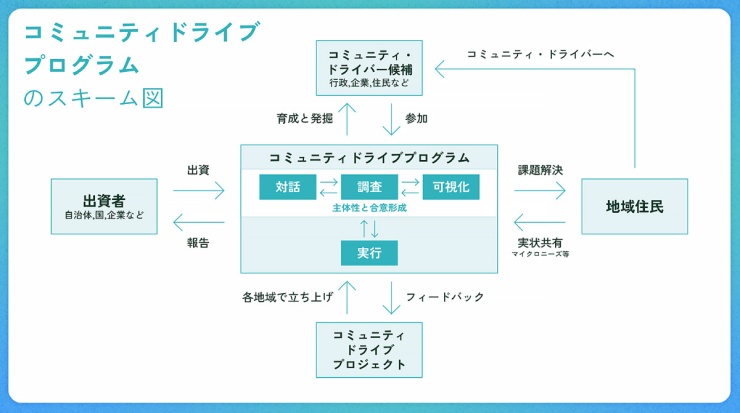
In this program, the key to success lies in connecting with enthusiastic individuals who are passionate about solving local transportation challenges, as well as those who are positive but struggling with how to proceed and how to build a network of supporters. Rather than starting with solutions such as technology or services, the program aims to foster resident initiative and community consensus building within the community, by first determining what needs to be addressed, what the real problems are, and how individuals in the community can work together to solve the problems without conflict. The goal is to discover and nurture "community drivers"—individuals who proactively tackle transportation challenges.
The six-month program will focus on "dialogue," "research," and "visualization," directly listening to local voices to clarify challenges and realities and stimulate discussion. It is important that people from various backgrounds and age groups, including government officials, businesses, and citizens, participate. After the program ends, mechanisms will be developed in each region to make the initiative that has emerged more sustainable and effective. This initiative is currently being piloted in Kurobe City, and as it progresses, new discoveries and results will become concrete.
The six-month program will focus on "dialogue," "research," and "visualization," directly listening to local voices to clarify challenges and realities and stimulate discussion. It is important that people from various backgrounds and age groups, including government officials, businesses, and citizens, participate. After the program ends, mechanisms will be developed in each region to make the initiative that has emerged more sustainable and effective. This initiative is currently being piloted in Kurobe City, and as it progresses, new discoveries and results will become concrete.
Future developments
In Kurobe City, which has already implemented the program, the city will further promote "implementation" as part of its second year of efforts. Specifically, local community drivers will take the lead in launching "micro-projects" to delve deeper into the identified issues.
We are also planning to expand the program to other regions, and we will work in collaboration with cities in the Chugoku region and towns in the Kyushu region that are considering introducing the program, verifying its effectiveness and improving it to make it more versatile. In the Chugoku region, the population structure by age group is similar to that of Kurobe City, and the ratio is calculated so that 4 people in the age group without mobility issues support 3 people in the age group with mobility issues (*1). Due to this similarity, we believe that the initiative in Kurobe City can be applied with only minor adjustments. On the other hand, in the Kyushu region, the population is smaller (*2), and the ratio is 1 person in the age group without mobility issues supporting 1 person in the age group with mobility issues, so we will improve the accuracy of the program while taking into account conditions different from those in Kurobe City. Furthermore, we are also working on building a system for the nationwide expansion of the program and are considering a mechanism that can be implemented sustainably and effectively.
*1: If we define the age groups that are considered to have some difficulty with mobility as 0-19 years old and 75 years and older, and the age group that is considered to have few mobility challenges as 30-64 years old, the ratio is approximately 0.77 for Kurobe City and approximately 0.76 for cities in the Chugoku region.
*2: The ratio is approximately 0.99.
We are also planning to expand the program to other regions, and we will work in collaboration with cities in the Chugoku region and towns in the Kyushu region that are considering introducing the program, verifying its effectiveness and improving it to make it more versatile. In the Chugoku region, the population structure by age group is similar to that of Kurobe City, and the ratio is calculated so that 4 people in the age group without mobility issues support 3 people in the age group with mobility issues (*1). Due to this similarity, we believe that the initiative in Kurobe City can be applied with only minor adjustments. On the other hand, in the Kyushu region, the population is smaller (*2), and the ratio is 1 person in the age group without mobility issues supporting 1 person in the age group with mobility issues, so we will improve the accuracy of the program while taking into account conditions different from those in Kurobe City. Furthermore, we are also working on building a system for the nationwide expansion of the program and are considering a mechanism that can be implemented sustainably and effectively.
*1: If we define the age groups that are considered to have some difficulty with mobility as 0-19 years old and 75 years and older, and the age group that is considered to have few mobility challenges as 30-64 years old, the ratio is approximately 0.77 for Kurobe City and approximately 0.76 for cities in the Chugoku region.
*2: The ratio is approximately 0.99.
SMART Welfare Lab (General Incorporated Association)
Project Manager Tokuaki Koshiba's Comment
"In the face of aging populations and population decline, which are affecting many regional cities across Japan, there is no quick fix for the transportation challenges that are finally becoming apparent. However, there are still many local resources that can be utilized. We need to mobilize the power of our communities and think for ourselves about the future, 10 or 20 years from now. The Community Drive project is not just about solving transportation problems. What we are working on is fostering "resident autonomy" and "community consensus building," which are the most important things for community development. We believe that cultivating this mindset, although it may seem like a roundabout way, is one of the solutions."
Our goal is to increase the number of people in local communities who can drive the community forward through positive, forward-looking dialogue, rather than confrontation. If we can foster a sense of ownership and build consensus within that process, then we can use any technology and create any service. That's because it's a process of creation by everyone.
Our goal is to increase the number of people in local communities who can drive the community forward through positive, forward-looking dialogue, rather than confrontation. If we can foster a sense of ownership and build consensus within that process, then we can use any technology and create any service. That's because it's a process of creation by everyone.
"Community Drive Project": Results in Kurobe City(July 2024–January 2025)
The Community Drive project began in Kurobe City in July 2024 and has been carrying out three main activities: “Dialogue,” “Research,” and “Visualization.”While “dialogue,” “surveys,” and “visualization” are already practiced as individual methods, the uniqueness of this project lies in the process by which a specialized team implements them in an integrated manner to foster local autonomy and consensus-building.As a result of the approximately six-month program, more than 90% of participants who responded to the survey stated that they had “become interested in mobility issues,” and we were able to identify more than 10 individuals to serve as “Community Drivers.”A diverse range of individuals volunteered to serve as drivers, including seniors over 70 without driver’s licenses, operators of local transportation services, and business owners providing local services under the “Private” initiative.
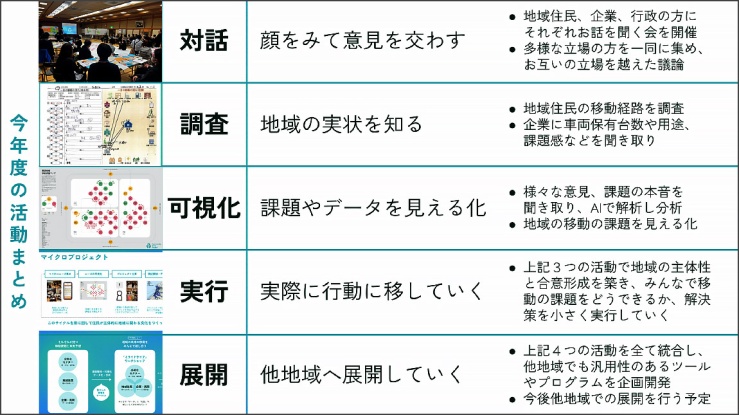 Five steps of the project
Promoting "dialogue" through workshops, etc.
In the first phase, "Dialogue," we gathered firsthand accounts of the difficulties of transportation and daily life in Kurobe City through hearings and workshops with government officials, businesses, and citizens, and deepened the discussion. On July 26th, we held a workshop for citizens, businesses, and government officials, and on November 28th, we held a Mirai Drive workshop with participants from diverse backgrounds.
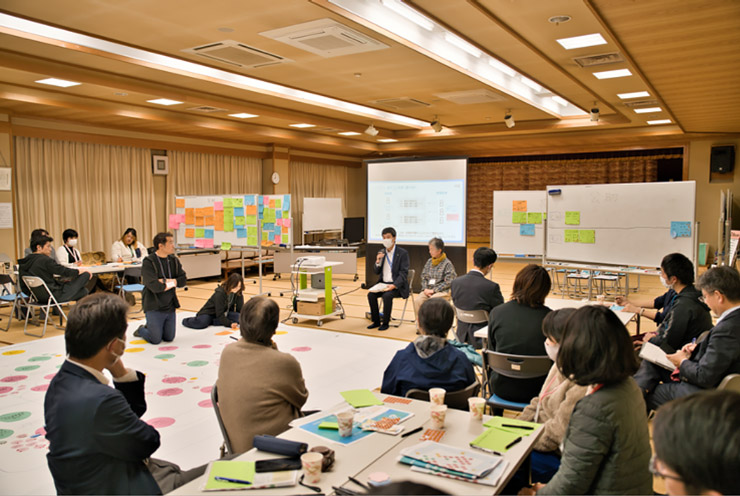 A scene from a dialogue workshop held jointly by residents, businesses, and the local government (November 29, 2024, Kurobe City)
"Investigation" using AI analysis
In the second "survey," we analyzed data based on firsthand accounts and travel information obtained from workshops and interviews, categorized by attribute and purpose, to investigate where people travel, for what purpose, with whom, and when. We also created a system for online submission of travel challenges to gather opinions from those unable to attend events, receiving over 150 submissions. This submitted data was then analyzed using AI to further deepen the understanding of travel challenges.
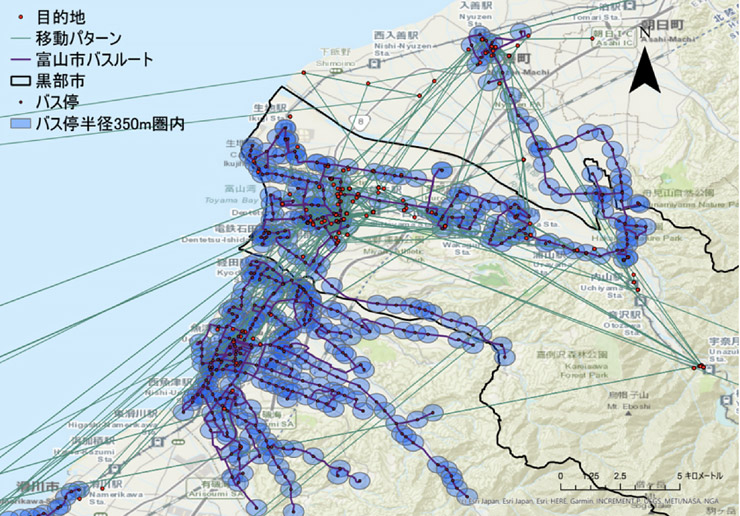 Part of the analysis of movement data aggregated on a map
Visualization: Making issues and data visible.
In the third step, "visualization," we developed visualization techniques to communicate the issues and data gathered through dialogue and surveys in an easily understandable way to a wide audience. For example, we created a "mobile issue map" that allows participants to grasp the overall picture and structure of the issues, and visualize causal relationships and impacts. In the workshop, we printed this map in a huge size of 4m x 6m, and incorporated an interactive method where participants actually walked around and worked on the issues using stickers and sticky notes.
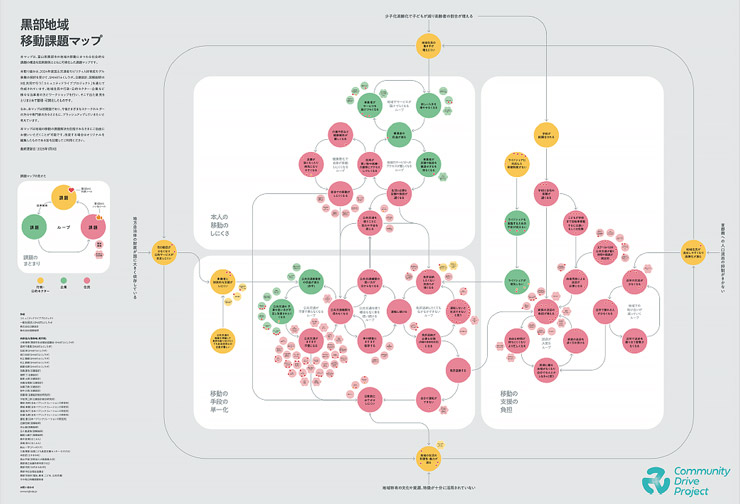 The mobile task map that was created
Moving forward, we will take actual action.
Going forward, we will establish a system to advance five activities, adding "execution" and "deployment." In "execution," project members and community drivers will collaborate to implement "micro-projects," small actions aimed at solving mobility challenges. We will work to solve problems by repeatedly going through hypothesis, planning, experimentation, and evaluation in short periods. In the final "deployment" phase, in order to spread the project that started in Kurobe to other regions, we will introduce an approach that adds "execution" to "dialogue," "research," and "visualization" to promote community drives. Through these activities, we will spread the community drive movement throughout the country.
About the Community Drive project
地域における移動の課題や未来に向き合い解決策を導き出し、地域(Community)の移動を促進(Drive)する人材である「コミュニティ・ドライバー」の育成と必要になるプログラムならびにツール開発を目指すプロジェクトです。福祉のDXを推進する一般社団法人SMARTふくしラボ(所在地:富山県黒部市)と建築・土木の設計監理、都市デザインを行う組織設計事務所である株式会社日建設計(所在地:東京都千代田区)、複雑な情報を図解で可視化する株式会社図解総研(所在地:東京都文京区)により2024年7月に発足しました。開発した研修プログラムでは、実際に課題解決に取り組む地域の住民や企業、行政といった多様なセクターが集まり、データ活用をしながら、対話し、自分たちで未来の地域の移動を考えていきます。その過程で住民に主体性が生まれ、合意形成が促進し、「自分たちの移動を自分たちで考えていく」マインドを醸成します。本プロジェクトは、2024年度国土交通省モビリティ人材育成モデル事業(https://www.mlit.go.jp/sogoseisaku/transport/kyousou/)に採択されています。
About SMART Fukushi Lab, a general incorporated association
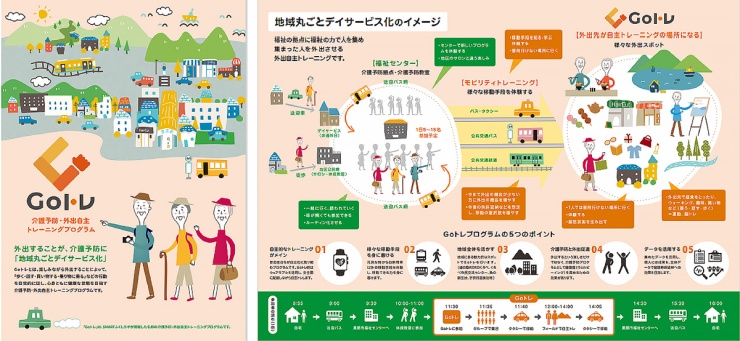
SMART Fukushi Lab is an organization that focuses on digitalization in the welfare sector, promotes DX (digital transformation), creates new businesses, and functions as a think tank. Focusing on mobility, a major challenge in local communities, the organization conducts research and studies. In 2023, it was selected for a co-creation model demonstration project by the Ministry of Land, Infrastructure, Transport and Tourism, and developed "Go-Tore," a community-wide day service that provides a hybrid solution to preventative care, support for going out, and revitalize public transportation, demonstrating its commitment to sustainable community development.
About Nikken Sekkei Ltd.
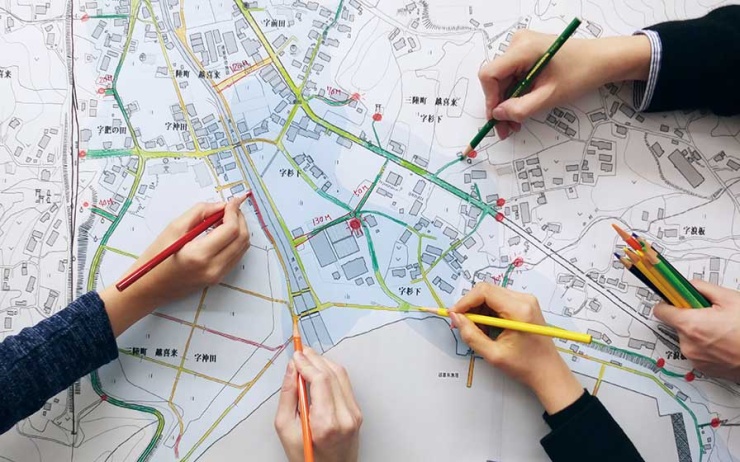
Nikken Sekkei is a professional services firm specializing in architectural and civil engineering design and supervision, urban design, and related research, planning, and consulting services. For over 120 years since its founding in 1900, Nikken Sekkei has been committed to creating value through "social environment design," which aims to solve both explicit and implicit social issues in order to meet the demands of society and the diverse needs of its clients. To date, it has been involved in various projects in Japan, China, ASEAN, and the Middle East, and in recent years has expanded into India and Europe. In addressing regional issues, it has developed the "Evacuation Map," which visualizes evacuation times on a map by applying disaster evacuation plans for buildings. Workshops to create this Evacuation Map have been held in 60 municipalities across 26 prefectures nationwide, and in more than 30 elementary, junior high, and high schools across the country, promoting risk communication and consensus building regarding evacuation in each region. At least 6,000 people, including local residents and municipal officials, have participated in these workshops.
About Zukai Soken Co., Ltd.
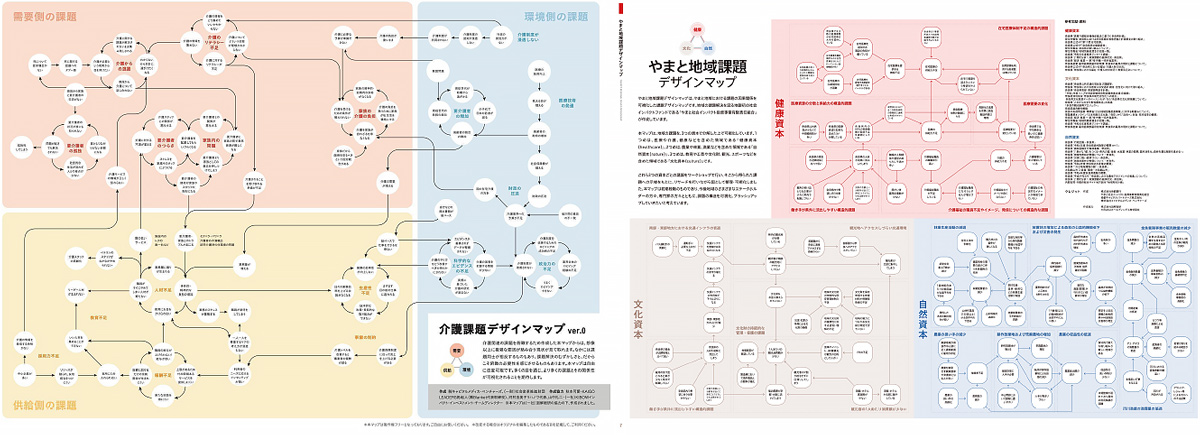
The Visual Think Tank, Zukai Soken, reduces the communication costs of mutual understanding and creates a common language among diverse stakeholders by structuring and illustrating complex concepts such as business models, accounting, co-creation, and policy using common templates. Its major publications to date include "Business Model 2.0 Encyclopedia," "Accounting Map," "Purpose Model," and "Policy Diagrams." Furthermore, by visualizing the structure of complex issues such as those related to elderly care and local communities, and organizing the relationships between these issues, it has created a foundation for discussions on what needs to be solved.
Inquiries regarding the contents of this press release
Community DriveプロジェクトPR担当 pr@cdpj.jp
Inquiries regarding the distribution of this press release
Community DriveプロジェクトPR担当(日本パブリックリレーションズ研究所):佐藤・黒崎・横田・渡邉
TEL:03-5368-0911 FAX:03-5269-2390 e-mail: cdpj@japan-pri.jp
TEL:03-5368-0911 FAX:03-5269-2390 e-mail: cdpj@japan-pri.jp
SHARE