
Towards a new society brought about by the coronavirus
~As part of our efforts to address various complex disasters~
Shigeki Sugiura
(Position as of the time of publication)
SCROLL DOWN
In 2020, we were faced with the threat of COVID-19, for which no vaccine yet exists, and were forced to live in a different way of life than before. Japan is a country prone to natural disasters and has experienced many such disasters in the past, but what would happen if an infectious disease and a natural disaster occurred simultaneously? When multiple different disasters occur almost simultaneously or in quick succession, it is called a "compound disaster," and I would like to reconsider how we should prepare for this risk of a "compound disaster."



 Executive Officer Engineering Department Structural Design Group, Principal
Shigeki Sugiura
(Position as of the time of publication)
Infectious diseases and natural disasters
Furthermore, unlike complex disasters that stem from a single event, such as "earthquakes and tsunamis," "earthquakes and large fires," or "typhoons and storm surges," we were made aware of the possibility of "complex disasters" that occur simultaneously from completely unrelated sources, such as "earthquakes, typhoons, and heavy rains during an infectious disease outbreak."
In Japan, where natural disasters are increasing in number and tending to become more severe, addressing these "complex disasters" is an urgent issue.
 You can scroll horizontally.
| July 2020 | Heavy rain in July 2020 | Heavy rain | Kumamoto Prefectural Government Torrential rains that occurred in various parts of Japan, primarily in Kyushu and the Chubu region. |
| September 2019 | Typhoon No. 19 | typhoon | Record-breaking heavy rains hit the Kanto, Koshin, and Tohoku regions, causing extensive damage. |
| September 2019 | Typhoon No. 15 | typhoon | This typhoon was among the strongest ever recorded to make landfall in the Kanto region. |
| August 2019 | Heavy rain in northern Kyushu | Heavy rain | Nagasaki Prefectural Government Across a wide area stretching from Saga Prefecture to Fukuoka Prefecture, torrential rains caused by a prolonged linear rainband occurred, with many locations recording their highest-ever rainfall totals, particularly on August 28. |
| September 2018 | Hokkaido Eastern Iburi Earthquake | earthquake | The magnitude 6.7 earthquake occurred on September 6th. The seismic intensity was recorded as 7 in Atsuma Town, and as 6-minus in Sapporo's Higashi Ward and Chitose Airport. A blackout caused by the emergency shutdown of the Tomatoh-Atsuma Thermal Power Plant resulted in power outages affecting 2.95 million households throughout Hokkaido. |
| September 2018 | Typhoon No. 21 | typhoon | A storm surge of 3 meters—exceeding that recorded during Typhoon Muroto II—was recorded in Osaka Bay. Kansai International Airport Co.,Ltd. The runway was flooded there, and a tanker collided with the access bridge, leaving the airport isolated. |
| August 2018 | Scorching heat | Scorching heat | Temperatures exceeded 40 degrees Celsius for the first time in five years. Kumagaya City recorded a new record high temperature of 41.1℃. Temperatures of 41.0°C were also recorded in Gero City and Mino City in Gifu Prefecture. Additionally, temperatures of 40.8°C were recorded in Ome City, Tokyo, and 40.3°C in Nagoya City. |
| June 2018 | Northern Osaka Earthquake | earthquake | A magnitude 6.1 shallow earthquake struck northern Osaka on June 18th. It recorded the highest seismic intensity ever observed in northern Osaka, at level 6-minus. |
| July 2018 | July 2018 West Japan Heavy Rains | Heavy rain | It caused extensive damage in Hiroshima, Okayama, and Ehime prefectures. 237 dead, 8 missing. This is the first time in the Heisei era that a flood has resulted in more than 100 deaths, and the first time since the Nagasaki heavy rains in the Showa era. |
| July 2017 | Heavy rain in northern Kyushu | Heavy rain | Heavy rains struck Fukuoka and Oita prefectures, resulting in 40 deaths and 2 people missing. |
| August 2016 | Typhoon No. 7, No. 9, No. 10, No. 11 |
typhoon | Typhoons that occurred from August 16 to August 31, along with heavy rains caused by a stationary front over the Hokkaido region, resulted in 24 deaths and 5 people missing. In addition to damage such as collapsed houses and flooding, there was also extensive damage to agricultural crops (such as potatoes for potato chips). |
| April 2016 | Oita Prefecture Central Earthquake | earthquake | A magnitude 5.3 earthquake occurred on April 16th. It was triggered by the Kumamoto earthquake. The city of Yufu in Oita Prefecture recorded a seismic intensity of 5-minus. In the main tremor of the Kumamoto earthquake, cities such as Yufu and Beppu experienced a magnitude of 6 on the Japanese seismic intensity scale, and the damage has spread. |
| April 2016 | Kumamoto Earthquake | earthquake | A foreshock (M6.5) occurred on April 14. A maximum seismic intensity of 7 was recorded in Mashiki Town. Subsequently, the mainshock (M7.3) occurred on April 16, recording a maximum seismic intensity of 7 in Mashiki Town and Nishihara Village. Kumamoto Prefectural Government Seismic intensity levels ranging from 6+ to 6- were observed across a wide area of Oita Prefecture. |
| September 2014 | Mount Ontake eruption | eruption | The eruption occurred suddenly when many hikers were at the summit, engulfing a large number of them. 67 people died. |
| August 2014 | Due to heavy rain Landslide disaster in Hiroshima City |
Heavy rain | Large-scale landslides occurred in multiple locations in the northern parts of Hiroshima City, specifically in the Asakita and Asaminami wards. Mudslides and other landslides resulted in 74 deaths, 174 houses completely destroyed, and 187 houses partially destroyed. |
| February 2014 | Heavy snowfall in 2014 | Heavy snowfall | Heavy snowfall isolated numerous settlements in Gifu, Yamanashi, and Nagano prefectures. Even the Pacific coast, which usually experiences little snow, saw heavy snowfall, leading to a high number of accidents such as slipping. |
| October 2013 | Typhoon No. 26 | typhoon | A mudslide caused by record-breaking heavy rains occurred on Izu Oshima Island in Tokyo. 39 people have died and 4 are missing. |
| August 2013 | Scorching heat | Scorching heat | In early to mid-August, there was an intense heatwave, with Shimanto City in Kochi Prefecture recording a temperature of 41.0°C, the highest ever recorded in Japan at the time. |
| September 2011 | Typhoon No. 12 | typhoon | Heavy rains fell across western Japan. The damage was particularly severe in southern Nara Prefecture and Wakayama Prefecture on the Kii Peninsula. 82 people died and 16 are missing. |
| March 2011 | Northern Nagano Prefecture Earthquake | earthquake | It occurred on March 12th. The magnitude was 6.7. Sakae Village in Nagano Prefecture recorded an intensity of 6+ on the Japanese seismic intensity scale, causing damage such as collapsed houses and landslides. |
| March 2011 | Great East Japan Earthquake | earthquake | A massive earthquake with a magnitude of 9.0 (the largest earthquake ever recorded in Japan). Maximum intensity: 7. It caused the Fukushima Daiichi nuclear power plant accident. A massive tsunami struck the Pacific coast of eastern Japan, causing immense damage. |
| January 2011 | Shinmoedake eruption | eruption | Mount Shinmoedake, with its crater located in the Kirishima City area of Kagoshima Prefecture, has erupted. The eruption began on January 26th and subsided from mid-April onwards. |
被害状況を表す数字は「内閣府防災のページ」内(https://www.bousai.go.jp/)より引用
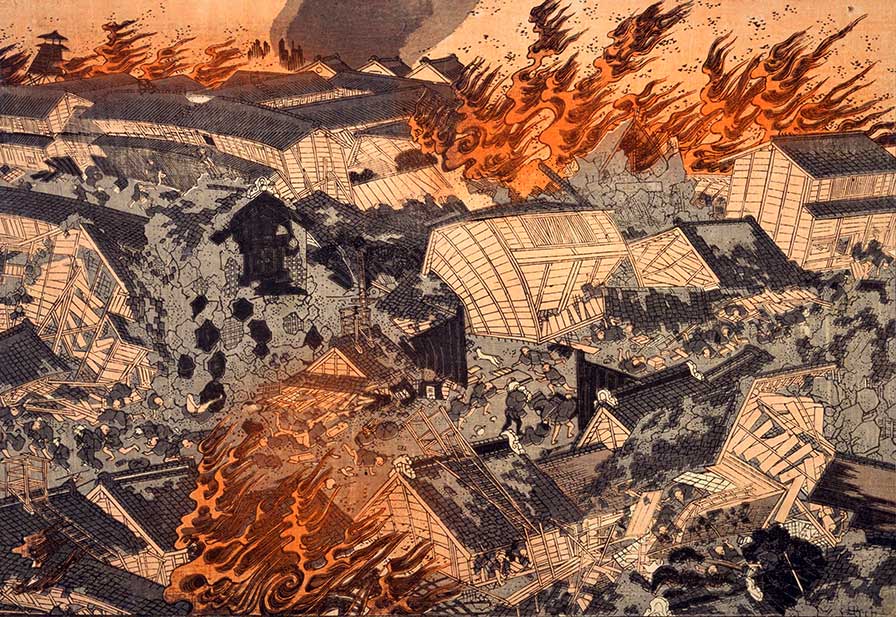 A map of the scene of the fire caused by the Great Edo Earthquake of 1855.
National Diet Library Collection
Towards architecture that protects lives and livelihoods at the same time.
Of course, preventing the spread of infection among those who have evacuated is important. However, reducing the number of people who need to evacuate in the first place is even more important. This is because fewer people evacuating will alleviate overcrowding.
From now on, in addition to the traditional concept of architecture that "protects lives" during disasters, I believe it is necessary to consider living spaces with a new concept: "staying home during disasters," that is, "protecting and maintaining daily life" even during disasters. This means adapting the concept of "BCP (Business Continuity Plan)" used in businesses to living spaces in general and positioning it as "LCP (Life Continuity Plan)."
Initiatives to strengthen national resilience
Japan is often described as a “nest of fault lines.” No matter where you live in Japan, you cannot avoid earthquakes. Promoting seismic retrofitting is essential to reduce the density of people in evacuation shelters. Actively promoting seismic isolation—which offers even higher seismic resistance—is also an effective measure.
Similarly, with regard to flood damage, there is a risk of flooding throughout Japan. Although we use the general term “flood damage,” it encompasses a wide variety of events, including storm surges caused by typhoons, tsunamis triggered by earthquakes, flooding from torrential rains, river breaches, and landslides.As mentioned earlier, due to the effects of global warming, typhoons and torrential rains have not only been occurring more frequently in recent years but have also been growing in scale. Furthermore, as seen with the tsunami from the 2011 Great East Japan Earthquake and the recent floods along the Kuma River in Kumamoto and the Hida River in Gifu, such events can cause extensive damage across entire regions.To address such water-related disasters, one approach is to identify high-risk areas through advanced simulations that draw on past experience and the latest technologies, and to discourage people from living in those areas as much as possible. This, perhaps, is what it truly means to coexist with nature.
With regard to typhoons, it is important to reinforce residential roofs and other structures to prevent finishing materials and roof tiles from being blown away.
When a “compound disaster” occurs, if cities and buildings are resilient, we can prioritize measures against infectious diseases. However, if they are vulnerable, we will be overwhelmed by the need to address both issues simultaneously, and the severity of the situation will only increase.
In this sense, taking proactive measures in advance is particularly effective when dealing with “compound disasters” involving infectious diseases, which require time to manage. This is where our expertise in urban planning and architecture comes into play.