
Air-mobility Oriented Development
Creating next-generation cities that accelerate the excitement of the future.
SCROLL DOWN
Advanced Air Mobility, Cities, and Architecture
A new form of public transportation is about to emerge in our daily lives. It is the next generation of air transportation, utilizing “flying cars”—known as Advanced Air Mobility (AAM)—and drones.
Until now, air travel has primarily consisted of long-distance transportation connecting cities and countries, with many of its hubs located in suburban areas or over the ocean. AAM aims to bring this mode of travel into our daily lives, allowing us to travel through the air just as we currently take buses or trains in the city center.Development is underway on aircraft that are more compact, quieter, and safer than conventional planes, bringing access to air travel—which previously had to be planned for in distant suburbs or over the ocean—closer to our daily living environments.



Nikken Sekkei has accumulated diverse knowledge through its efforts in Transit-Oriented Development (TOD), which integrates the development of stations and surrounding areas, primarily focusing on public transportation. Now, we are beginning to explore Air-Mobility-Oriented Development (AOD), which incorporates Air-Ambi (AAM), the network of air transportation. By considering above ground, underground, and above ground as an integrated whole, we may be able to realize a completely new vision for cities and an exciting future social environment design.
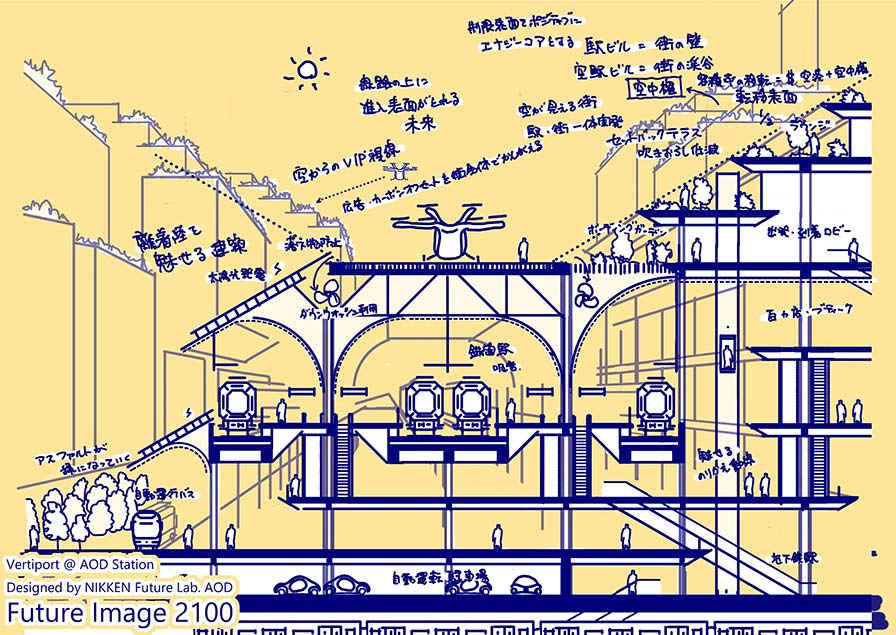 An image of integrated ground and air transportation networks. The era of Active Access to the Earth (AOD), where the sky becomes an integral part of our lives, may be upon us.
It's not just the development of aircraft technology that will accelerate the future of flying.
Creating a friendly environment to build an interface between technology and people.
At Nikken Sekkei, in addition to constructing facilities for takeoffs and landings, we also pay attention to the changes in the cities where networks are built, and we consider what kind of design proposals would be effective, while exchanging opinions with relevant parties.
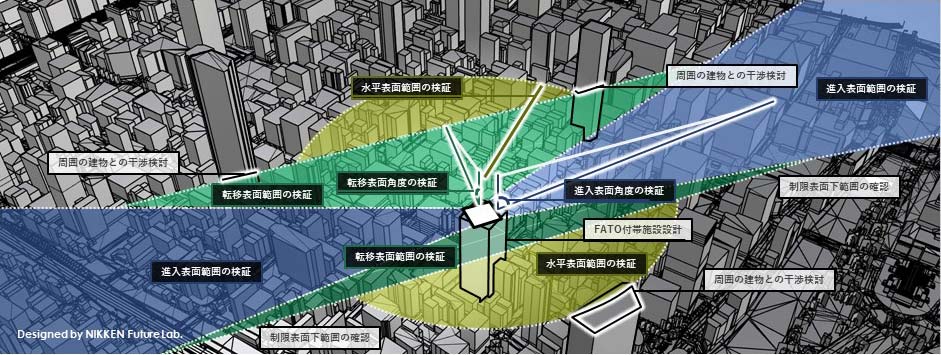 This is a model image illustrating how the clearance required for aircraft takeoffs and landings is reflected in the cityscape. While the takeoff and landing field itself is compact, a multifaceted examination is required from a broader urban design perspective, including views from air routes and skyline planning.
Before considering rebuilding in preparation for the arrival of the AAM era, why not explore renovations that are possible within current regulations? While a Verti Port, which requires a flat area of approximately 80m x 80m, may be impossible, a Verti Stop could potentially be installed. This could unlock the untapped potential of emergency landing and takeoff areas already built on top of many buildings as required by law, potentially increasing property values.
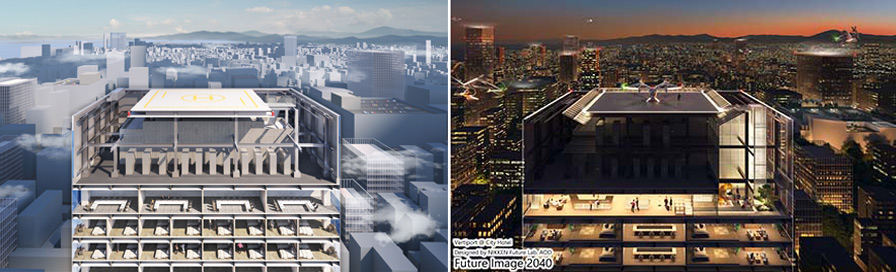 An idea for utilizing the rooftop of a high-rise hotel in the city center. By developing Verti Stop, it will become a beloved "Airport City Hotel."
Nikken Sekkei is participating in the landing and takeoff area working group of the "Public-Private Council for the Revolution in Air Mobility," established by the Ministry of Land, Infrastructure, Transport and Tourism and the Ministry of Economy, Trade and Industry.
We are building a system of research and social proposals that transcend industry boundaries, enabling us to provide appropriate design proposals to our clients by keeping a close eye on the evolving legal framework for takeoff and landing fields, which will change in the future due to the maturation of AAMs and the recognition of aircraft performance, as well as by keeping a close eye on the evolution of mobility in other fields.
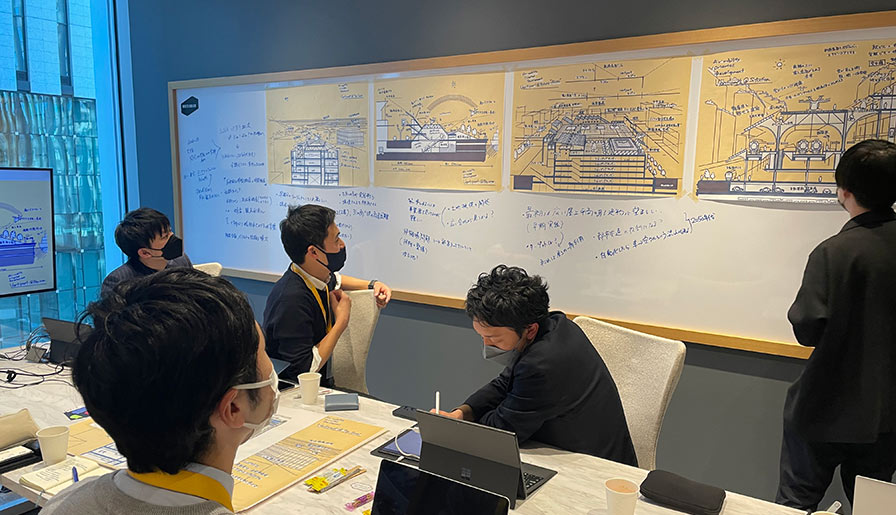 Workshop with AAM operators.
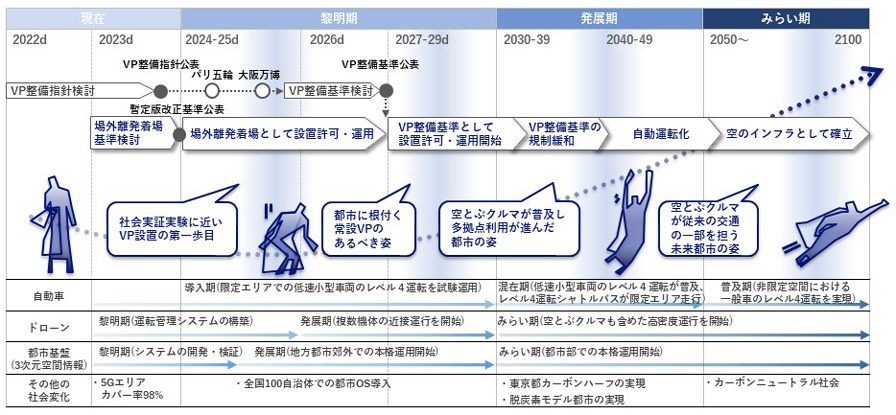 We integrated the roadmaps planned for various mobility services with the expertise of the Nikken Group, and organized information surrounding architecture and urban planning through exchanges of opinions including those from other industries.
Life changes with AAM
~Creating new activity spaces through urban development that leverages technological advancements~
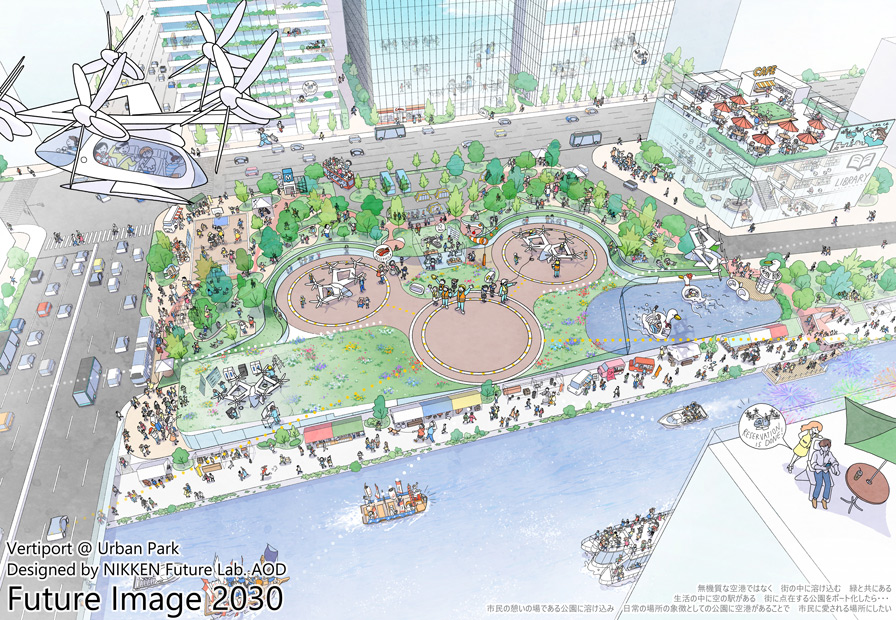 Image of the relationship between AAM (Advanced Air Mobility) in the implementation stage and cities.
For example, by utilizing the airspace above cities as a transportation network, we could reduce the density of ground-based transportation networks. This freed-up ground space could then be transformed into parks, green spaces, and other areas, potentially creating new places for activities.
Initially, it would be advisable to start with demonstration experiments in relatively easy-to-implement locations such as riverbanks or ground-based landing and takeoff areas. As aircraft performance, architecture, and urban planning are refined in coordination, the next stage would involve installing landing and takeoff areas on top of buildings and converting ground-based landing and takeoff areas into parks. It is important to have a plan that appropriately considers the future vision and schedule, ensuring that society correctly recognizes the capabilities of AAMs while maintaining a connection between technological advancement and daily life.
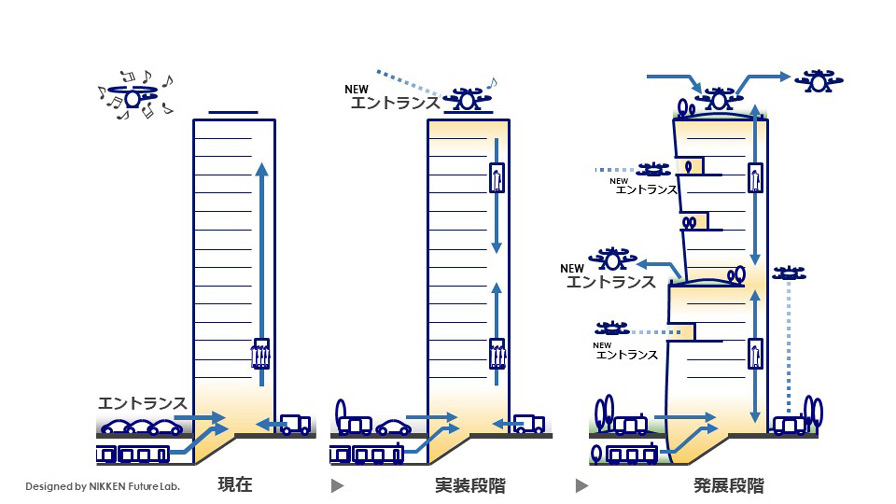 The relationship between AAM (Advanced Air Mobility) and architecture.
We might be able to design a future where entrances are distributed to upper floors, and the ground floor is naturally opened up.
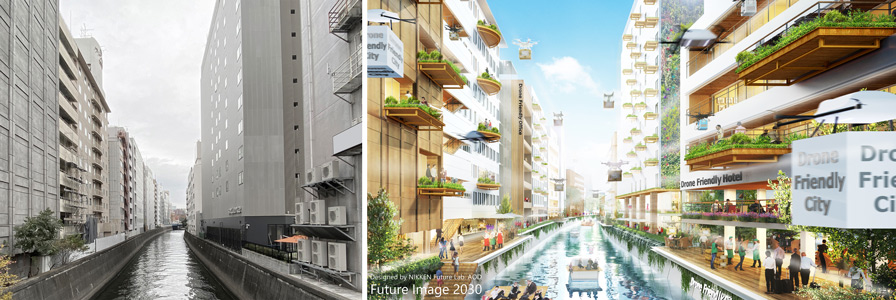 By utilizing rivers with little pedestrian traffic within cities as flight paths for air-to-air missiles (AAMs) and drones, we expect a synergistic effect that will accelerate the evolution of aircraft performance and create more vibrancy in the city.
Understanding sustainability is essential in recent urban planning and architectural design, and proposals for long-lasting buildings are almost always on the table. What will society and life be like in the future, after these robust buildings have continued to thrive?
Nikken Sekkei will pursue this through next-generation social and environmental design.