
Area management envisions a new way to create Shibuya. [Part 1]
SCROLL DOWN
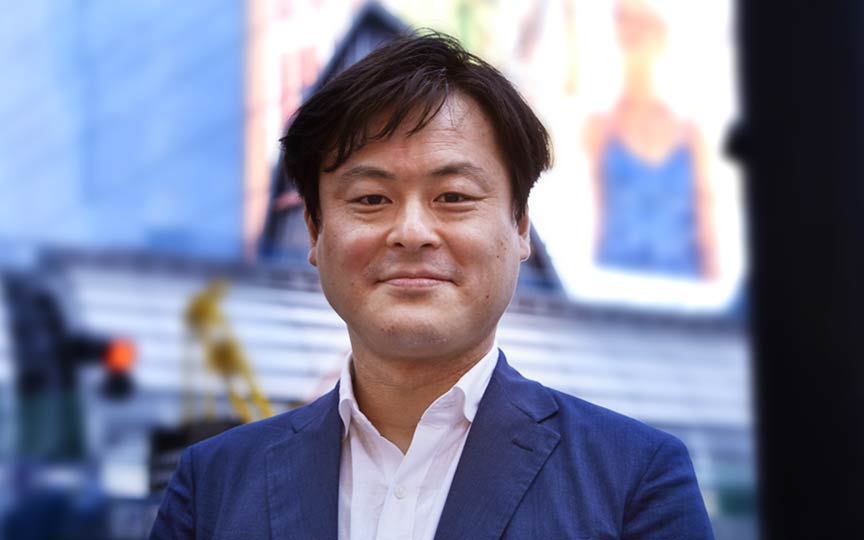
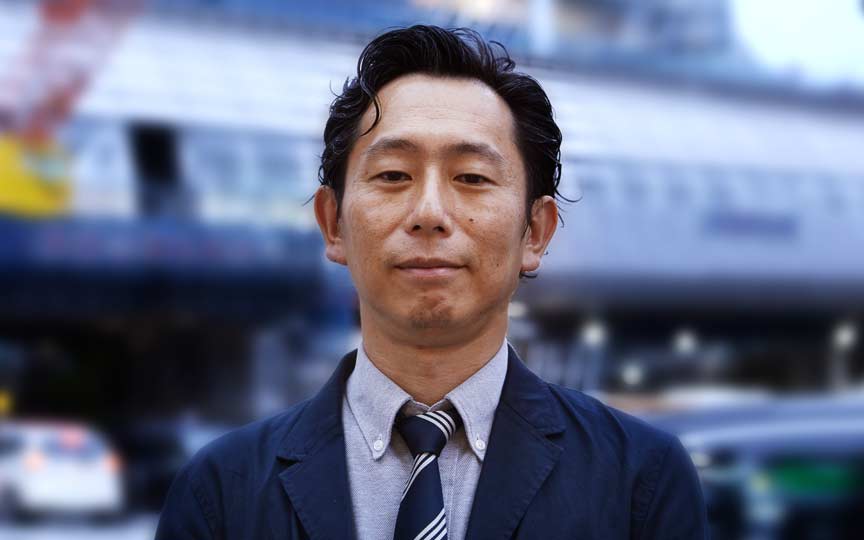
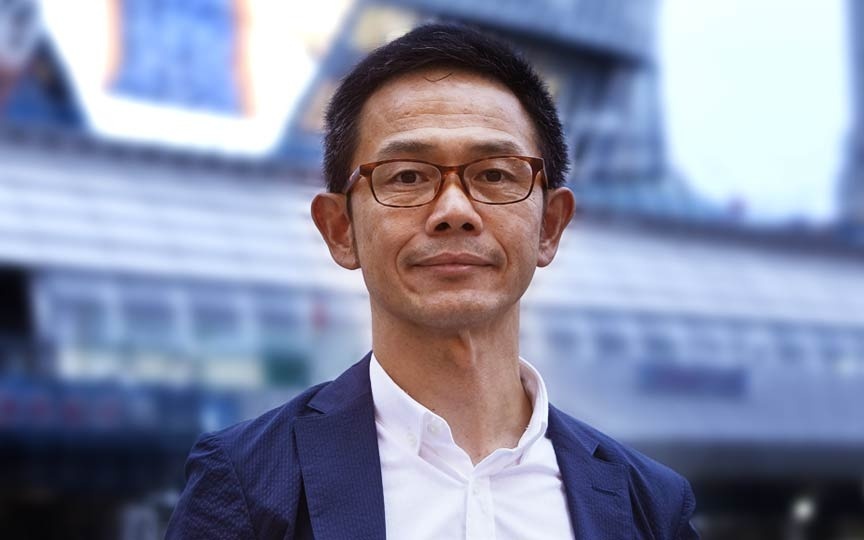
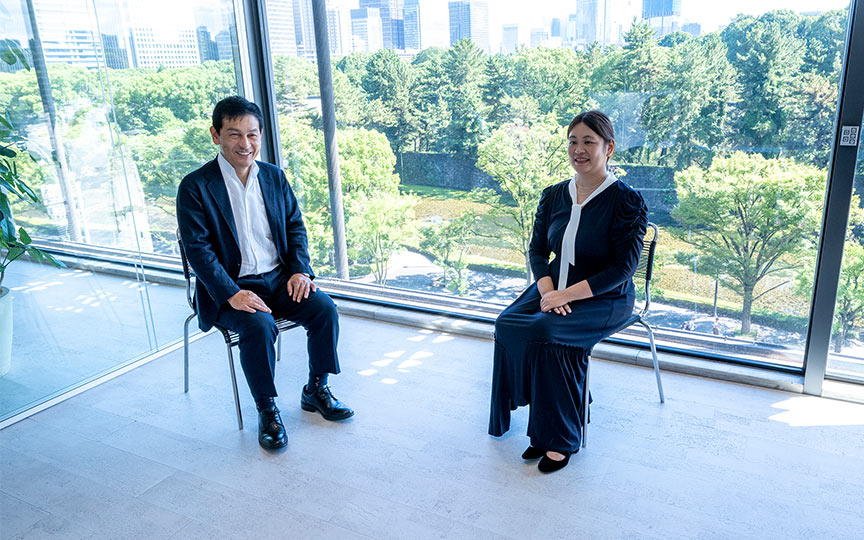
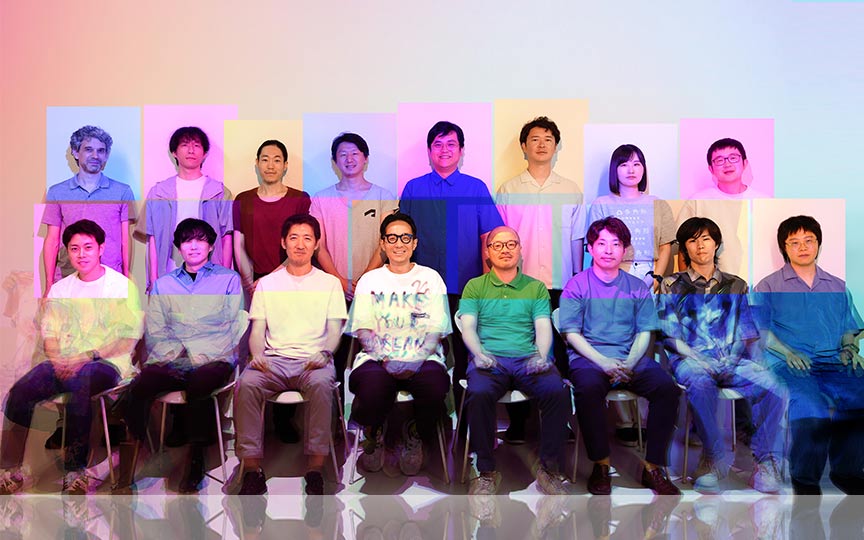
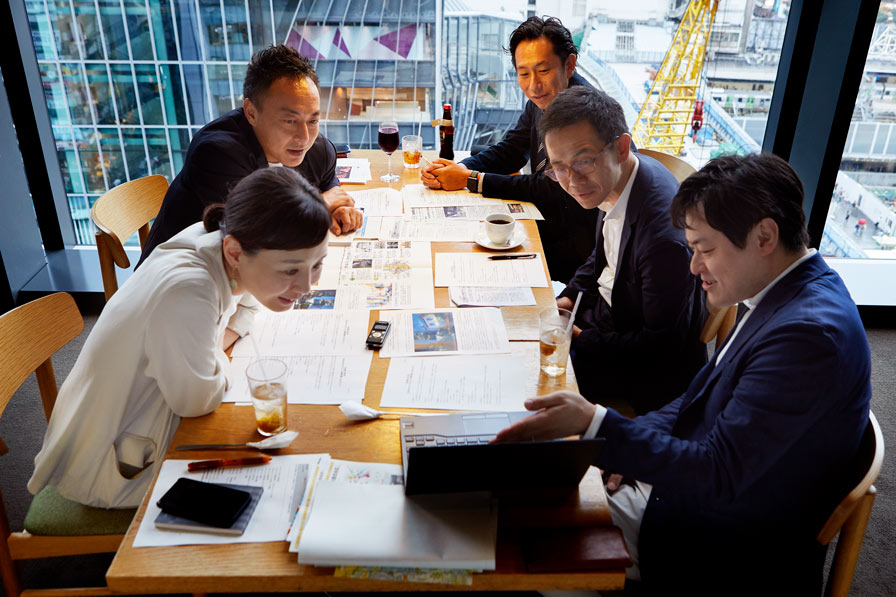
At “Shibuya Scramble Square the First Phase (East Tower), Phase 1 (East Wing),” which opened on November 1, 2019, a pilot project is currently underway using “Shibuya Scramble Square the First Phase (East Tower) Vision,” a large-scale digital signage display installed on the building’s exterior.The Shibuya Station Area Management Council (hereinafter referred to as the “Eri-Mane Council”) is involved in this experiment. The council is a public-private partnership working to establish guidelines for the Shibuya Station area with the goal of realizing “Shibuya” as a hub for lifestyle and culture open to the world.In addition to advertising initiatives at Hachiko Square, the council is carrying out various activities—such as creating a lively atmosphere around Shibuya Station and disseminating information—to foster a positive community in Shibuya as the area undergoes redevelopment. Featured in this article are Mr. Ryuji Akimoto (Tokyu Corporation, from left in the photo) and Mr. Yoichiro Sumi, who serve as Deputy Directors-General of the Secretariat for the Shibuya Station Area Management General Incorporated Association (hereinafter “Shibuya Station Area Management Association”),as well as Associate Professor Tomohiro Fukuda of Osaka University, who is supporting the pilot project, and Taro Fukuda of the Urban Development Department, Urban Division, Nikken Sekkei Ltd. Director. Together, they discussed the past and future of area management in Shibuya. The facilitator was Mika Kanayuki of the Urban Development Department, Nikken Sekkei Ltd. Director.
*Shibuya Station Area Management Council: The umbrella organization for urban development in the Shibuya Station area, comprising public and private sector stakeholders (five building operators, the land readjustment project implementer, the Ministry of Land, Infrastructure, Transport and Tourism, the Tokyo Metropolitan Government, and Shibuya Ward). Established on May 30, 2013.
*Shibuya Station Area Management General Incorporated Association: A component of the Area Management Council, this organization consists of the five building operators and the land readjustment project implementer. As an Urban Regeneration Promotion Corporation, it promotes urban development projects using revenue generated from initiatives such as outdoor advertising. Established on August 18, 2015.



Outdoor advertising and digital signage: Connecting the city with a playful spirit.
Akimoto: In 2013, a proposal was made to designate Shibuya Scramble Square the First Phase (East Tower), Shibuya Fuclas, and Shibuya Stream as a Special Urban Regeneration District. That’s when the idea of an Area Management Council came up, and I happened to be transferred there just as preparations for its establishment were underway. By that time, the list of activities had already been largely decided, and I thought, “Wow, this is community development!”
Corner: I was transferred to the project partway through, and I was surprised by the heated debates taking place. It’s only natural that each member—including the building operator, the land readjustment authority, the national government, the metropolitan government, and the ward government—would want to handle things as much as possible under their own control. Everyone involved was really giving it their all.
Gold Shop: Back then, there weren't many examples of area management in the world yet.
Corner: That's right. Initially, there were concerns that "overall management would erode Shibuya's unique character," but even so, the vast urban infrastructure was steadily taking shape, so figuring out how to maintain and manage it was a major challenge.
Akimoto: One of our strategies, in keeping with Shibuya’s character, was to strengthen our ability to disseminate information, generate advertising revenue, and reinvest that revenue into community development. We pushed forward with single-minded determination, believing this would serve as the catalyst for area management activities in Shibuya. Nowadays, people around us even say, “We never thought you’d actually go through with it” (laughs).
Gold Shop: Then, in 2015, Ichisha Erimane was established, and despite prohibitions under the Outdoor Advertising Ordinance and the Landscape Ordinance, they conducted an experiment with advertising displays, didn’t they? Our company’s Fukuda was in charge of this. Starting from scratch, it’s really come a long way over the past few years, hasn’t it?We’ll get into the details of the digital signage experiment later, but first, I’d like to ask you about Ichishya Erimane’s current activities.

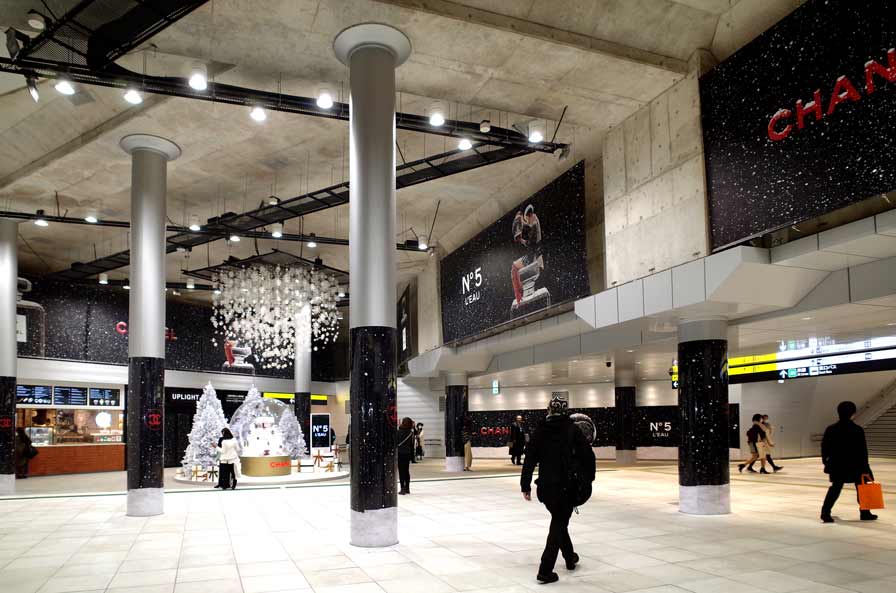
Corner: We also discussed the East Exit Underground Plaza, which will open to the public on November 1. This space extends beneath the Shibuya River, the East Exit Station Plaza, and the bus stops, and we’ve created a “hospitality space” there by installing a café with tourist information services, a bus information desk, and coin-operated lockers.
Fukuda (Futoshi): It’s a spacious area with an exposed concrete finish that really highlights the material’s texture, isn’t it? Since the station plaza at street level is currently under construction, this is a valuable open space right in front of the station.
Akimoto: Yes. We’ll be displaying outdoor advertisements on the walls of the underground plaza and also inviting creators to use the space as a canvas. This space is actually a public road in Shibuya Ward. It has a ceiling height of 6 to 7 meters and is equipped with beautiful lighting—the concept is that it’s “a road, yet not a road.”
Gold Shop: It has a cool vibe—it looks really stylish.
Fukuda (Tomomi): That's a great initiative. What else are you doing?
Corner: We will standardize the directional signage, which previously varied from business to business. We have also changed the underground entrance and exit numbers and decided to divide the building into four zones—A, B, C, and D. Once you get your bearings and learn the layout of this large building, you’ll be able to head in the direction you want to go.
Akimoto: Just dividing up the zones turned out to be surprisingly difficult. Zone A is the area in the direction of Hachiko Square, starting from the station, but it felt like we finally settled on it after a lot of discussion about exactly which area should be included in Zone A.
Gold Shop: Once you get the hang of it, this entrance/exit numbering system is pretty easy to understand. Does that mean we’ll be changing everything at once based on the current display?
Akimoto: This is already factored in for the newly built Shibuya Scramble Square the First Phase (East Tower) and Shibuya Fukurasu, among others, and the Tokyu and Tokyo Metro stations will all go live at once on the evening of October 31—the day Shibuya gets incredibly crowded for Halloween.
Corner: There’s also been talk about whether we can collaborate with local events for promotional purposes. The idea is to pursue community-building initiatives on the soft side as well.
Akimoto: It’s a milestone in a large-scale development project said to happen only once every 100 years. This year in particular, we’ve adopted the theme “HELLO neo SHIBUYA” for our town-launch campaign, inspired by catchphrases like “I Love New York.” Under this banner, we plan to hand out maps and wear badges as we all work together to show visitors around.
Corner: After all, the concept of the Eri-Mane Council is “Let’s get Shibuya moving with a sense of playfulness.” The idea is to bring everyone together—both long-time residents and newcomers to Shibuya.
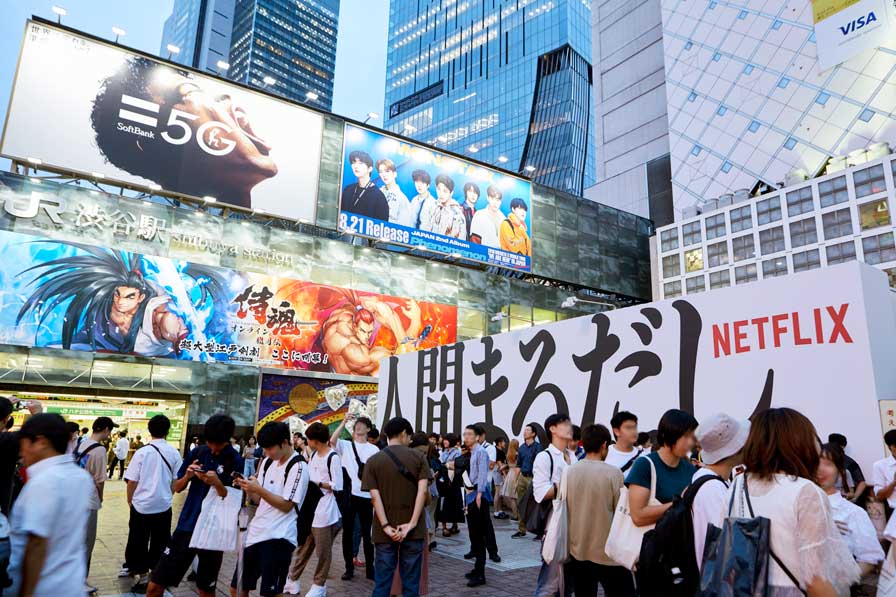
We are tackling the challenge of "deregulating outdoor advertising" through steady efforts.
Fukuda (Futoshi): The foundation was laid during the preliminary consultation phase for the proposal regarding the Special Urban Regeneration District. That was around 2011 to 2012.
Gold Shop: When all of us involved listed every single challenge we faced back then, this is what we ended up with… (laughs).
Akimoto: That’s because the construction period for Shibuya’s urban development project is so long. As the physical infrastructure is completed step by step, the issues that arise are temporarily incorporated into the area management activities—otherwise, things would get completely out of hand.
Gold Shop: However, while we’re now conducting a pilot project at Shibuya Scramble Square the First Phase (East Tower)—which began with the outdoor advertising pilot project at Hachiko Square—I don’t think there were any concrete discussions about relaxing outdoor advertising regulations at that time.
Fukuda (Tomomi): When did you start viewing advertising campaigns as a challenge?
Akimoto: I believe it was around the time of the 2013 urban planning proposal. I recall being told that, since Shibuya could generate advertising revenue, we should use that as a funding source for urban development; however, because buildings constructed within the Special Urban Regeneration Zone are subject to regulations that prevent the installation of such advertising, we should aim to relax those regulations.
Fukuda (Futoshi): The digital signage ended up being much larger than we’d originally anticipated—it really fits the Shibuya vibe, after all (laughs). Two ordinances are relevant here. One is the Landscape Ordinance. For large-scale buildings constructed under designations such as Special Urban Regeneration Zones, advertisements can only be installed at a height of 10 meters or less above ground level.The other is the Outdoor Advertising Ordinance. While it allows for installations up to 52 meters above ground level, the size of a single display panel is limited to 100 square meters or less. Both regulations were a far cry from what we wanted to do. In particular, the Landscape Ordinance was originally designed for large clusters of buildings like those in the Daimaru-Yu area, so it didn’t really fit Shibuya.
Corner: At first, we discussed the very concept of advertising itself. Government officials believed in displaying advertisements with a design that was appropriate for the Urban Regeneration Special Zone—ones that weren’t overly commercial—while we in the private sector felt that unless it was pure advertising, it wouldn’t serve any purpose.
AkimotoI think it all started with the question, “What makes Shibuya unique?” There are all kinds of advertisements around the Scramble Crossing, and many foreign visitors stop to look at them—but is that a good thing or a bad thing? If we’re going to say that’s what makes Shibuya unique and that’s a good thing, then let’s put up regular advertisements there as well. We repeatedly argued that we should generate revenue and then redirect that money to other areas. And then there’s the issue of environmental considerations.

Akimoto: So, you’re talking about a spectacular landscape that’s characteristic of Shibuya. You mentioned that it’s important to tailor our approach to each area of Shibuya and the local environment. Since the Shibuya Urban Management Council placed a high priority on disseminating information, the first thing we tackled was establishing local rules for outdoor advertising.We held discussions with the Tokyo Metropolitan Government and Shibuya Ward and organized study sessions. I believe that thoroughly addressing this issue was a major turning point for Shibuya’s urban management.
Corner: Starting a business that isn’t viable won’t turn a profit, and unless everyone is eager to get on board—saying, “I want to do this with this system”—it won’t become a successful venture, so I didn’t compromise.I explained to Shibuya Ward officials, “If we calculate it in terms of advertising value, the revenue would be this much,” and “It’s important to attract customers from other areas as well.” From an advertising agency’s perspective, where in Tokyo they place ads is largely up to the discretion of the account manager, so my priority was to create a system that would be easy for them to work with. I communicated my vision persistently and with great conviction, so it took quite a long time.
Akimoto: Landscape administration falls under the jurisdiction of the Urban Development Bureau, but because it’s also intertwined with road-related matters handled by the Construction Bureau, it was difficult to coordinate even within the Tokyo Metropolitan Government itself. Whenever I went to each department to discuss the matter, the reaction was more like, “Area management in Shibuya? What’s that?” (laughs).But in the end, the Tokyo Metropolitan Government took the plunge. We worked out a structure where we’d establish a “General Incorporated Association”—an entity with legal personality capable of managing operations—to handle the advertising business, and that’s how we founded Ichi-Sha Eri-Mane.
Fukuda (Futoshi): Ichisha E-Man was founded in 2015, and from that point on, discussions aimed at relaxing advertising regulations began within the Shibuya Station Central District Design Council (hereinafter referred to as the “Design Council”).
Akimoto: First, we established a framework for the public space (Hachiko Square), including the creation of the Iri-Mane company. Then, during a design meeting, Professor Hiroshi Naito said, “This is important, so we have to do it,” and we decided to make adjustments to the building’s facade. However, since there are existing advertising regulations on private property, this proved to be quite a challenge as well.We had to go back to square one and start from scratch, discussing how to proceed with Shibuya Ward and the business operators.
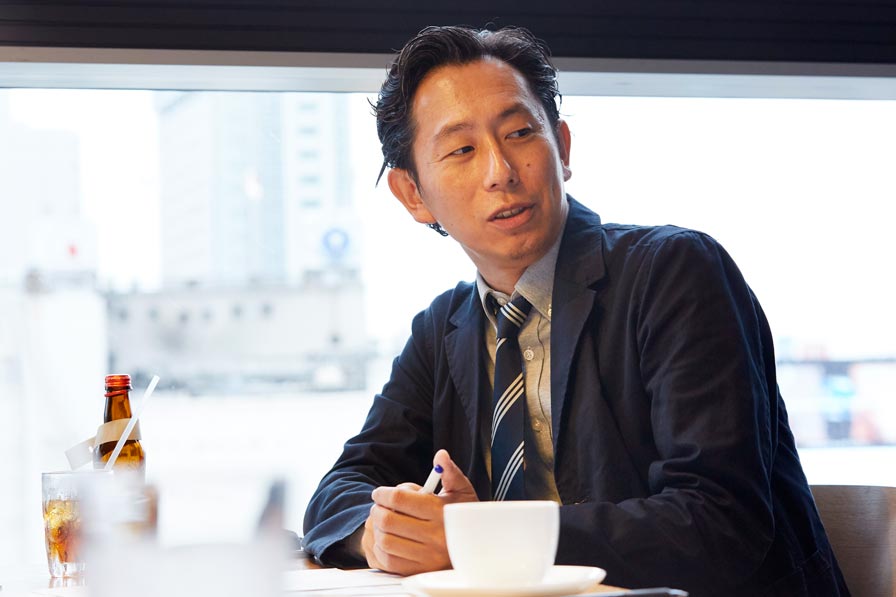
Fukuda (Futoshi): After all, this was a first-of-its-kind initiative where everyone—from the E-Management Council and the E-Management Association to business operators, government officials, and even experts—was feeling their way forward. My staff and I went through a lot of trial and error. I’m not sure if we lost any sleep over it, though (laughs).
Akimoto: This design meeting brought together a group of experts, so we were always on the edge of our seats, with our hearts pounding, whenever we attended (lol).
Fukuda (Tomomi): What were the members like?
Corner: There were about three members from the Tokyo Metropolitan Government’s Landscape Advisory Council and its Planning Subcommittee, and it felt like we had to explain things to them every time. We discussed with the Tokyo Metropolitan Government officials whether the issue of deregulating outdoor advertising should be addressed from the perspective of “landscape” or “advertising.” Apparently, the Outdoor Advertising Act is an older law than the Landscape Act.
Gold Shop: Back when I was involved in the development of the Shiodome area, there were hardly any discussions about the cityscape. It’s only recently that urban landscapes have become such a hot topic.
Fukuda (Futoshi): The area surrounding Shibuya Station is subject to the “Specific Area Landscape Formation Guidelines,” which impose special landscape regulations even within Tokyo. Although the issue originated with outdoor advertising, we also engaged in substantial discussion during the design meetings about what Shibuya’s landscape—particularly its “nightscape”—should look like in the first place.Ultimately, Shibuya Ward took our discussions into account and revised the Specific Area Landscape Formation Guidelines with a positive, Shibuya-specific approach. The end of fiscal year 2018 marked a moment when the public and private sectors worked in harmony to make significant progress.
(Part 2 scheduled for release: January 20)